Overall Objectives

When in doubt, hand sew: it’s good for the brain and the soul.

Thinking about reenacting in terms of mission worked in sorting out my Trouble with Ticonderoga.  The Fort’s Defiance and Independence event is meant to further their mission to “ensure that present and future generations learn from the struggles, sacrifices and victories that shaped the nations of North America,” and the BAR’s mission is to recreate the life of the common soldier of the AWI, and my family’s mission is to have fun while recreating the life of the common soldier of the AWI, if some part of an event doesn’t seem like fun, it doesn’t further our mission. And if it doesn’t seem like fun, don’t do it. It’s just that simple.

Another way of looking at this is to recognize that not every event is for every reenactor. Obviously you don’t take a Charleville to Gettysburg, but more importantly, if an event is primarily to recreate a military action, but you and your family are looking for a shared reenacting experience, you are likely to be disappointed.

I also thought about it all in terms of priorities: family first, then Regiment, and so on up the line. Better by far to hone what we have to interpret the Regiment’s history first, and to get ready for Redcoats & Rebels at Old Sturbridge Village.

This event has more tangled into it than you’d think. Last year was not so great. The Captain didn’t seem happy, Mr. S’s overalls did not pass muster in foot-related fit, the Young Mr. pouted for a half a day, and I was stuck in camp with a blowsy woman talking about babies while the public tramped across our blankets. This year, we’ll camp over and entertain Mr. S’s parents, who are determined to see one of the reenactments. OSV offers the most opportunities for them and for us. There’s the Village itself to entertain and feed them, and surrounding areas with antiques and sight-seeing. We will be “stuck” minding camp and won’t be free to entertain or feed them in the evenings, and if they stay for the twilight camp tours, there will be a curfew. There is much to like about this arrangement for us.

So in preparation, I’m making new overalls for Mr. S, who has lost enough weight that last year’s are just too big. For myself, I’m cruising bedgown images like The Provider. Chardin is a favorite painter, and while I can’t have a pinner apron, I have a blue and white striped petticoat. The white concerns me, though it would definitely get dirty fast, and there’s a lot to like about that, too.

No matter what we choose to do in the future, the sewing helps now.

Fort Ti-ed Up in Knots

Warning: Heavy Re-enactor/Museum Management/Philosophical-type Content

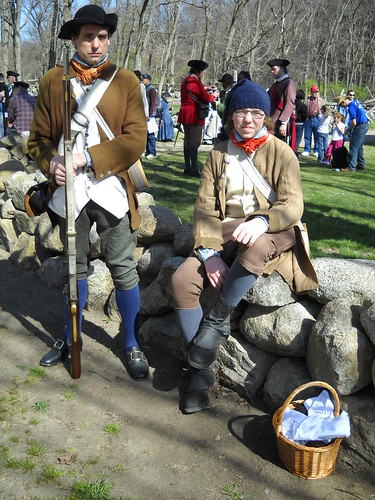
Battle Road, with photographers

Who is this authenticity for?

I think that is the core of the question. I spent much of yesterday (when not banging head here at work) banging my thoughts on the question of Fort Ticonderoga’s standards, and the relative abilities of my family to meet them. Somehow, out of that and previous thoughts about bullying, research, cattiness, and the general meaning of “living history,” “reenacting,” and “The Hobby,” I reached a simplistic conclusion, or perhaps it was a question:

Who is the “good enough” for? Moving past that wretched verbal construct, think about this:

Each event, each unit, each individual is like a museum or historic site in microcosm.  The unit I belong has a mission: to re-enact the 2nd Rhode Island Regiment of the Revolutionary War. The regiment and its members belong to the Brigade of the American Revolution (BAR), which has a mission, “The Brigade is a non-profit living history association dedicated to recreating the life and times of the common soldier of the American War for Independence, 1775-1783.”

Clear enough, right? Following from the mission would be standards. And those standards would, in an organization’s strategic plan, be goals. (The vision statements or values statements would be different–and I don’t know what they would be for the BAR. For my unit, I can only guess but I think one of our value statements would be “Tolerance, kindness, patience.”)

So, let us consider the nexus of the BAR and Fort Ticonderoga from the mission and standards point of view. They clearly overlap where the recreation of the life and times of the common soldier are considered in the context of 1777’s assault by the Continentals on the Fort. Excellent. Because everything you do as an organization should point toward, or be derived from, or further your mission. The BAR, in fulfilling its mission to recreate the life of the common soldier, creates an event that fulfills Fort Ti’s mission “to ensure that present and future generations learn from the struggles, sacrifices and victories that shaped the nations of North America and changed world history. They serve this mission by:

  • “Preserving and enhancing our historic structures, collections, gardens and landscapes.
  • Educating and inspiring our visitors about the history of Fort Ticonderoga and the diverse peoples who met here in war and peace.”

The BAR event would fall under the “educating and inspiring” part of “how” the Fort fulfills its mission.

Clear enough so far, I think, how the BAR and the Fort overlap. Now comes the tricky part: the people part.

Looking at the Fort Ticonderoga event, my first thought weeks ago was, “We can’t do that; no Rhode Island troops were there.” I’m not just a stitch counter—I’m a troop counter too. Then I realized that there aren’t necessarily enough MA and NH re-enacted troops to make the event possible without “reinforcements” from other states.

Conquering that, I began to consider the standards, and as previously stated, I’m a stitch counter so I have to follow them or be a hypocrite. And that’s when I started thinking about “who is this good enough for?” What’s my mission? Is it aligned with my unit’s mission, the BAR mission, or even my own family’s mission?

Because the place of overlap, given that this is a hobby, is in the conjunction of my desire to have fun, and the mission of the BAR: If I think it is fun to “recreate the life and times of the common soldier,” then we’re good.  I love to sew, the challenge of creating 18th century garments for the three of us is fun the way art school was fun, but it’s not any fun to be all dressed up with no place to go.

That’s where it gets tricky.

To Ti, or Not to Ti?

We’re at a critical moment: onward to Fort Ti, or not. We haven’t had a chance to ask the captain if anyone else from our regiment is going, so we could be on our own, and need to fold into another unit in the field. Fortunately, Mr. S has done that in the past, fielding with a NY Regiment at the School of Instruction. So that’s not the barrier.

We can probably borrow a tent from the Captain, perhaps even one that will not collapse in a high wind, or be ripped to shreds. (It’s a bit of a Swamp Yankee unit, stuff is kept and mended for years, which makes it all the more authentic for this recreation of the “Ragged Lousey Naked Regiment.”)

I can get the day off, and I bet Mr S can get off work early enough that we can get to Fort Ti before dark. I don’t want to set up camp in the dark…and I bet I can figure out food and eating and cooking and even coffee.

No, what’s stopping me is “Information for Reenactors,” or the authenticity standards. There aren’t any for the women attending the event, since we won’t be “in the line,” so it isn’t about me. It’s about the men. I think of the things I’ve made and the time I have and am convinced “We’re not good enough.”

Thanks, Fort Ti!

I get the standards, and I appreciate them. I’m a thread counter myself. But the standards are high and I don’t think we’ll meet them—I know Young Mr.’s footwear won’t. He only has modern shoes, he’s a size 12, and possibly growing. Could I even get him shoes in hand by July 19? Maybe… after that we get into the clothing, which for the boys would need to be re-fitted, and perhaps even made.

So I think, on the whole, we will have to pass on Fort Ti until another year, one when we can meet the standards. Sad for us, but at least the Fort’s staff and the other attendees will not be perturbed by the child’s rubber soles.

Or do I order shoes for the child, and start sewing like a madwoman on the off-chance that Mr. S really can get off at noon, or that I can pick him up by 2:00 at a commuter line station on the way north?

Decisions…and internal conflict. Feeling “not good enough” for standards sucks, especially when you take standards seriously. At some point, OSV is going to enforce the standards they have copied from Fort Ti and Battle Road. These are good things.  But the bar is high, and I think that the kid-shoe factor is a major irritant for some folks, and to a degree to me, though I can afford the shoes and can even, by force of will, cause them to be worn, as long as they arrive in time. (Fugawee, not Robert Land, would have to be the supplier.)

And that seems like madness, really. Better to focus on the mission, if you will, the core:  Improving regimental kit, and expanding civilian wear over time, for Battle Road and elsewhere. It makes participating in the hobby more like running a museum, and while I love my job, I was honestly looking to have a little more fun than I do at work.


Watson Farm

20120703-061241.jpg Sunday afternoon we decided to go to a farm, and chose Historic New England’s Watson Farm on Jamestown. It was a good choice, I think, and perhaps this will be the summer of historic farms and landscapes.

I always wanted to be Tasha Tudor when I was little, live in a historic house, wear historic clothes, eat historic foods, perform historic chores. We lived in a ca. 1875 house in Chicago, so of course I wanted 1875 clothes for my school, which was also ca. 1875, at least in part. Fortunately, I did not get them, children being even less tolerant in the Dark Ages of my youth than they are today.

So Watson Farm’s ca. 1790 date and traditional methods appealed to me, and appealed to Mr. S, who wanted just “farm,” and the Young Mr. was just stuck with the decision.

20120703-061408.jpg The farm is largely uninterpreted. HNE provides a brochure and map for a self-guided tour, and there are cows, sheep, chickens, ducks, and cats scattered about the landscape. The fields are pasture, with the farm managers maintaining a vegetable garden for their own use. In terms of learning, it was not a stellar experience and knowing what I do about the farm, I can see why. With 285 acres that need to remain untouched, you can’t plant signs everywhere despoiling the landscape and getting in the way of cattle. In terms of beauty, it was outstanding.

The brochure takes you on a roughly 2-mile walk through the fields and down to the shore of the island. (There is a shorter loop option.) The view was lovely and on Sunday, with weather coming in from the west, the sky was dramatic and it was just about like walking in a Thomas Hart Benton painting.

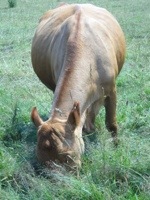
I think the best moment for me was hearing the cows eat. I don’t remember ever hearing a cow eat grass before, but it was a wonderful sound, “like eating a whole lot of celery, with a pillow over your head,” said Mr. S. Well, sort of. I wish I’d made a recording of it, because it is a sound very few people ever hear anymore. Even the most urban among us can encounter police horses snuffling in their feed bags, and reenactors can visit the dragoon’s horses at battles. But cows snuffling up and chewing grass–that’s another kind of almost-lost sound altogether.

And that’s the whole point of these historic landscapes, preserving the things that would otherwise be lost: not just the vista, the plants and the animals, but the sounds the animals make, the smell of hay toasting in the sun, the sandy prints of burrowing animals, and the truly otherworldly, out-of-time experience of stepping off the asphalt path.