
Feeling Shifty

It’s clean now, but in the photo you can see some of the abuse a shift takes in a day or two of real wearing. This shift was made from the Kannik’s Korner pattern. The first shift I made is now on a mannequin at work; I used Mara Riley’s Instructions, and they worked, mostly, with some operator error. I’m tall, and that means that proportions for my clothes sometimes have to be adjusted. The third shift I made was a late-18th century version, adjusted for the change in style and my height, and it is by far the best one yet.

So now I know I need to make another mid-18th century shift, what will I do? The first place I’ll start is with Sharon Burnston’s awesome article, The Cognitive Shift. This is one of the best pieces I’ve read on costume history and the logical, methodical approach is one that not only explains her process, clarifying objects and construction, but also sets a standard for how other garments could be considered.

Among the points Sharon has made over time is the lack of decent linen available for making shifts and shirts. What we can get today is too heavy, too coarse–it lacks the hand of the linen items made in the period we’re reenacting, and not just because the objects have been washed. The fabric is simply different, and unavailable. What  I think I’ll try (having exhausted whatever shift linen I bought from a sutler) is this light weight linen, not softened. I have some that was used for a cap, and so far seems to be working out. Once it is washed, it seems to have a decent drape and appearance.

My impression is not of a fine lady, and that is at least a saving grace. I don’t want to go all the way down the social ladder to wearing an oznabrig shift, but I do want to be as accurate as I can be–and as comfortable.
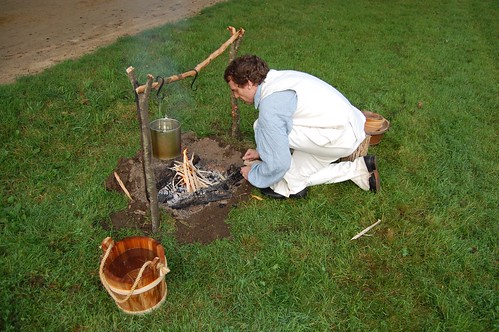
Camp Cooking

Our first overnight, camping-in reenactment went fairly well. Why the artillerists had to bring a concertina to a gunfight, I’ll never know, but a 2:36 AM rendition of “Good Night Ladies” was truly unnecessary.

The most important thing I can emphasize about reenacting in high summer is to stay hydrated. We brought the big white water pitcher we used at the House Cleaning in April, sliced a lime into it, and filled it repeatedly at the town pump. The Young Mr doesn’t like lime in his water, so he filled the coffee pot for himself, but the rest of our Regiment and members of the 10th Mass helped themselves liberally. It was well worth bringing.

The meals we ate were simple: apples, bread, ham and cheese for breakfast and lunch (I forgot to bring the eggs…) and beef stew for dinner. The stew is the most interesting part of the business. Mr S bought the meat, and without even realizing it, he picked up the appropriate amount of rations. Men were supposed to be issued a pound of beef and a pound of flour or bread a day; women, half that, and children a quarter. The amount we packed was a pound and three quarters. Seemed like too much when I packed it into the cooler, but as it turned out, we ate it all.

Enhanced Ration Stew (feeds 3 to 4)

  • 1.75 pounds beef stew meat
  • 3 carrots, sliced
  • 1 very large onion, roughly chopped
  • 4-5 small, firm, potatoes, cubed
  • Half a small kettle of water
  • 2 packets or cubes of portable soup (beef boullion)

Note: start the fire and get it hot before you bring the meat out…

Cut the meat into smaller chunks, add to the kettle, and place over the fire. Brown the meat on all sides; note that this will take as long as it takes.

When the meat is browned, add the onions and cook until they start to get soft. Add the rest of the ingredients, stir, and cover.

Bring to a rolling boil for at least twenty minutes; stir occasionally. Be sure to add wood to the fire to keep it hot. I think we cooked our stew for about 2.5 hours, but it’s hard to say exactly, as we were not wearing timepieces. We started the fire after the battle, which would have been at about 3:30 or 4:00, and ate around 6:30.

I used my pocketknife to slice the vegetables first, and arranged them in our wooden bowls. Then I sliced the beef into smaller chunks, using a piece of firewood as a cutting surface—since it gets burned, you don’t have to wash anything but the knife in hot water. Thanks to the 40th Foot at the SOI for demonstrating that technique.

Sturbridge Lessons

20120807-054104.jpgThe game warden is coming for my shift.

It has the most distinctive odor, and my friends at work should thank me in advance for not bringing it in. Wood smoke, sweat, rain, black powder and something else I cannot place all infuse the fabric, and it will be a shame to wash it, except that it is, truly, gamey enough to suggest I need a license to keep it. So, the lesson learned from this, and other observations:

Make another shift. Make another two shifts, even. You will want a dry one to sleep in, or to put on in the morning. I didn’t get rained on until 4:00 PM on Sunday. No, I soaked every layer of my clothing with sweat. Make another shift, stat!

Make a bedgown. In trying to maintain maximum 18th century effect, the stay-less parade to the flush toilet necessitated short gown over shift. My short gown is pleated to be worn over stays. Ahem. Make a bed gown, now I truly get their purpose, and as soon as I clean up the house, that’s what is going on my sewing table.

Line your stays. I was too lazy or busy or finger-chewed to finish installing the lining in my stays. Now they’ve gotten soaked through, I have a sweat line on my stomacher. Gross, isn’t it? Authentic, but….Line your stays. Just do it.

Make more than one cap. I have three, and was so glad to have a dry one for Sunday. Saturday’s cap now has sweat stains.

Finishing Touches

Sewing:

  1. Finish Overalls for Mr S
  2. Waistcoat for The Young Mr
  3. The Young Mr’s haversack– can finish in camp
  4. If there’s time: linen jacket for Mr S, off-hours.
  5. Bed gown or short gown for K
  6. Linen work bag

Things to Acquire:

  1. Cane rod, local source
  2. Blanket (wool with blue stripe, in Texas) or two
  3. Tent??
  4. Camp kettle
  5. Coffee pot?
  6. Tea pot (Jackware or brown-glazed redware)
  7. Canteen for K

Things to Modify:

  1. Paint knapsack
  2. Paint Ikea box
  3. Swap Ikea box screws for brass flat-head screws
  4. Marble paper or hand-paint wallpaper to cover sewing kit
  5. Hemp webbing for pack basket (Missouri source)

As you can see, I have a sewing problem. Right now, those overalls have become breeches, and I am at the knee band stage, just before 10 more button holes. I can manage those in a week, but I suspect that will be it. And a work bag, I can probably manage a work bag. Last year, I went to OSV with bleeding and punctured fingers. This year, I’d like to have fingertips I can do things with. Also, I need to sleep in order to do my job decently, so perhaps this list is more about learning my limitations than it is about things I really need to do.