Passing Strange

Inspiration: gown, 1740s (silk) remade 1775-1780. Colonial Williamsburg 2000-133

In representing Magdalen Devine at the Museum of the American Revolution’s Revolutionary Philadelphia event, I decided to make a brown silk gown. This is an easy and solid choice for nearly any (every) woman in any location in the Anglo-American colonies in the latter half of the eighteenth century. If you want another option, go blue. But the reason I chose brown is not just because it’s common, or because I have achieved a certain age, but because both Magdalen Devine and Anne Pearson, although members of the Church of England, were associated with prominent Quakers. 

Magdalen Devine, known to Elizabeth Drinker as “Dilly,” accompanied Drinker on trips to Bath at Bristol, Pennsylvania, where the two visited the waters. In what is now Bucks County, these baths were chalybeate or ferruginous, meaning they contained iron salts. These mineral baths,  initially described as “nasty,” were eventually sought for their medicinal uses. (There is a handy book on American spring resorts called They Took to the Waters: the Forgotten Mineral Spring Resorts of New Jersey and nearby Pennsylvania and Delaware.

Devine and Drinker visited Bath several times in July and August of 1771. Drinker seemed hesitant to take to the waters at first, and while it is not clear whether “Dilly” helped her overcome her nervousness, the two made multiple trips over the course of several weeks. Eventually, Drinker recorded sharing a bed with Devine, so the two must have achieved a level of comfort, if not friendly intimacy, with each other. (You can read the diary entries here.

A Lady, ca. 1747-1752 watercolor by Paul Sandby. Royal Collection Trust, RCN 914415

There is nothing in Drinker’s diary to suggest Devine’s appearance or clothing, which, although disappointing, is normal for a diary of the period. But this level of comfort suggests that Devine projected a pleasing, non-jarring appearance and blended in with Drinker and her family and friends fairly well. This could easily be achieved in a brown, grey, or other dull-colored gown. Any of these colors would have been appropriate for Devine, who by 1771 was likely in or approaching her 50s, having been married in Dublin in 1748. (Lest you think Dublin means Catholic, Devine was married at Saint Catherine’s Church, https://www.saintcatherines.ie/our-story, an Anglican church originally built in 1185 and rebuilt in 1769. The Catholic St. Catherine’s in Dublin was completed in 1858.)

Similarly, milliner and trader Anne Pearson is recorded visiting Dr. John Fothergill in London in February 1771. Fothergill wrote to James Pemberton of Philadelphia:         

“Dear Friend,

I have just got the enclosed in time to send by our valuable acquaintance Nancy Pearson, who has been so obliging as to see us as often as her business would permit. We were pleased with it as she acts the part of a mutual Friend; brings us an account of our esteemed Friends with you, and carries back all the intelligence she can get that may be acceptable to you.” Pemberton Papers, Etting Collection, II, 65, Historical Society of Pennsylvania.

I know this is Anne Pearson, because she wrote to William Logan of Pennsylvania describing her meeting with Dr. Fothergill. Anne was known as “Nancy” to her mother and family. “Nancy” is described in a footnote by editors as “A Quakeress, well esteemed in her ministry,” but I believe they have mistaken the meaning of “mutual Friend.” 
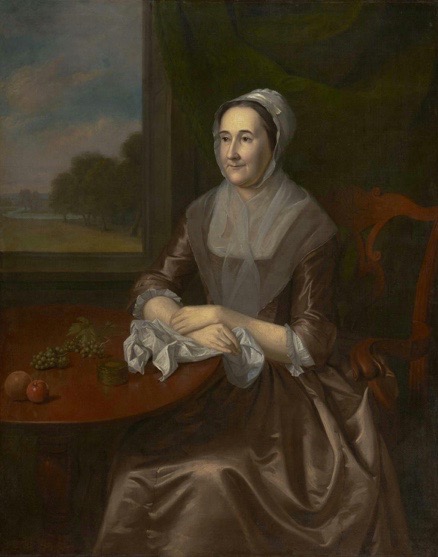
Hannah Lambert Cadwalader (Mrs. Thomas Cadwalader). Oil on canvas by Charles Willson Peale. Philadelphia Museum of Art, 1983-90-2

Did Fothergill assume Anne was a Quaker because she came from Philadelphia? Or did she dress in a manner that suggested she was a Quaker? It would have been easy enough to achieve a level of “plain” dressing with a brown gown and simple accessories like a white handkerchief and apron, and a lappet cap or a relatively unadorned cap. Did Anne and Magdalen (Nancy and Dilly) dress in ways that made their Quaker customers feel at ease? It would be possible to dress both plain and well, with neatly made fine accessories that would appeal to the eyes and instincts of Quakers and Anglicans alike. Perhaps. While there is no way to know for certain, and two passages do not make data, they do suggest something about these businesswomen and their ability to move among and between distinct groups.
Looking for a Ship

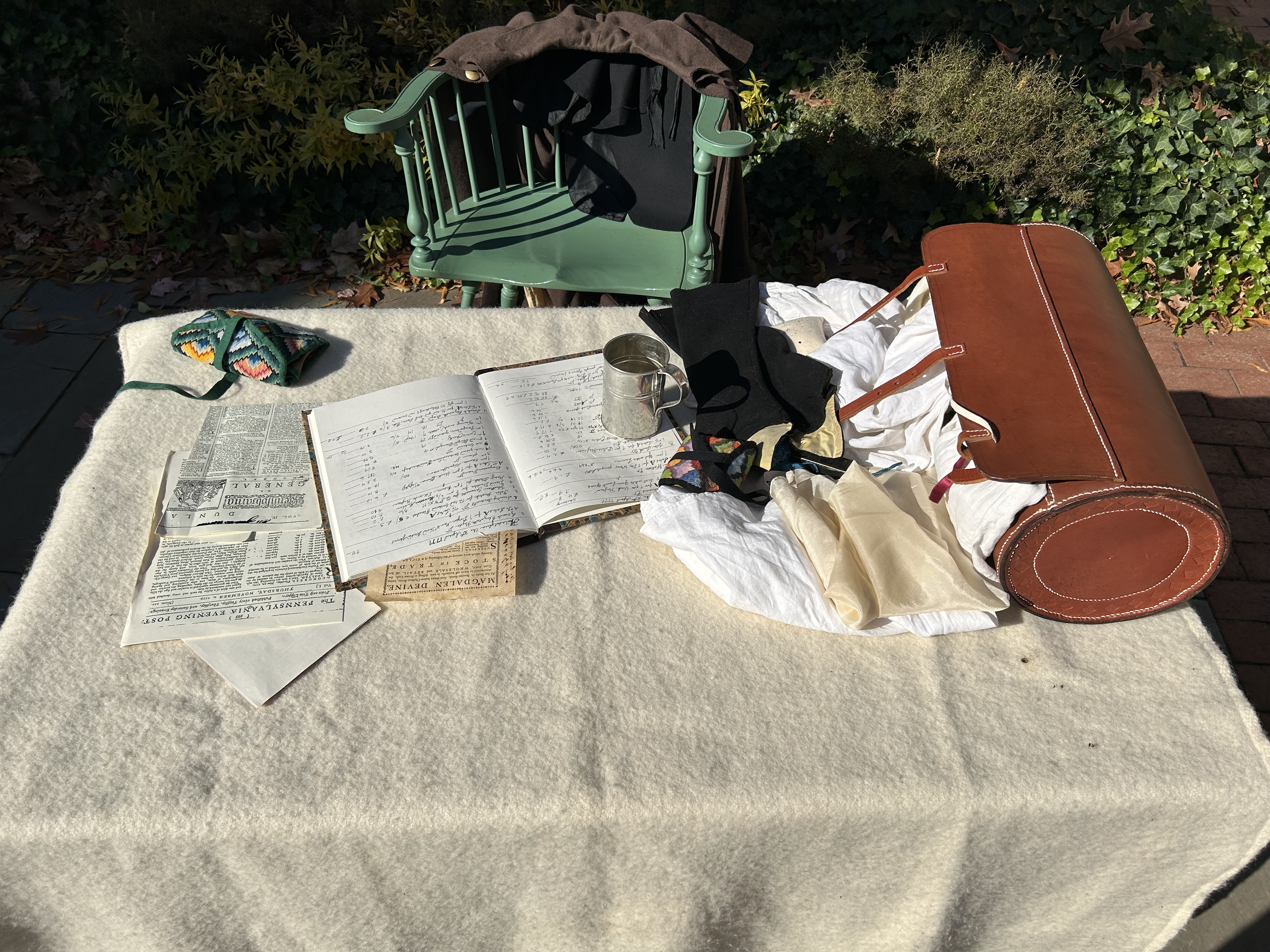
a table covered by a blanket with reproduction newspapers, a ledger book, and a leather bag
Collecting debts and packing up.

This past weekend (November 1-2) at the Museum of the American Revolution’s Revolutionary City (Pre-Occupied) event, I was pleased to represent Magdalen Devine, a feme sole trader in Philadelphia who ran a mercantile business between 1762 and 1775. Devine’s situation in 1775 reflects the tensions and uncertainties felt by many at the start of the American Revolution, and continues to resonate today.

a printed broadside advertising textiles for sale by Magdalen Devine in 1775
Broadside, Magdalen Devine, printed by John Dunlap, n.d. [1775] Historical Society of Pennsylvania, Ab[1780]-16

In 1775, Magdalen Devine, “being determined to leave off business,” advertised that she was selling “at Prime Cost, for CASH ONLY, WHOLESALE AND RETAIL, all her STOCK IN TRADE.” Devine first appeared in a Philadelphia newspaper ad in September 1762, selling imported goods with her brother, Frances Wade. By the following spring, the siblings had dissolved their partnership, and Magdalen had set up her own shop in Second Street between Market and Chestnut.

Devine’s ads reflected a keen sense of merchandising, including woodcuts illustrating printed and check fabrics and tightly wound fabric bolts. For more than a decade, Devine imported and sold goods on Second Street, eventually moving into a house she owned that was equipped with “two show windows with very large glass,” probably among the first instances of London-style shop windows in Philadelphia. 

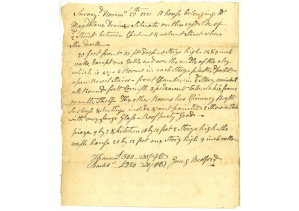
Fire Insurance Survey, “A house belonging to Magdelane Devine.” Insurance Survey S01561

For more than a dozen years, Devine traveled between Philadelphia and London, selecting, importing, and selling “a large and neat assortment of European and India goods.” The chintzes, linens, cottons, and woolens that Devine imported represented the wide range of textiles available, many with specific applications from jean cloth for clothing enslaved workers, tickings for mattresses, and hair cloths for sieves along with the chintzes, taffeties, and superfines that dressed the city’s elite. 

By April 17, 1775, she had “determined to decline business, as she intends for England shortly” and published ads in the Philadelphia newspapers calling in debts. Although she initially gave debtors two months (until mid-June), in August she was still in the city and advertising her intention to put debts “into a lawyer’s hands” if not paid within two weeks. An August 30th paper reprinted her ad of August 1, suggesting that the debt collection was not going as she’d planned in April, and the weeks and months kept stretching ahead. The ad placed on August 30th suggests she planned to leave not later than September 15th.

This slideshow requires JavaScript.

Unfortunately for Devine, mid-September saw a slowdown and stoppage of ships coming in and going out of Philadelphia. By September 18th, no ships were reported outward bound from the city. Magdalen Devine was stuck. 

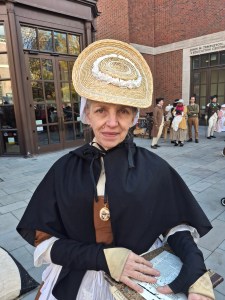
A woman in a brown eighteenth-century dress with a straw hat and a white apron, standing in front of a painted door set into a brick wall.
“Magdalen Devine” dressed in brown silk with a new straw hat.

Did she get out on an early September ship bound for Cork or Dublin, and make her way from there to England? Perhaps, but it seems more likely that she miscalculated and was caught in the city as insurers, shippers, and sea captains struggled to make sense of the news from Boston, Providence, and London. Newspapers published English threats to burn all the port cities of the American colonies, and warships plying coastal waters from North Carolina to Maine surely made sailing seem unwise. 

Why did Magdalen Devine decide to close her business and leave Philadelphia for England? Just one year before, in 1774, she had acquired the shop with the “two show windows.” What made leaving a good idea? The threads are hard to find, let alone pull, but perhaps her childhood and young adulthood in Dublin suggested that the violence the British were willing to use against a rebellious colony. Famines and strikes in the 1740s prompted British reprisals against a country that served as a laboratory of colonialism.

a woman in a straw hat and short black cloak
With my ledger in hand– and a fabulous new hat.

In the absence of passenger lists, it is hard to know whether Devine made it back to England in 1775, or whether she had to wait until 1783. We know she made it to London, because her death is recorded there in late 1783. 

Resources on the English in Ireland 

http://www.sneydobone.com/webtree/history-ir.htm

https://www.tcd.ie/news_events/articles/2023/how-ireland-served-as-a-laboratory-for-the-british-empire/

https://www.nam.ac.uk/explore/timeline-ireland-and-british-army

https://daily.jstor.org/britains-blueprint-for-colonialism-made-in-ireland/


Unpacking Wedgewood at the End of the World

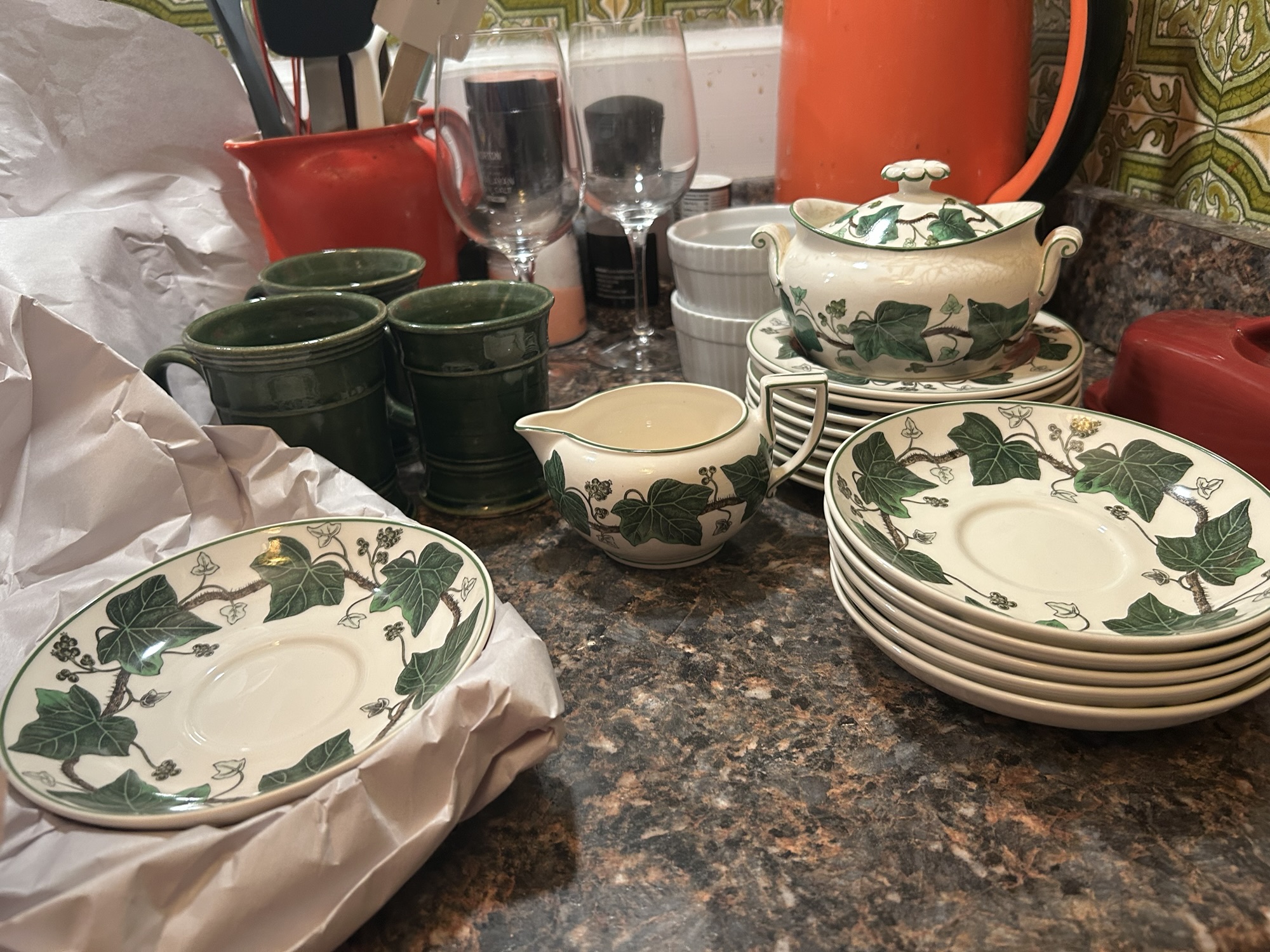
img_9058

I’m standing at the sink in the kitchen in my Baltimore apartment. It’s the smallest kitchen I’ve ever had, but I’m unpacking Wedgewood plates, cups, and saucers. There’s a creamer and a sugar bowl. What on earth am I going to do with these? We will eat from them, but how ridiculous is it to stand at the sink, some 30 years after receiving the wedding present, washing a service for eight? There are no longer 8 of everything– some have chipped badly, some broke in use– and I wonder how hard it is to get replacements. They’re available, if I want to spend $70 to $90.

This is crazy! No one will care if the plates are chipped. We’re in the collapse right now, and things are not going to improve unless there is drastic (unlikely) change. We will be lucky to have food to eat, who cares about plates?! But still I ordered three replacement plates, because I hate chipped plates, and well, why not? Why not have nice dishes as the world we know changes forever, irrevocably?

A nice table won’t stop the fascism (that takes other work).  Does a nice table affirm our humanity and our dignity? Am I mimicking the disaffected and the royalists who clung to sensibility as the American Revolution swirled around them? Maybe. For now, our dishes will be pretty and clean, and the cat will get her special meals, and we will be as normal as we can be, knowing all the while that nothing is normal and nothing ever will be. 

Furniture Check

The original, in 2013.

Lo these many years ago (one dozen) I embarked upon a gown-making folly based on the familiar Oyster Seller image. There was collective interest in this gown 12 years ago, probably because the original painting came up for auction at Christie’s in London. There’s more than one of these out there, and mine was not the best. I am okay with that.

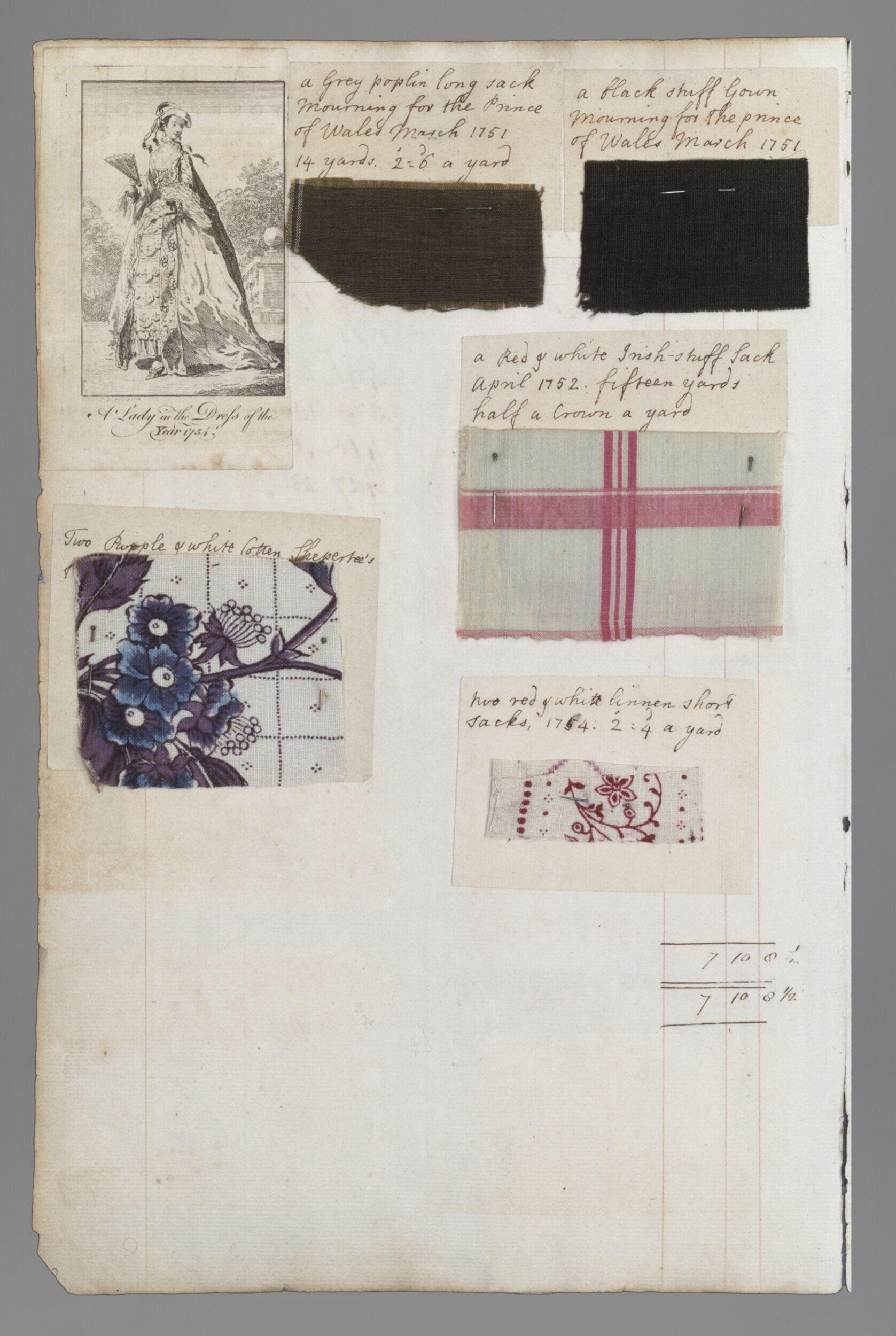
I think we were using the print derived from the painting as a justification for the cross-barred gown, along with a bunch of silk cross-barred sacques. I don’t remember whether or not I’d clicked onto the Barbara Johnson album page with the “red and white Irish [stuff? skiff?] sack, April 1752” swatch. Good stuff, that, and I would be delighted to find fabric like that. However, I had a cross-bar in hand in a form that I did not love.

Barbara Johnson Album, Victoria & Albert Museum

I didn’t alter the gown at the time because… I was embarrassed by the failure. The person who pointed it out to me was renowned for lack-of-tact, and did not offer any solutions, suggestions, or offer assistance. (That behavior is why people leave all kinds of hobbies, folks. Being kind really ain’t that hard.)

But it is hot this month, and getting hotter. So although I went to storage to look for, and not find, another wardrobe option, I did see this old gown. Did a klaxon sound? A siren? A choir of angels?


Furniture check on an upholsteress? How could I not?

Equipped with more knowledge, and one hopes, more skills, I spent Friday night and part of Saturday disassembling the gown. 
What I like about this project is that not only will I end up with a new gown, I’ll have a new gown that is obviously remade from an old gown. Props to me for developing the patience to do this.

It’s not a huge change, but the modifications include making the back pleats actually make sense, and doing them the way Adventures in Mantuamaking taught me to; tweaking the overall silhouette to match the sleeves and cuffs; and adjusting the robings. This should also prevent the various wardrobe malfunctions previously experienced.

I did recut the back lining from fresh linen; the back strikes me as the most critical structural element, so I made sure to replace that. I then stitched a center seam in the upper back, as you do, to mark the center of the back and set the total bodice back length. Overall, the back seemed far too long, and the front too short.

Re-pleated and stitched, the back was ready for new fronts. These required piecing (which is period) and I almost managed it on the lining, but they needed extra work. Even if the piecing is “correct,” it will likely be hidden by an apron.

Fortunately, the sleeves worked with the new bodice shapes, and are actually a better match to the style– they are too narrow for the initial style. I have enough to to rework the robings, but I don’t think I can get a stomacher out of what I have– not unless it’s massively pieced, which is also OK. 

I spent some time digging into Pennsylvania newspaper advertisements looking for checks, check’d, and check fabrics. They’re there– plenty of them– though linen checks for women’s gowns are a lot harder to find. Oops. 

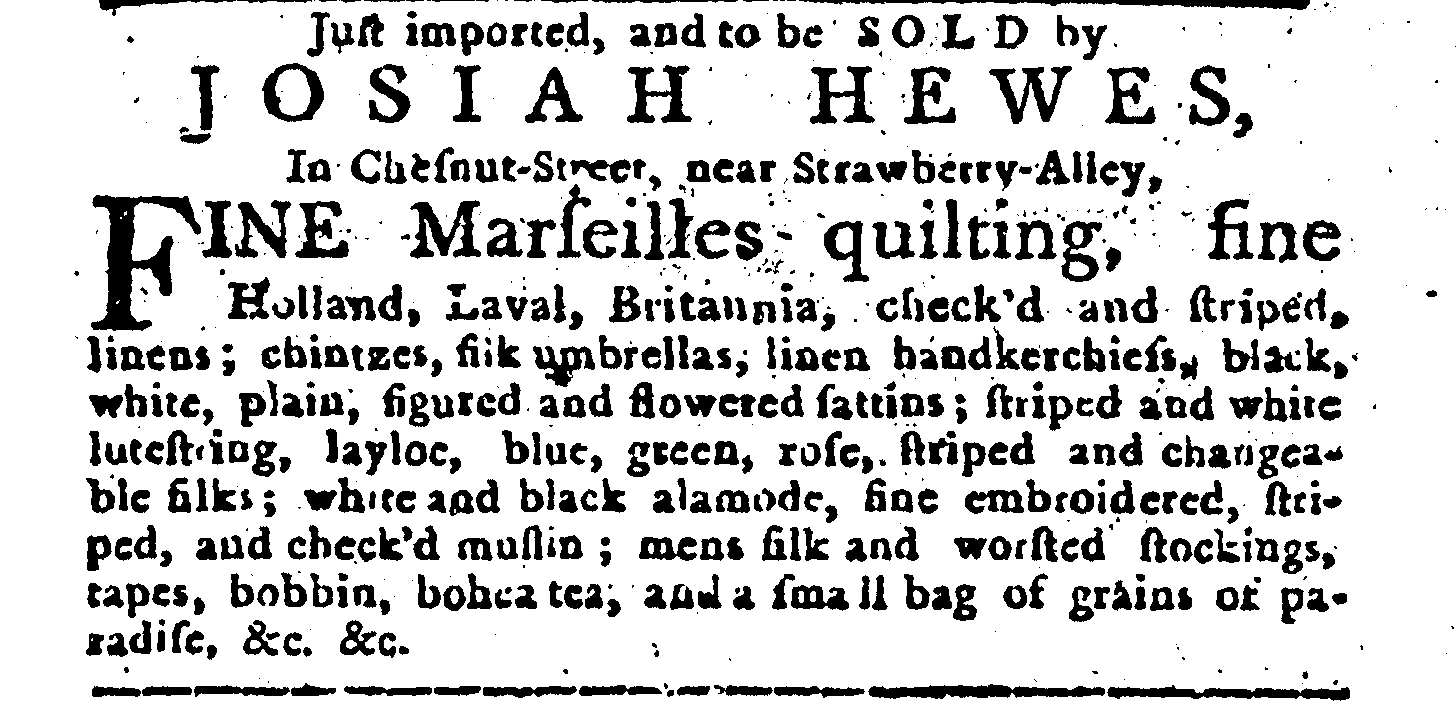
Still: I found  “check’d mantuas” (silk for gowns) and “Holland, Laval, Britannia, check’d and striped, linens.” Holland linens tend to be heavier, utility linens; Laval designated linen woven in Laval, in Pays de Lorraine (northeastern France), a town noted for fine linens. Could one of those be a lighter-weight check, suitable for a working woman’s gown? (That’s from the Pennsylvania Journal or Weekly Advertiser, December 26, 1781). It’s hard to say there weren’t checked linen gowns, just as it is hard to say there were. The possibility exists, partially because myriad types and patterns of linen were available in Philadelphia, and partially because we lack visual documentation of non-elite women in the Anglo-American colonies.

Pennsylvania Journal, or Weekly Advertiser, December 26, 1781

The runaway ads describe some Scots women and one English servant running away in checked gowns from 1753-1778. This does suggest checked gowns are associated with “lower sorts,” which isn’t exactly what I’m going for, but since I portray a working woman while also not melting, I’ll keep going. 

Pennsylvania Chronicle, July 10, 1769