
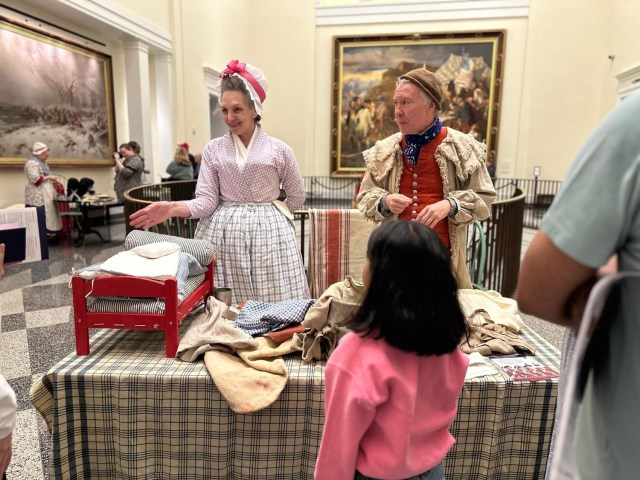
With some regularity, I portray an upholsterer-turned-contractor at the Museum of the American Revolution, and I’m scheduled to be there again mid-month. One upgrade I made last year, based on a friend’s adorable creation, was a doll-sized bed.
This is an IKEA bed for children or cats, so it’s an affordable, durable option for hands-on demos. It’s reasonably easy to adapt, with a chisel and a drill (Mr. K has a little drill press which made the rope-bed conversion much easier).

I outfitted the bed with woven ropes and a sack bottom, designed to make the bed more comfortable (the mattress can’t sink through the sacking). That’s topped with a a bed (mattress) of ticking stuffed with wool.

Beds were stuffed with a range of materials, including straw, cattails, cornhusks, hair, and wool. Hair is pretty itchy and I had wool on hand; in graduate school round one I slept on a wool futon so I can attest to its loft and comfort.

A feather bed tops the wool bed, feathers stuffed into a linen bag stitched shut. The linen is pretty tightly woven vintage material, and still the feathers escape! The case of checked linen ties shut. A ticking bolster, also stuffed with wool, supports the feather pillow in its linen case. The top sheet is, again, linen, with a center seam to mimic historical sheets.
This week, I started making the blanket. Modeled on an original rose blanket in the Colonial Williamsburg collection, I used wool broadcloth cut from a remnant. This, too, has a center seam like most originals. I have a stash of wool thread for embroidery, and matched the colors as best I could. It’s satisfying work, though I discovered that I’ve been stitching the wedges incorrectly (this is the result of having a laptop, rather than a large monitor). Oh well. I’ll stitch the last rose correctly.


The Workwoman’s Guide lays out how a bed should be made up, with layers of mattresses (beds), a feather bed, sheets, counterpane, and blankets. It’s a lot of layers. The Workwoman’s Guide was published in 1838, and although it is always dangerous to engage in backward interpretation (i.e. to apply the logic of 1838 to 1778), it is not unreasonable to think that an eighteenth-century bed would be similarly furnished. In houses without central heating, layers would be necessary.

While sheets and blankets could be made at home (butt-seaming linen or wool is easy), wealthy folks without enslaved laborers could order sheets and blankets from seamstresses or upholsterers. Betsy Cadwalader did not make her sheets, and while Martha Washington stitched cushion covers, the labor for the slipcovers or case covers was likely accomplished by enslaved seamstresses. The Cadwaladers ordered their case covers from Plunkett Fleeson, who probably had the work done by women rather than by more expensive male workers.
The new blanket will debut at the Museum of the American Revolution on Flag Day weekend, and I will once again talk about women’s work in eighteenth-century Philadelphia as they pivoted from domestic to military work during the Revolution.
 Kirsten Hammerstrom
You must be logged in to post a comment.