
Hips Do Lie

Nine years ago, I made a pair of hip pads to go under the unfinished cross-barred sacque. This time around, I thought I should make the more common hoops or pocket panniers. I used the Dreamstress’s Pannier-Along pattern and instructions but failed in a few respects. 

My panniers are crushed by petticoats, and fold in on themselves. The canes (I used synthetic whalebone) are both too soft and probably too long. The extra length allows them to curl in at the ends so that they migrate a bit to the rear even as they squish down. The linen I selected is too lightweight for this task; I erred by choosing based on color and not weight. Of course, I had (and have) enough mid-to-heavy-weight white linen in hand, but I was afraid I wouldn’t have enough for the gown lining. (Never mind the fact that I could have purchased fabric at the workshop, I was focused on the goal and not thinking things through as thoroughly as I might have.)
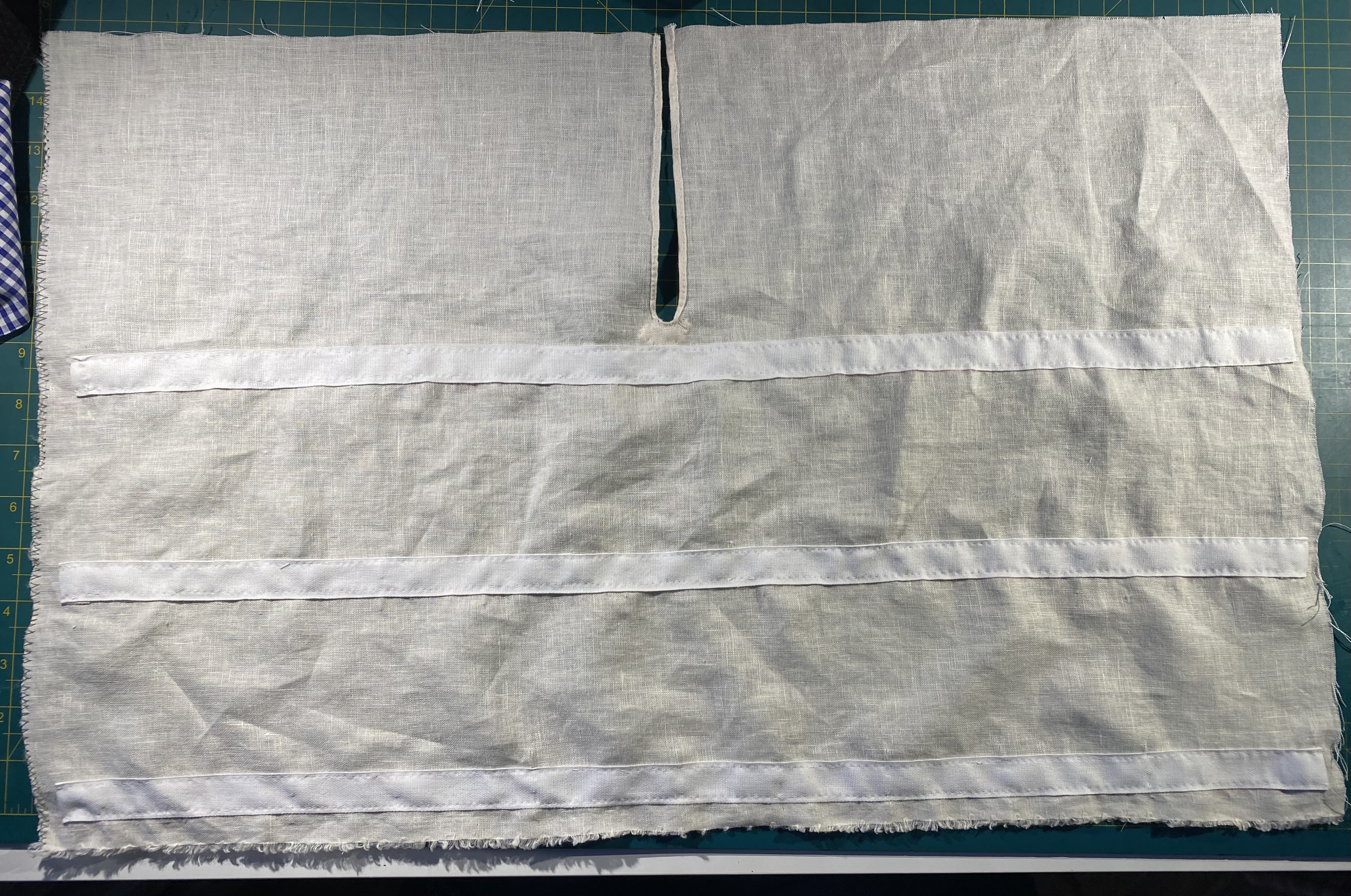
Side One with Tapes and pocket slit sewn

I started this project on Monday and finished by 10:00 PM on Tuesday, with full workdays in between start and finish. The panniers are sewn entirely by hand which makes it even more sad that they’re not all they could be. They’re supposed to be collapsible for travel, and they certainly are. That means that the solutions I try should not prevent these from folding flat. 

First side all finished

It makes sense to start by pulling out the bones and trimming them a bit to prevent the curling. Another step might be cutting a pasteboard bottom insert to maintain the silhouette. This will require undoing some stitching to slip the bottom piece in but it still seems worth a try. I could double the bones (if I have enough) or supplement what’s there with canes (I do have that). 

All finished, but a little squished

That’s three ideas before I need to start over with heavier linen. Even then, I can salvage and re-use the tape channels and bones to use again. 

Sacques-Piration

Once upon a time, I fell in love with cross-barred sacques. The style appealed to me for the way it combined a high-style 18th-century feminine form (the sacque, worn over hoops) with a tailored, streamlined look (the cross-barred fabric). That was 2013. Ten years elapsed before I tried again, without success (i.e. finishing the gown).

IMG_3414After a workshop at Burnley & Trowbridge led by Brooke Wellborn, I realized how little thought I’d given sacques in the past decade, and how little I actually knew. Workshops tend to produce that effect in me, which I why I sign up for them. When, in 2023, I looked back at what I’d been doing in 2013, I thought only of trying to complete the project. Now when I look back, I see so many things I need to change. So long, bodice fronts. So long, pleat stitching. I’m almost sure I have enough fabric left to make those changes. The width of the back pleats on the 2013 sacque suggest a style from a period earlier than I typically represent, but not impossibly early.  Still, they are stitched too far down my back– the pleats should release where the armscye starts its descent to the underarm. Deeper than that, the pleats look clumsy.

As I look even more closely, I begin to wonder if, instead, I need to make that gown over completely, possibly into an English or nightgown. The side pleats are not where I want them;  the back pulls in the wrong direction; and I don’t like where the side seam lands.  There is so much to change.

IMG_5149
Back pleats! Finding the rhythm– but also, notice the direction of the grain. Opposite gown # 1.

The gown I started at Burnley & Trowbridge was made differently from the start. The largest difference was setting a baseline from which to generate the rest of the gown. It’s a different process entirely, which is not to say that one is better than another, only that I understand the results of one better than the other.

Screenshot
Screenshot of the gown at the end of the workshop

There are points of fitting to correct in this new cross-barred sacque, all focused on smoothing the bodice. Whether that can be done while maintaining the initial sleeve set remains to be seen. I can imagine ways to manage that, but it’s definitely sewing without a safety net.