
Here are some simple things that can knock your impression up a notch if you’re portraying an 18th-century woman.
- P O C K E T S please carry your stuff — all of your stuff– in your pockets. They are crazy easy to make, and the originals are BIG ASS BAGS. They’ll hold all kinds of stuff– including water bottles of every description.
- Cuffs. This is one of those things that quickly dates a gown, or marks it as “off.”
- By 1770-1774, tight pleated cuffs that hug a sleeve are common. Really common.
- Cuff details should match your fabric, that is, if your gown is wool or linen, pleated cuffs (or no cuff) is most appropriate. If you’re wearing silk, sleeve ruffles or sleeve flounces can be used in the correct context. They’re less common on day gowns and Quaker clothes, and more common on earlier silk gowns and sacques. But if you are working class, wearing serviceable workaday fabrics, Edna Mode’s voice should resonate in your head: NO FLOUNCES.
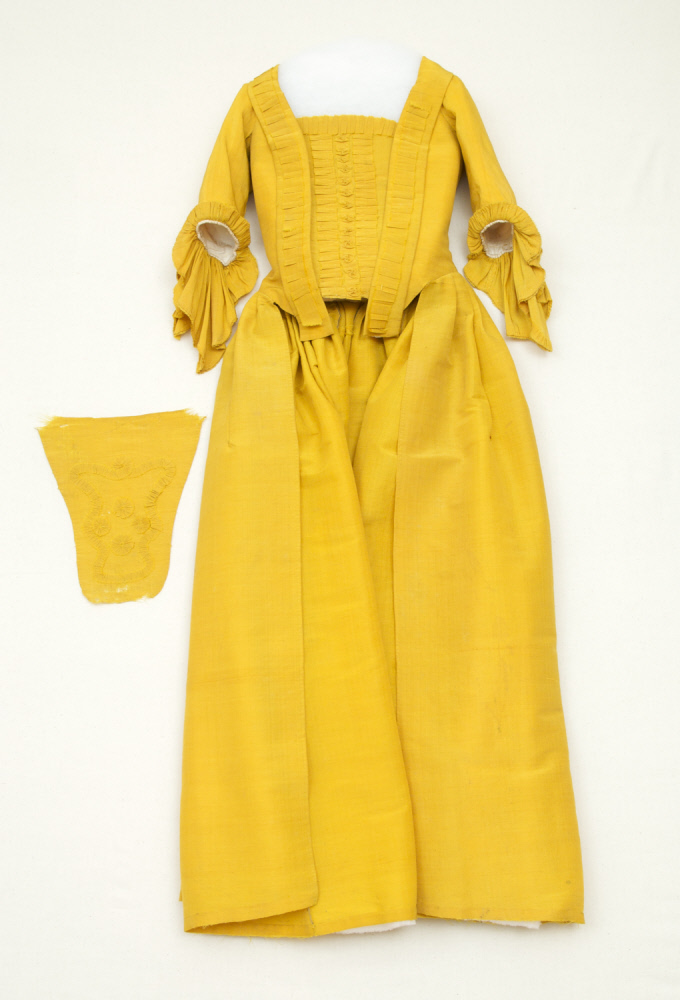
NT 1348707
But, you say what about THAT gown? That yellow wool one at Snowshill? Well, first of all, it’s a silk/wool fabric, and the gown was made sometime between 1750-1760. It is in England. It is trimmed. If you can justify wearing a ruching-trimmed gown while washing dishes, I guess you can do you. But the VAST majority of us should be wearing pleated cuffs on our wool (or linen) gowns, and anyone wearing a silk/wool fabric in a deep, gorgeous golden hue should be taking tea, not making tea.
- Proportions matter. Skirt lengths vary according to gown use and fabric.
- Working? Linen? Wool? Shorter skirts– at or above your higher ankle bone– are better. Imagine going up and down stairs carrying things. You want to be able to climb stairs while carrying laundry or a child WITHOUT worrying about your skirts.
- Going dancing? Feeling fancy in silk? Go longer. You can have a train on a sacque. After 1780 you can go a little longer in cotton if you’re in the Mid-Atlantic. Clothes are fancier in Philly, conservative in Connecticut, restrained in Rhode Island and boring in Boston. (Apologies to Boston, just sticking to the alliteration.)
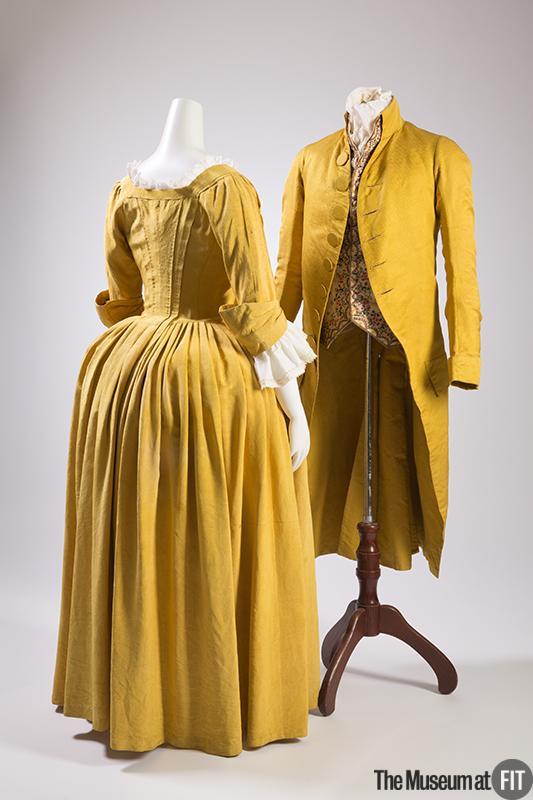
- NO HOOPS unless you are wearing silk or fine-printed cotton and swanning about a house or garden tea party. They are not worn under wool or cotton gowns. They are worn with at least one petticoat OVER them– the frame is not meant to be visible. A matelasse petticoat could be ideal, if not too heavy. It would smooth the hoop lines and give you some additional lift. Since these were worn under sacques, you’d have multiple layers– the under-petticoat, the silk petticoat, and the gown– over the hoops to smooth them. You probably also want to avoid them after the mid-1770s unless you are very fancy– rumps come into their own as we slide into the 1780s. Silhouettes are a whole thing, and worth a post on their own. Bottom line: you’re not at a party? You’re not wearing hoops.
But what does all that mean?
It means that how you dress depends on where and when you are. I know that’s obvious, but in some ways, it just isn’t. The rules for Rhode Island flex a little more than the rules in Massachusetts unless you are in a Boston Anglican mercantile family. Mostly you won’t be– you’ll be a Congregationalist and wool, in sober, well-wearing colors, will be your most common choice. It’s the religion, folks!
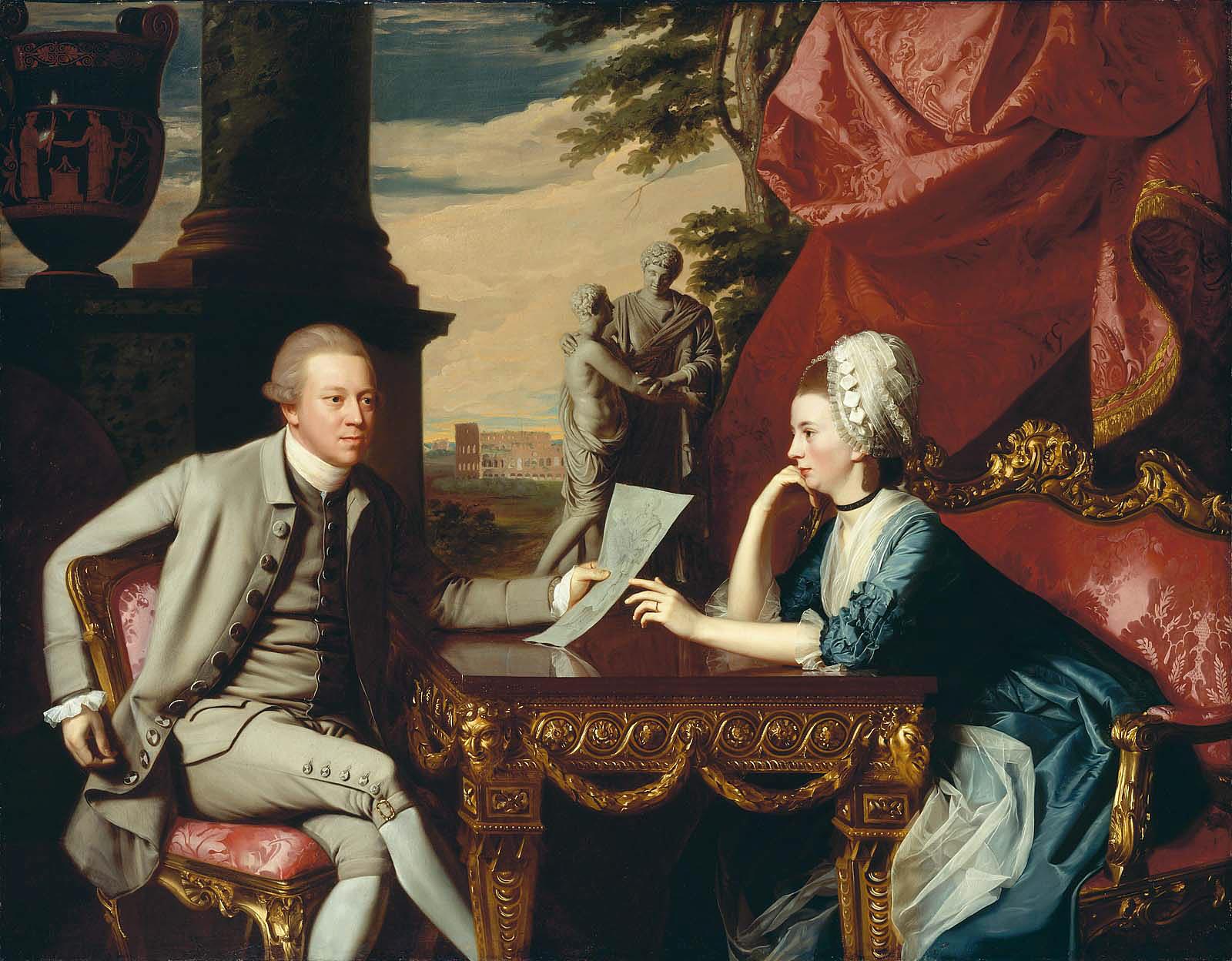
John Singleton Copley (American, 1738–1815)
1775 MFA 03.1033
Take the Izards. These are wealthy merchants from South Carolina, but she’s not wearing hoops (there is a lot of heavy silk, but the skirt folds in a way that suggests no hoops). She has a ruched cuff, not flounces. Her handkerchief does not overwhelm her gown. She’s a reasonable reference for mid-1770s general style guidelines.
Rhode Island, home of Soul Liberty and heretics, has thriving ports in Newport, Bristol, and Providence. Here, cotton prints show up in the runaway ads far more often than they do in Boston. It’s a different culture, with Baptists, Anglicans, and Quakers outnumbering Congregationalists. We used to joke that the state mottoes for Rhode Island and Massachusetts were “You do you” and “You did what now?” respectively.
If you’re in New York, you’ll have Dutch influence, and enough Anglicans to make a difference.
In Philadelphia, wow, you can get anything you want “at prime cost.” Ships go back and forth to London and Leeds all year round, carrying “large and neat assortments” of European and Indian goods. This is where you can go more nuts– unless you’re Quaker! And probably unless you’re Presbyterian. There are also plenty of Germans and some Swedes. All of those cultures swirl and mix in Philadelphia, but you’d be able to tell the difference based on what folks were wearing.

Portrait of John and Elizabeth Lloyd Cadwalader and Their Daughter Anne, Charles Willson Peale, 1772. Philadelphia Museum of Art 1983-90-3
In Philadelphia, the Cadwaladers were among the most conspicuous consumers. A pound of hair powder a month. Hundreds of hairpins. Yards of fabric and ribbons, caps, aprons, ruffles, and gowns made and remade. Were they wealthier than the Izards, or just more ostentatious? I’d guess wealthier and more ostentatious. Mrs. Cadwalader is sporting flounces on her lilac silk gown,which looks like a robe a l’anglaise or nightgown rather than a sack. She’s wearing a lot of lace– lace everywhere– and a paste or stone cross, while Mrs. Izard wears a black ribbon.
In a culture where appearance (and reputation) are your credit rating, you’d want to dress as well as you could afford to. But you’d also know what the rules were, and those rules included not wearing ruffles on a linen or working gown, carrying as much as possible in your pockets, and adjusting the proportions of your clothes to your work and your figure.
 Kirsten Hammerstrom
You must be logged in to post a comment.