
Some Assembly Required

Picture

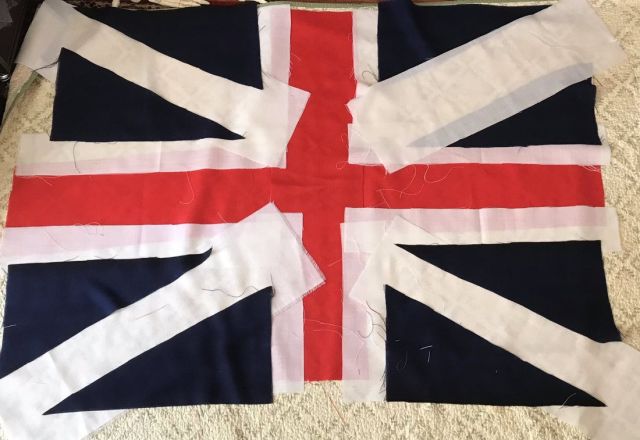
Canton pieces laid out on a quilt on the living room floor. The house is too small for the entire flag!

Picture

After I unpacked all of the pre- cut pieces of bunting, I separated the canton pieces and laid them out on the living floor. But perhaps an orientation is in order, though, to the pieces I’ll be assembling. Wikipedia provides a handy diagram, though of a far fancier flag.

  • ​Canton: The upper hoist corner of a flag
  • Field:The background of a flag
  • Hoist: The edge of a flag nearest to the flagpole

In this case, the canton comprises the ca. 1707 Union Jack, that is, the Cross of St. Andrew and the Cross of St. George. The field will be red, as this is for a ship operating outside of British home waters. (See previous post for detail

The (thankfully) pre-cut pieces are all cut with a 1” seam allowance, larger than the ½” finished seams will be. This margin of error takes into account the bunting’s extreme willingness to unweave itself at every opportunity and the difficulty of cutting very large pieces of fabric. (I am really grateful I didn’t have to cut all of these — there are many flags being made– and can only imagine the hand cramps!) But to the business at hand: I had to guess a little bit, since there isn’t a construction manual. It looks a fright, I know: all those overlapping bits! The disorganization! If you like things just so, as I do, this project needs some corralling. 

To get a better handle on a project too large for my table or floor, I made a list and measured each piece so that I could put them all into Illustrator and move them around more easily. I realize this is a luxury lots of people don’t have, but it’s really just a fancy, digital way of putting together what would be scaled-down pieces of paper in an earlier age.

It may not come as a surprise that in the process of doing the actual sewing, tweaks had to be made. What’s the rule?
Check drawings against field conditions!
Unpacking the True Colours Flag Project Package

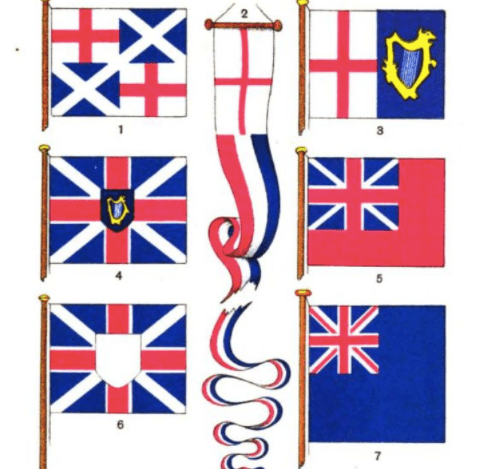
PictureWe are making No. 5 in this plate from British Flags, Their Early History, and Their Development at Sea… by William Perrin (Cambridge University Press, 1922)

The Museum of the American Revolution asked me to be part of their True Colours Flag Project and I readily agreed, happy to build on the research I’d done for the Flowers’ Artificers program a couple of years ago. I opted to do the British Ensign, since I’d looked at an original early 19th century version at the National Museum of the American Indian. Making this full-size, hand-sewn ensign for a museum is a challenge. From the careful marking of seam allowances to steam slightly puckered seams to getting the layout just right, this project keeps me thinking.

The ensign we’ll be stitching is figure 5 in the plate at left. The first question you might have is, why does this flag look the way it does? Why is there a Union Jack (that doesn’t look like a Union Jack) on a red field? Shouldn’t it be blue, like Tecumseh’s flag? Or just a Union Jack? Happily, the Museum supplied documentation. 

From William Falconer’s Universal Dictionary of the Marine (1769):
Ensign: “a large standard, or banner, hoisted on a long pole erected over the poop, and called the ensign-staff. The ensign is used to distinguish the ships of different nations from each other, as also to characterise the different squadrons of the navy. The British ensign in ships of war is known by a double cross, viz. that of St. George and St. Andrew, formed into an union, upon a field which is either red, white, or blue.”

In that definition, we have the double cross, St. George (the red vertical/horizontal cross) and St. Andrew (the white diagonal cross) that form the core components of the canton of the British ensign I’m making. The red field was seen as early as 1707, and the layered crosses were the standard from the union flag of 1606 and 1707.  This red-fielded British ensign flag was for use outside home waters, which did not include the North American colonies. (This attitude– that the American colonies were not “home,” and its inhabitants were not “British,” was part of what fueled the Revolution.)


PictureCarmine, Joseph, “Tableau de tous les pavillons qu l’on arbore sur les vaisseaux dand les quatre parties du monde” (1781). Prints, Drawings and Watercolors from the Anne S.K. Brown Military Collection. Brown Digital Repository. Brown University Library.

The image at left, from 1781, provides a good overview of the range of flags seen in the latter years of the American Revolution. The one I’m making is visible in the second row, fourth from the left (enlarge the image on the Brown site).

​Satisfied that I had enough of an understanding to start making, I unpacked the box.