I had a bonnet I made in 2014 (I think) that had been languishing in a box for years. I liked it– the soft tip was unusual, and the vintage ribbon and pink paper roses from the V&A went well with the dull grey– but I didn’t wear it. Sunday morning, I woke up resolved to remake the bonnet into something I will wear.
An upcoming weekend event in Dutchess County has me trawling through the fashion plates again, along with research helpfully sent along by the event organizers. A particular plate has stuck with me for some time, and finally I had the skill set necessary to tackle the thing. It takes making and looking and failing and remaking to figure out these things.
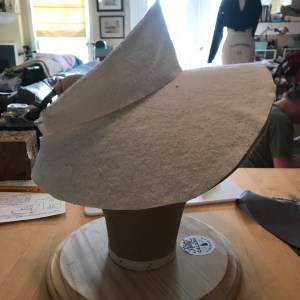
Step one was to take apart the bonnet-as-was. Satisfying work, really, not as unnerving as I feared it might be. And then? Paper patterns to figure out the sizes of the ridge and crest pieces.
I’d already committed myself to the silver-grey taffeta– slightly slubby, so second-chop, I’d already made muff cover, and had just enough left for a bonnet. The silver-grey seemed well-suited to a helmet-inspired style, and came close to the deep grey of the gros de Naples of the plate.
For mull, I used organic cotton quilt batting. It’s a little thick, but I pull my stitches tight and don’t want the buckram or pasteboard to show too much. The old brim piece served as a pattern for new, though I did have to use a different color for the brim lining.
The ridge was cut from homemade buckram (gum arabic on coarse linen from Burnley and Trowbridge). I used heavy cotton organdy to interline the crest. I know there is a way to get the ruffle more even, but my brain hasn’t produced it yet. Cartridge pleats and starch come to mind, along with goffering irons, as places to start. For now, this represents a Hudson River Valley milliner’s interpretation of the latest fashions.
The crown is taken from the 1770s bonnet I made, to take advantage of the way that crown slopes from a brim shaped like this one. If I were to make another one of these, I might switch up the order of assembly, and I might make the ridge piece of interfaced taffeta instead of taffeta-covered wired buckram.
The finished bonnet reused the same ties as the original bonnet, with a similar Petersham or grosgrain ribbon band. With my 2014 pelisse and a new muff, the only new accessory I’d like to make (or can remember wanting to make) is another, slightly larger, reticule to complete the ensemble.
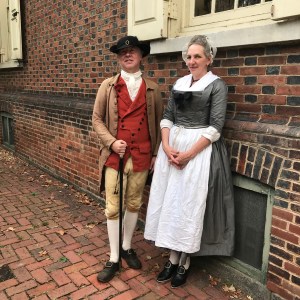
Rebecca Young at the Museum of the American Revolution. Always a good experience.
We made it: another turn around the sun, another year, a time of resolutions and reflection. 2019 was the year I had three jobs, invented a job, and qualified for Medicaid. It was a year I spent wondering who I was, and what my experience meant, if anything. I developed a new chronic condition (can you have too many?) and continued struggling to manage the old ones. I applied to, was waitlisted by, and ultimately rejected by a prestigious graduate program. I applied and interviewed for five jobs and got two. The one I have now, though a short-term contract, uses all the skills I honed over three decades working in museums. I expanded the repertoire of 18th-century women I represent, learned about flag making, and increased the number and accuracy of remedies in my medical box. I even journeyed further back in time to represent a Lost Colonist of Roanoke.
Together in multiple centuries, despite the bumps. Photo by Aaron Walker
Still, six months of working all weekend every weekend at job number two put me so far from my friends and habits that despite the pleasure of representing Rebecca Young and Elizabeth Weed, I still feel uncomfortable with living history and costuming. Those months certainly strained my relationship with Drunk Tailor, and with my own identity. Twenty nineteen is year I would revisit only in select details.
Mrs. Wainwright, Miss White and Miss Baker going into the Supreme Court to hear the decision on the Ohio ratification of the suffrage amendment, 1920.
For this coming year, I know only a few things. My contract expires at the end of March. I still love things and order, but I don’t know if I want to work full-time in a museum again. In a bit of perfection, I’m working as the de facto collections and project manager to transfer the library, archival, and object collections of the National Woman’s Party (NWP) to the Library of Congress and the National Park Service, effectively closing the NWP as a cultural organization (the house is now preserved as a national monument).
I took this contract before my Kickstarter succeeded and admit I am ambivalent about it. Kitty Calash as a business is a little too small to sustain me with a kid in college, but museum work, aside from the work of establishing ownership and provenance, remains difficult for me. I wonder about the accumulations of objects, their meaning, and relevance for the future. I was a curator for a long time, but now I wonder what my role will be, in the evidence locker of history.
Like “curator,” “reenactor” no longer feels like it fits, even though I love history and clothes and dressing up. Perhaps this is too many weeks where dressing up was not an option, too many events missed, the habit lost. Perhaps it’s fear of succeeding, of striking out on my own and doing well, and instead of jumping, hesitating at precisely the wrong moment. Suddenly, it all seems so silly in the face of elections, climate change, and the instability of the gig economy.
Purveying ideas and goods as a milliner is a lot like being a curator.
The core of the issue was this: “What happens when we no longer fit our own context?” The answers were varied, and to me, seemed like long shots (too many uncontrollable factors) but this struck me: It will require risking compassion to create an expanded and possibly destabilizing relationship to visual culture.
In 2019, I learned the key to most successful endeavors is vulnerability. I spent a lifetime building walls to protect myself that now box me in. Razing those walls is what I think of when I read “risking compassion,” though it’s hard to say exactly what a destabilizing relationship to visual culture (or history, or costume, or fashion) might be. It may be understanding how little one knows about the past, accepting new aesthetics, or trying something completely new. Even as I contemplate a possible grant-funded costumed interpretation program, clothes from 1919 don’t feel “new” enough to me; they are not different enough. I don’t know what will be, but I do know that unless I’m emotionally uncomfortable, I’m not learning.
On the way home
the view can be amazing
For all the angst and tears and anger of 2019, all the feelings I do not want to feel again, this year taught me to trust myself, to try, to fail, and to succeed. We learn as much from our failures as our successes, and while some of us more easily recall painful memories, it is worth remembering they can lead to our happiest moments. For this coming year, I will try to hold onto hope, that thing with feathers, and plan to learn new skills, improve the ones I have, and continue to find joy in the everyday.



 For mull, I used organic cotton quilt batting. It’s a little thick, but I pull my stitches tight and don’t want the buckram or pasteboard to show too much. The old brim piece served as a pattern for new, though I did have to use a different color for the brim lining.




 Kirsten Hammerstrom
You must be logged in to post a comment.