I’m really looking forward to recreating this (and to making a custom stand for it). It reminds me of the lovely brown bonnet sold by Augusta Auctions ten years ago. Poking around in fashion plates, I’d be comfortable putting a date range of 1825-1835 on this, with a likely date of ca. 1828. The two-part construction, the exuberance of the caned brim, and the color suggest to me that this is pre-1837 (when the effects of the economic crash can be seen almost immediately in smaller sleeves and tighter bonnets). Still, combing through fashion plates is never dull and I look forward to learning more in the year ahead.
Since I moved to Virginia, I have made more use of the local public library than I have since I was a kid. Not only do I go there to write when home is too distracting (some tasks need to be finished in a cat- and fridge-free zone), but I go pretty much every week. Traveling to DC gives me ample time to read, and I can finish a book or two every week just reading on the train. Among the titles I read this year are some that might interest readers of this blog (and could make a good last-minute holiday gift if you need some ideas).
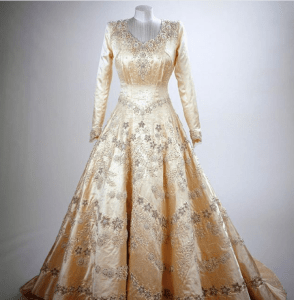
Princess Elizabeth’s wedding dress, by Norman Hartnell. Royal Collection Trust
The Gown: A Novel of the Royal Wedding by Jennifer Robson (William Morrow, 2018) was a little outside my normal range. I don’t usually read historical fiction and this veered into historical romance fiction and that’s just not my thing. And yes, if you read the reviews on Goodreads, those folks make some valid points. I did read the whole thing, but what really held my attention were the descriptions of working in the couture houses of Paris and London, in particular at Norman Hartnell. Hartnell’s gowns for the queen were marked by detailed embroidery. The wedding dress was made while Britain was still under rationing, which meant that then-Princess Elizabeth used her rationing coupons for her dress; thousands of women sent her their coupons, too, in a curious gesture that is noted in the book. There are some obvious plot twists, and some trite moments, but on the whole, this was a good summer read that got me thinking about the hidden labor that goes into clothing, and ways to make that visible.
Dress in the Age of Jane Austen: Regency Fashion by Hilary Davidson (Yale University Press, 2019). I have one gripe with this book: the type is printed in grey, not black, ink so it is difficult to read at night in bed. Otherwise, this is a solid, comprehensive look at late-18th and early 19th-century clothing. The focus is Great Britain, which is clear from the title, but the information is still useful to those interpreting early 19th century America and Europe. Davidson makes excellent use of written sources along with extant garments, fashion plates, and portraits for a well-rounded examination of what people wore.
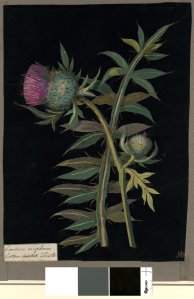
Carduus Eriophorus, formerly in an album (Vol.II, 62); Cotton-headed Thistle. 1781. British Museum 1897,0505.163
The Paper Garden: Mrs. Delany Begins Her Life’s Work at 72 by Molly Peacock (McClelland & Stewart, 2010) I knew Molly Peacock from her poetry, but stumbled across this book at my local library. Mary Delaney’s handwork included needlework and painting, but her most incredible creations were the cut paper flowers she made in the 1770s. Her life story is a good example of the choices that were (or weren’t) available to upper-class women and widows in the 18th century, and of the creative ways they spent their time.
I read plenty of other books this year, from Scandinavian murder mysteries to histories of Roanoke to histories of the suffrage movement, but aside from novels by Colson Whitehead (whichI cannot recommend enough) these three stuck with me.
December: when the year ends and begins again, a time when historically, for many Scandinavians at least, there was no spinning or winding, lest the world stop turning. No one wants to be stuck in mid-winter forever. This is the time when most of us look back, wondering what we accomplished this year, what it means, and begin to think about what we want for next year.
For me, this year has brought changes: three jobs, and my own business. I’m fortunate that I never stopped working. But I also never stopped working, and that keeps catching up with me. The days are grey and wet, and now that I work (part-time, for a few months more) in the district, I see winter creeping into the city as well as the suburbs, with all the signs of the changing seasons.
It’s not just sunsets, increasingly bare tree limbs, wool coats, or holiday lights as I walk to the train station, it’s what I smell. Some nights on Capitol Hill, it’s steak. Some nights at Huntington, it’s pizza. But even on the mornings when I collect the office mail from the post office, the terrazzo floored lobby with its glazed bronze doors smells like the office building lobbies of downtown Chicago in the 1970s and ‘80s. What was that smell: floor cleaner and metal polish, paper, and the seeping damp of melting frost? As difficult to describe as it is easy to remember, where I work now smells like where I grew up.
5200-5244 S. Greenwood Ave., Chicago
The landscape is similar, too, rowhouses on one walk to work, and office buildings on another, and, as I walk past the station proper, pigeons and homeless people. That, in particular, reminds me of Chicago, and a boy I knew from Eastern Europe.
He drove a cab with his father, but with me, he walked the scabby downtown streets eating croissants bitter with chocolate that turned sweet in our mouths as we kissed down the stairs from the cheapest seats at the Auditorium, sweets we carried in our pockets to share at intermission when we crept down to better seats not sold for that matinee performance.
I met him at a punk club, but he alone of all my friends loved ballet with me, he alone knew the ballerinas, the ballets, the composers.
He was tall and unforgiving.
“Your parks!” he said, “Dead pigeons and dog shot! People sleep in that!” and I had no answer, for he was right. He could say nearly the same about my walk to work today.
I think about this as the decorations go up, rituals are re-enacted, and we look forward and back at once. We’re our own private historical societies, editing our collections, interpreting our lives in ornaments, family photos, dinner menus, and table settings. Everything is different for me this year, even when I set the table with the same plates I’ve used for 25 years. And I have no idea what it will mean.
Next time, a look back at this year with an eye to next year’s aspirations.
You’ve washed, mended, ironed, darned, and sorted.
Now what? Now, my friend, the hard truths: the assessments and upgrades.
The hard stuff. Winter is a good time to frankly assess what you have, what you need, and what you already have needs. Could that sleeve be re-set? Stroke gathers re-done on an apron waistband? When you’re finally not planning and packing every few weeks, you have the time to really think about what you have and what you want.
There are two primary areas to assess, fit and appropriateness.
Still needs work….
and the bonnet’s too big.
Fit:
How well do your clothes fit you? Are your skirts long enough? Short enough? Are your breeches tight enough? Cut correctly? Waistcoats long enough? Getting dressed and taking a good look at your clothes can be enlightening. I find that photographs help me figure out issues with fit. As Drunk Tailor and I work, we take photos (especially of backs) so that whoever is being fitted can see what the fitter sees. This has proven more useful than attempting to turn around to see one’s own back like a cat chasing its tail. I’ve also used mirrors and selfies to achieve similar results, but even a non-sewing friend can take a picture of your back.
Now I can see what works
and what to work on.
Period-correct clothes fit differently than modern off-the-rack clothes (you know this), so looking at period images will help you figure out what you need to change. Typically, I find that sleeves are too loose, backs too wide, or bodices too long. Making the changes you need to make can be intimidating, but even 20th-century guides can help you get where you need to go. (The Bishop Method book is super useful if you want to sew vintage clothes, or just get better at sewing clothes in general.) More online sources for 18th-century techniques include the Early Modern Dress & Textiles Research Network , and Burnley and Trowbridge’s videos.
Appropriateness:
Purveying ideas and goods as a milliner is a lot like being a curator.
New York and Maryland
Do you have the right gear for your impression? Are the fabrics correct? Do you have the accessories you need? You know I’m not going to tell you what you need: that’s for you to figure out, but there are some good methods for figuring how what to wear and carry. (Soldiers have it easier: the sergeant tells them, and there are manuals.) For the rest of us in the 18th century, runaway ads are helpful and can be a good source of inspiration for ensembles.
2015
2016
For other centuries, fashion plates and portraits can provide guidance and inspiration, and eventually, there are even pattern books and sewing guides. Small upgrades can make a big difference: in the course of a year, I improved my shoes, upgraded the scarf, and made both a cap a new and better bonnet. It took two more years, but eventually, I really upgraded everything. Sometimes it takes a while to get things right, and that’s okay.
It takes research, and there are some pitfalls (like confirmation bias) but Drunk Tailor lays out some avenues to pursue. What you choose depends on who you are, so that’s always the place to start: who are you, where do you live, and what do you do? With those questions in mind, you can embark on making the changes to perfect your impressions.






 Kirsten Hammerstrom
You must be logged in to post a comment.