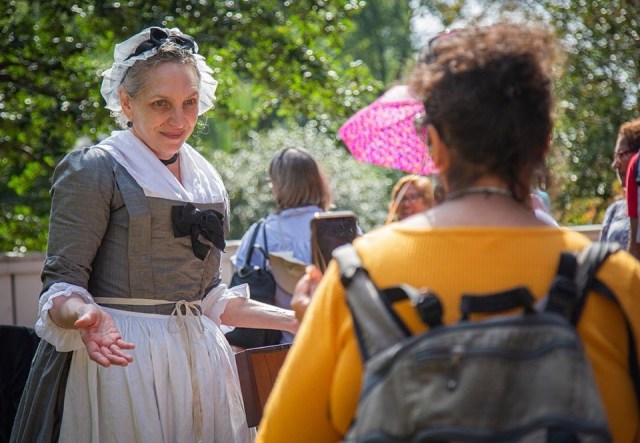
Starting Over, Again

Autumn is my favorite time of year, a time for fresh starts and new beginnings. Surely for many, that season would be spring, but for me, after summer’s dreary end, when the world seems stale, flat, and unprofitable, autumn is something else again.

This year, it was the time when my Kickstarter campaign succeeded, I quit a job I hated and stumbled into another that paid twice as much for fewer hours and was situated completely within my competencies. All of that was unexpected and probably hinged almost completely on taking the leap to quit a thing I hated doing.* The most successful moments– the most satisfying ones– come when I start something entirely new that scares me completely and for which I have no script. Those are dramatic and risky: big gestures, where failing will be public and painful.

There are other ways to change, smaller, incremental, but still meaningful, and sometimes still painful. Failure is always an option.** So this fall, in addition to the big changes, I took on some small ones.

I signed up for a Burnley & Trowbridge workshop, An Introduction to Mantua-making. When I signed up, I knew I would need to quit the job I had in order to take the workshop– and I had zero regrets. (There was no way to take three days off that included non-negotiable Sundays). I also knew I would be making a dress in miniature rather than a full-size gown, and I was thrilled: I do not need another gown.

What I wanted from the workshop was a skills reboot. I’ve been sewing and fitting clothing off-and-on since I was in middle school, and after a few years making my own clothes, toys and quilts for my son, and exhibition props for work, I took up historical costuming. Along the way, I took some workshops, did a lot of research, and developed habits both good and bad. What I wanted from the workshop was to unlearn my bad habits and acquire new skills, and Brooke Welborn delivered. I understand construction in ways I didn’t before, and now that I’m back home, my sewing is fast again (thank goodness!).

The joy of taking a basic workshop when you’re experienced is that you have a higher likelihood of completing the project, and you get to see a technique laid bare, broken down, and simplified. Sometimes we forget how important a regular, fast, backstitch can be– and how lovely it can be.

Ballet dancers take classes at all levels: they are always working on technique. Apollo or Coppelia: both are built on basic steps repeated endlessly unless perfect and apparently effortless. There’s always something to refine, perfect, polish, re-examine, or an old habit to break. Dancers also take classes in different genres: jazz, modern, ballroom, hip-hop: these require movement and gestures very different from classical ballet, but help expand a dancer’s abilities and understanding. And to that end, I took up something new as well.

I signed up for a new-to-me event at Fort Dobbs, the military timeline. Muskets and guns really aren’t my thing anymore, but the possibility of embarking on a new time period, and a character full of laments, appealed: the Lost Colony of Roanoke. This requires a new realm of research and new garments to make.***

Attributed to Abel Grimmer, The Marketplace in Bergen op Zoom, Flemish, c. 1570 – 1618/1619, probably 1590 and 1597, oil on panel, Gift of Mr. and Mrs. Earl H. Look

Working in the 16th-century aesthetic is pretty different from my usual comfort zone of the last half of the 18th century. Bodied petticoats or kirtles instead of stays; smocks with square neck openings or even collars instead of the more open shift neck; transitioning silhouettes; waistcoats and doublets as well as gowns; coifs and forehead cloths instead of caps: all pretty different. But all helpful in thinking about how fashion evolves, how we get from loose gowns to bodies to mantuas to open robed gowns to chemise gowns. Looking back can help us see the present more clearly, and so it is with fashion.
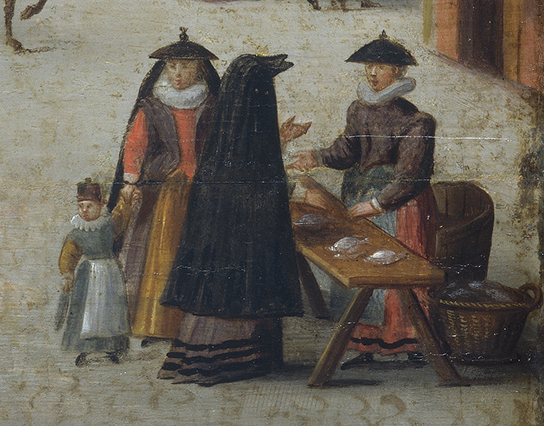
Detail, Attributed to Abel Grimmer, The Marketplace in Bergen op Zoom, Flemish, c. 1570 – 1618/1619, probably 1590 and 1597, oil on panel, Gift of Mr. and Mrs. Earl H. Look

It has also been an interesting look at the effect of climate on economy, society, and dress. In addition to reading about Roanoke and the archaeology of early English settlements in North Carolina and Virginia, I picked up Nature’s Mutiny from the Library. All the wool and layers make more sense in a period when temperatures were 2℃ colder than they are now. Blom’s arguments began to tire for me (the Times review is fair), but overall, thinking about the push of lower harvests on European exploration of the “new” world was a helpful angle to consider.

Riverside, Jan Brueghel (I) (copy after), 1600-1650.oil on copper. SK-A-68, Rijksmuseum, Amsterdam

Finishing all the pieces I need to be a sad shopkeepers wife who wishes she’d never set foot on the Lion is a challenge, but the effort has definitely been worth it for all the things I’ve learned along the way.

*Retail was hard the first time I did it of necessity, and several decades in public service made it only slightly easier.

**I am a big Adam Savage fan, and if you’re a maker or just enjoy my blog, I recommend Every Tool’s a Hammer. It was a birthday present this year, but you can likely find it at your local library. Short version? Keep learning, be adaptable, and put your tools away.

***Yes, an entire 1585 wardrobe at the same time I am working on patterns, researching the Lost Colony, finishing commissions, starting commissions, and starting a new short-term contract untangling collections. This kind of load is not new and is a habit that needs unlearning.
The Charm of the Third Time

One must keep up with the news (and the competition)

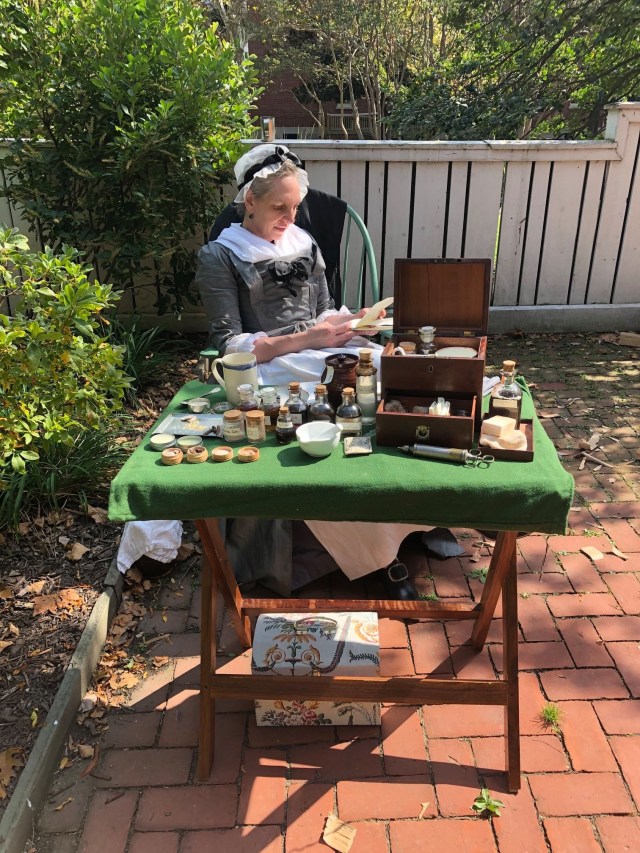
I’d call it “three times a lady,” but truly, I’ve only been a lady in Occupied Philadelphia twice. Last year and this year, I portrayed Elizabeth Weed, a widowed pharmacist living on Front Street in 1777 with her son, George. We don’t know why Elizabeth Weed didn’t leave the city along with nearly half the population. Was she a loyalist? Was her son too ill to travel? Or did she choose to stay to protect her property from the British– or the son of her late husband’s first marriage, who withheld a portion of the estate? Whatever the reason, remain she did, advertising her wares in the October 23 edition of the Pennsylvania Evening Post.

New remedies, new box, new ingredients: refining an idea

Last year, with Drunk Tailor’s assistance, I made a number of remedies using 18th century receipts, with some interesting and sometimes successful results. This year, we improved one– the yellow basilicum ointment– and added some new concoctions. The sulphur ointment for the itch (possibly scabies) worked well on the insect bites I got in the Carpenters Hall forecourt. A charcoal-oyster shell-cinchona bark-benzoin tooth powder was a new addition. I used the clove oil-scented pomatum to achieve the highest hair I’ve managed yet, but the truly satisfying work was recreating multiple recipes actually used by Elizabeth Weed.

As Drunk Tailor notes in his entry on this year’s event, we can never truly enter the 18th century mindset. Recreating the clothes, food, daily rhythms, and medicines help us experience the feel of the past, but we can never truly be those people. If you regularly cook 18th century meals, you’ll experience the palate of the past: aromatic, relying heavily on cloves, nutmeg, cinnamon, and allspice. This same range informs the aroma and flavor of the remedies from cough syrup to tooth powder.

Almost undoubtedly one of the ‘smells like Christmas, tastes like death’ tooth powders. Courtesy Jason R. Wickersty/Museum of the American Revolution

It’s a toss up which is less pleasant to the modern tongue, the Syrup of Balsam or the Syrup for the Flux. Both use the “paregoric elixir,” which some of you may recall from the medicine cabinets of old. Camphorated tincture of opium or anhydrous morphine has been used to treat diarrhea for centuries, and the ingredients for the modern version (anhydrous morphine) is remarkably similar to that for Weed’s paregoric elixir:

Weed’s Paregoric Elixir Anhydrous Morphine (Paregoric)
8 ounces opium Anhydrous Morphine, 2 mg
4 gallons spirits of wine, rectified Alcohol, 45%
1 ounce oil of anise seeds Anise oil
2 ounces Flor. Benzoin Benzoic acid
8 ounces camphor Glycerin
Purified water

There are some differences– most of us don’t want to ingest camphor, and “purified water” isn’t quite a thing in 1777– but the active ingredient makes these essentially the same compound. It’s an essential component of both Syrup of Balsam and Syrup for the Flux, so it had to be made first. Over the course of ten days, the elixir cleared from a yellow-orange slightly opaque liquid to a clear yellow liquid, with white sediment at the bottom of the jar (probably the benzoin).

With that in hand, I was ready to tackle Weed’s most famous (and well-protected) remedy. It appears more than once in the daybook, but both listings use the same ingredients and proportions.

One of the original receipts for the syrup for the (Bloody) Flux. UPenn Ms. Codex 1049

Syrup for the Bloody Flux
1.5 pints, simple syrup or molasses
.5 pint, elixir paregoricum
1 drachm each:
Essence of peppermint
Essence of pennyroyal
Essence of anise seed
Essence of fennel seed
tincture aromatic

“Mix them all together, and stop them up in a bottle for life.” (Or, as the other receipt says, “Mix and Digest.”

The resulting mixture is probably meant to soothe the intestinal cramps (with anise, fennel, and peppermint) while the paregoric relieves the endless diarrhea. Licorice-flavored molasses with a peppermint tingle isn’t unpleasant so much as odd to the modern palate.

Syrup of Balsam defied expectations.

On the right: Syrup of Balsam: -10/10 would not taste again.

Syrup of Balsam
1 pint, simple syrup or molasses
.5 print, elixir parigoric
1 ounce each:
Essence of fennel
Essence of anise seed
Royal Balsam
Tincture of Balsam of Tolu

“These must be mixed together, and then put up for use.”

If I attempt this again– to be fair, I have enough ingredients and more knowledge– I’ll try to get the Balsam of Tolu to dissolve more fully into the main mixture, though I doubt the separation is why the taste is so unforgettable. While it did mellow after several days, the basic flavor remained licorice cough drops dissolved in corn liquor with an afterburn of turpentine. Fortunately, the dosage is not by the spoonful, but rather ten or more drops in a wine glass of water, depending on the constitution of the patient. As a “cure for the whooping cough,” the syrup with fennel and anise was probably intended to soothe the throat, and paregoric might have helped the pain of damaged lungs. Living in the post-DTaP era, I’ve never had whooping cough, or been around anyone who did, so it’s much harder for me to imagine treating it without antibiotics (or simply not getting it).

“No, really, no antibiotics!” Photo by Jason R. Wickersty/Museum of the American Revolution

That was really illuminating to some people: antibiotics weren’t invented until 1928 (in the case of penicillin) and were not available for civilian use until March, 1945. Until then, diseases like strep throat could be fatal. Often, the best medicine in the 18th century was to help a patient be comfortable, and ease their symptoms.