Auction Season: The Holiday Sales

Screen Shot 2018-12-05 at 6.34.13 AM
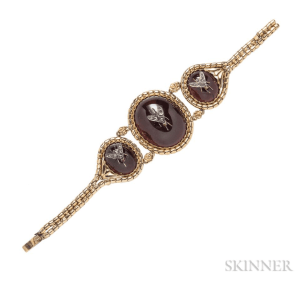
Lot 1159 Antique Gold, Carbuncle Garnet, and Diamond Bracelet. Yes, those are rose-cut diamond flies.

First come the jewelry sales, the big guns like Sotheby’s leading the way with sales as crazy as Marie Antoinette’s jewelry (Royal Jewels from the Bourbon Family of Parma, technically, though it sounds more like a delicious lunch than a sale), but the smaller houses play, too. Skinner’s sale closed December 5, Freeman’s earlier, but later than Sotheby’s. These are not sales I bid in, but they are places to see things you’d might not otherwise see. Garnet bracelets with rose-cut diamond flies? Not something I see gracing the wrists of my fellow Metro riders or grocery shoppers.

Screen Shot 2018-12-05 at 6.41.39 AM
Lot 7, Contemporary painted tin hat trade sign, 20th Century. 7″ x 13.25″

Once the serious stuff has sold, the fun begins: the toys! Pook and Pook’s two-day toy sale begins December 7th, and you might call it whimsies and toys, since it begins with shop signs. Who doesn’t want an enormous tin hat? What’s the point, you ask? Why look, if you don’t collect? Because you can collect– information, screen caps of reference images, ideas for things to make, and a visual reference library to fill in the blanks of what you read. The steam engine that breaks in The Railway Children seemed crazy to me as a child, and I assumed it was just a model of a steam locomotive. But no: there were steam toys and accessories, from lighthouses in moats with Indians in sailboats to working looms to….steam locomotives.
Screen Shot 2018-12-05 at 6.52.23 AM
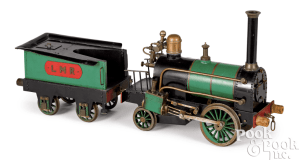
Day Two, Lot 521, Large Bassett Lowke live steam train locomotive and tender, 3 1/2″ gauge, engine – 13 1/2″ l.

The darling thing even looks like Percy, filling in the gaps of the origins of Thomas the Tank Engine, Edwardian children’s stories, and the wonders of the steam age (which you can replicate, if you choose). Hard to believe, in our age of safety, that steam engines might be de rigueur in the parlors of well-to-do Victorian and Edwardian families. (Perhaps your childhood was not as full of E. Nesbitt, Kenneth Grahame, and Arthur Ransome as mine, but if your mother’s primary caregiver was born in late 19th-century Great Britain, you might grow up with an attachment disorder and a taste for fabulist literature of the early 20th century.)

Day One, Lot 230,
German dressmaker and milliners shop room box.

And then there are the dioramas or room boxes, many, if not most, German. These early 20th-century displays give us a sense of the kinds of craft or hobby activities people enjoyed, front-facing dioramas. I think you either “get” them, or you don’t; not everyone wants a miniature world to control or fantasize about, but from the perspective of someone trying to understand what the past looked like, these can provide a three-dimensional view of what are usually only black and white images. Are they perfectly correct? No. But they do give us a sense of the kind of visual stimulation people encountered and enjoyed shopping and playing.
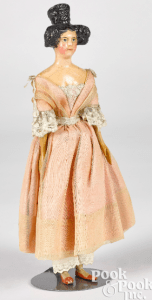
Day One, Lot 220, Papier-mâché milliner’s model doll.

There are dolls, always divisive (they’re creepy or cute, few folks fall in between) and they have they own usefulness. None in this Pook sale tell us much about early toys, but there are a couple of early 19th century examples to remind us of what children played with in the past, and how new fashions were disseminated. In the case of the milliner’s model doll at left, we get a good sense of the Apollo’s knot hairstyle, and a pair of red slippers I would love to have. The back view is equally useful, for it is only with three-dimensional objects (dolls or sculpture) that we can get a complete sense of a hairstyle or costume. With enough looking, you can extrapolate, but there’s nothing like being able to see the past in the round. That’s even better than the telephone-book-thick catalogs from Sears and J.C. Penney that arrived before the holidays in decades past.
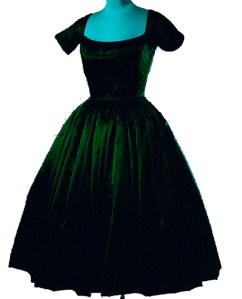
Dresstory: The Green Eyed Lady

Almost my dress, thanks to PhotoShop

I didn’t know then that it was called changeable silk; what I knew was that the skirt rustled when I walked, and spread out like a plate when I twirled. Irresistible. Probably homemade, I would have found it in a junk shop on South Broadway in St. Louis, or at the Veterans Village thrift store on Natural Bridge Road, a place white girls like me had to be careful (respectful) about going to.

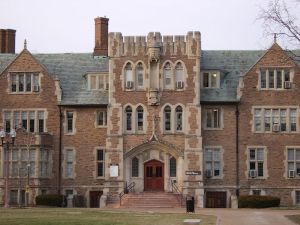
Square neck, tight waist, full skirt, side zip: at one point, I was skinny enough to pull it over my head without opening the zipper, as long as I wiggled just right. The only time I clearly remember wearing the Green Taffeta Party Dress was to the KWUR Student Radio end-of-year party at the Women’s Building on the Washington University Campus. April or May of 1987, probably, though possibly 1986, before I went to Skowhegan on a summer scholarship.

My date was my on-and-off boyfriend, another sculpture major, working on his master’s if it was 1986, and newly graduated if it was 1987. He had a shambling walk, shuffling, a little hunched over, as if 6 feet were too tall for the spaces he occupied, though the city was large enough. Sneakers, jeans, an Army fatigue jacket, a smile waiting for reactions, waiting to deploy. Patrick was the son of a firefighter and a nurse, and I stole him from his college sweetheart.

Rosemary Clooney in White Christmas. Velvet, but very similar.

The green of my dress was like the green of his car, dark and forest like. We made installations together, layering found objects and drawings in the small gallery in the studio building where we worked. We drifted into a relationship: his girlfriend visited every weekend, driving up from the smaller college town where they’d met. Red haired, pale-skinned, in burgundy beret, Roslyn sat on a stool and watched Patrick work. Across the wide wood shop, I watched her watching him, and smirked. Reader, I was unkind. My friend Jane and I played Raspberry Beret on repeat every time Rosyln visited, hard to do in the pre-CD era, but we managed.

My style icons at the time were Joe Strummer, the Beastie Boys, and Lydia Lunch and when we weren’t taunting Roslyn with Purple Beret, I was inflicting 8 Eyed Spy on my studio mates. Reader, I was a snob. Paddock boots and ankle-zip jeans; white high tops and baggy Marithe et Francois Girbaud trousers; and the occasional 1950s evening gowns comprised my idea of campus-appropriate dress. My wardrobe came from thrift stores, gifts from my mother and grandmother (the Girbaud trousers), and practical work wear I bought with money I earned in the summers (high tops and paddock boots). In winter, I had a ca. 1950 Army trench coat with a button-in lining, which I insisted upon wearing to a Fortnightly dance in Chicago my senior year of high school. It is amazing my mother lived through all this sartorial humiliation, and amazing, too, that I was harassed as little as I was on the streets of Chicago and Saint Louis.

Wash U Women’s Building. KWUR was in the basement.

The KWUR Prom was in May, though I think of that evening as summer, so I would have needed nothing over the dress. I wore it with a gartered corset, black fishnet stockings, and Johnson motorcycle boots styled like paratroopers boots, leather soles slick from walking, and good for dancing. By May of the year I met Patrick, he’d broken up with Roslyn. We started making art together on a dare, and in our rambles collecting window screens, broken chairs, old medicine cabinets and other detritus, we grew closer, stopped being adversarial and became friends, and then lovers, until we were not. I wonder about Roslyn sometimes, and what became of her; I know where Patrick is, though we have not spoken since 1991. I broke his heart, for a time, after he broke mine, and now he lives where I began.

Museum Monday: GWU & Textile Museum

Friday I found myself in Foggy Bottom with time to spare on a parking meter in Alexandria, so I cast about for someplace to explore. For the first wearing of my favorite boots this season, the Mall seemed too far, so I chose the George Washington University Museum and The Textile Museum. Once upon a time, the Textile Museum had its own home, but as with so many museums, it could not support itself, and found a new home within a university. GWU is also home to the Albert H. Small Center for National Capital Area Studies, which collects Washingtonia, documenting the evolution of the District of Columbia’s landscape and built environment.

University museums make me a little nervous the same way museums associated with private hereditary-based membership organizations do– there’s an increased level of exclusivity beyond the usual white marble stairs and bronzed glass doors. Is the museum for the public, or only for the students? How well does the museum integrate with the community around it? That’s not much of a concern for the GWU Museum, given that it is embedded in a neighborhood primarily comprised of college students, but the hands-on lab is clearly oriented towards school groups of all ages, and school groups have their own (slightly half-hearted) page.  Still, it’s not like Penn’s Museum, which is embedded in a very different kind of neighborhood.

Still, the front desk staff were friendly helpful, suggesting two ways to see the museum (basement up, via the stairs or top down, via elevator). I chose the stairs. The basement level featured selections from the Textile Museum Collection, Textiles 101 and Faig Ahmed: Nonvisual Language. It’s a good thing I’ve got years of museum training because Ahmed’s work is really tactile. I wanted to plunge my hands into the first piece I saw, a luscious red wall hanging. Really: you want to get your hands in it.

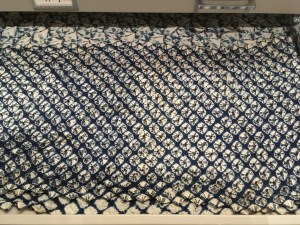
Shibori in a drawer in Textiles 101

Textiles 101 provided the chance to touch, a welcome relief after looking. There were drawers to open, and a large explanation of the types of weave structures that make up textiles. A very helpful security guard recommended (insisted) that I watch the video on the 2017 Maryland Sheep to Shawl Contest,  which I did enjoy. As the only person in the galleries, my heels echoed and I attracted quite a bit of (friendly) attention.

On the second floor, I found the Alfred Small Collection of Washingtonian’s Eye of the Bird: Visions and Views of D.C.’s Past which I found incredibly helpful in understanding the evolution of the city, and in orienting myself when on the ground. The diagonal streets and circles are confusing to someone  familiar with grids, or cowpaths, or grids laid over cowpaths, so I need all the orientation I can get. An unexpected treat was a lovely 1830s dress with whitework pelerine, illustrating resident dressed for one of my favorite eras.

The Basics:

Admission:
Free (suggested donation, $8; front desk staff waved me in when I brought up AAM)

Hours:
Monday and Friday: 11 AM–5 PM
Tuesday: Closed
Wednesday–Thursday: 11 AM–7 PM
Saturday: 10 AM–5 PM
Sunday: 1–5 PM

Closest Metro: Foggy Bottom (Blue, Orange, and Silver Lines)