The Past Never Grows Old

It’s obvious that the people I know and associate with understand the genius of They Shall Not Grow Old, and the importance– necessity– of seeing it. This is a brilliant public history project in the most public sense of all– and not only because it’s a movie made by Peter Jackson, which one hopes will attract a wide audience– but because the mini-documentary after the feature lays bare the bones of the making. Jackson’s explication feels at times as if he is speaking to you through his laptop camera on the best Skype connection you’ve ever had. Despite the occasional weirdness of that, it’s worth staying for, because it makes clear what makes the film powerful: research and meticulous attention to detail (plus phenomenal computing power and the genius of WingNut productions).

Royal Irish Rifles, Battle of the Somme

This film rests on research: 100 hours of footage from the Imperial War Museum, 600 hours of oral history audio. Jackson and his team immersed themselves in the media, and it shows. Their intention was to create a generic experience of the common soldier (I may well have teared up at that), so the description of the assault is generic– is it the Somme? Vimy Ridge? Ypres? It is all of them and none of them.

Now the magic of that choice is not that we hear anything about how a Lee-Enfield works, but rather about the minutiae of getting ready to go over the top. We are in the soldiers’ world, and that world is made up of mud, bread and jam, and tea. Yes, there’s talk of the packs and what they carry, but the descriptions of what the waiting was like, how the officers behaved and gave their orders, are what make the moments so immersive. The words match the abject terror on one private’s face, caught in a grimace more rictus than smile. At the same time, we do get descriptions of the logic of the shelling, what the shells contain, and how the mines work. Matched to footage showing what the veterans describe, we come to understand how terrifying those moments were– and then we hear how, once you go over the top, fear disappears as you walk towards the German lines. (The walking always astonishes me: but that’s how they did it, lines of soldiers walked towards the machine gun nests.)

But it’s the details of the getting ready and the tension of the waiting that make the assault so much more intense, as contrast always will. The assault itself, for which there is no footage because it was too dangerous to send cameramen over the top, is depicted with halftones from The War Illustrated, selected for their realism and lack of heroics. (Published in Britain, it was as much a propaganda tool as a documentary publication, though accuracy improved over time.)

We don’t get the “glory” of a battle. We don’t get heroics. We get descriptions of the most terrifying and dehumanizing “job of work” people (mostly men) are ever asked to do. And we get the aftermath, rendered small. In detail. The descriptions of wounds and deaths are moving, and the tireless work of the doctors, but then there is the desire for a cup of tea. Tea threads through the film, seeping into every aspect of the war. It is, after all, men living daily lives in the most outrageous conditions, where every banal desire– dry feet, strawberry jam, a safe place to defecate–is thwarted by the conditions that make those desires so achingly large and yet dismissable. You have to enjoy what you have and can achieve and laugh at what you cannot, or you won’t survive. No one can ache endlessly.

What makes this film really work is the hyper-attentive focus on detail, on getting everything as right as possible, from the color of the uniforms to the accents giving the soldiers voice. The point of the research is not detail for details’ sake, but immersion. Only when there is nothing to notice– nothing that seems amiss, an entirely seamless world–can we fully enter the other, another time, place, culture. That is what we are seeing: another culture, with its own language, mores, habits and taboos.

This is what we are trying to recreate when we reenact the past: we are reviving a lost culture. To do that correctly and well, we need to apply the same level of care and understanding and empathy visible in Jackson’s film. We need to make sure that the details are correct not because the public will call us out on errors, but because the oversights are disrupting. The difference between a well-researched, highly detailed impression that does not focus on “Want to know how a musket works?” and one that’s musket-centric and approximates the past with “If they’d had it, they would’ve used it” is not actually of quality or necessarily or care. The difference is that one allows both the enactor and the audience to more fully enter the past. It’s like a bubble of time we can step into, one where we get as close as we can to how the people of the past saw, thought, felt, smelled. The other, often excused with “The public can’t tell the difference,” remains performative and distant, only half-reaching the past.

The public can tell the difference. They can tell when what they are seeing comes closer to the past, engages with the material in detail and in attitude, and creates attitude, worldview, empathy rather than a recitation of facts. To reenact the past, we must inhabit it, from the color of the wool to accent of the speech, to the taste of the food. The moments we recreate are specific in time, and, when they embody everything you can know about that moment, help us reach across time to understand both the past and the moment in which we stand.

Vera Brittain and her brother, Edward, in 1915. Testament of Youth was my gateway drug to World War I.

I am the last person to tell you I get close to this ideal of detail. I strive for it, and do the best I can to be whatever character I’ve selected. I write this not from the position of someone who has mastered the past, but as someone who has seen technique and principles applied to one medium– film– that are applicable to living history, exhibit design, public programming, and writing. Jackson’s film illustrates the power of knowing details and the power of caring about those details not for trivia’s sake but for the Tommy’s sake. Those specific details serve to create the “everymen” of the War. The research to find which regiments are shown, to get the shoulder badges right, to find how what speech an officer is reading, prove the power of the archives. The past is there, waiting for us, in acid free boxes. We can restore the dignity and humanity of the people of the past by reading their words. Specificity creates archetype.

At the end, Jackson encourages the audience to ask their family members about their history, to find out what stories there are, to find out how the Great War touched them. He reminds us that those memories die with the people who carry them, unless we ask and write them down (or record them). That is perhaps the greatest public history lesson of all: that the past touches us all through the people we know and love, and that by knowing those stories, we can understand not only our family stories, but the history we all share.

Turn Me Round

Gattinoni red brocade party dress, Rome, 1950s Augusta Auctions Lot: 155 October 24, 2018.

One of the best things about auction sites (when compared to museum sites) is that you get far more images of the objects, and often from unusual but helpful angles. This is true for furniture– good auction sites will post photographs of the undersides of sofas and desks, a level of detail museums simply lack the time for. For clothing, construction details aren’t always noted in the record, so we rely on images. This is where the auction sites can really be a boon: turn me round, baby.

Interior, showing black mesh boned corset w/ attached black petticoat. Gattinoni red brocade party dress, Rome, 1950s Augusta Auctions Lot: 155 October 24, 2018

I don’t know if I’d go as far as “boned corset” (well, I wouldn’t) but the boned bodice provides a lot of interior structure to this gown. The box pleats give the brocade skirt structure and fullness, but rely on the petticoat for the full silhouette. The interior structure probably didn’t provide enough support to allow the dress to be worn without additional undergarments– bra, panty girdle, even another petticoat– though it’s hard to say without knowing the original owner and feeling the dress. (Think of the boned bodices in late 19th century bodices: we know those weren’t enough to create the proper silhouette.)

It’s a wonderful look at the interior of a vintage dress, though, and one that makes replicating this garment (and look) so much easier.

Dresstory: The Turnabout Skirt

Two first dates, at least, and almost always with boots: the Pendleton plaid reversible pleated “Turnabout” skirt. I bought it in a long-gone shop on Thayer Street in Providence in 1989 or 1990 with money I earned working in the inter-library loan department at the Brown Science Library, the ugliest building on College Hill, until the apartments went in on Brook Street across from the Wheeler School. It would not have been cheap; that is, it probably cost enough to make me think twice, but it was a Pendleton, it was warm, heavy wool, and it fit. The knife pleats opened slightly when I walked, revealing a contrasting color. How could I resist? Practical and pretty, in a fabric more durable than the soles of my shoes, this skirt was made for walking.

The heavy wool was useful in the chilly frame triple-decker flats where I lived and kept the heat low for money’s sake. This would prove useful again, when I moved back west to Saint Louis, and had even less money as a graduate student than an entry-level library employee. Saint Louis had been home before, and the source of much of my vintage wardrobe, though I lost many pieces in a very bad breakup before I had the Green Eyed Lady dress. By the time I started my second round of graduate school, my wardrobe was a melange of slightly professional pieces, vintage clothing, well-worn jeans, and sweaters stolen from my father’s closet. Sometimes I think I must have looked like a walking laundry pile from a disgruntled teenager’s floor, but there I was, 24, and ready to take on anything in my eclectic armor.

I wasn’t wearing the Turnabout the night I met the man who really broke my heart, but I wore it on our first date the following Saturday when we went for a walk in Tower Grove Park. He was a photographer, living in a second-floor flat on a street named for a river on the near South Side of Saint Louis. I’d known him in college, or known who he was, as he had known who I was. Photography and sculpture were in the same studio building, and even among a group known for being obnoxious, I stood out.

A trip to Colorado

When I met him again late on a November Wednesday, in a partially-converted brewery, I was bored with an art opening, trying to decide whether to get a drink or go home. He stopped in the doorway to survey the gallery, a hazy golden light behind him like a Renaissance painting, so unlike the bruise-blue sky above the bony trees that waved outside my windows. A neon blue line, like the colored lines in a Thiebaud painting, wavered around him.

He talked me into a date that Saturday afternoon, picking me up at the studio so we could take his sandy-haired dog, Cooper, to the park. Cooper, distinguished as the only dog to survive eating both a Hasselblad and a Harris tweed jacket sleeve, kicked up brown leaves as he ran ahead of us. The late autumn light in Saint Louis made anything red more red, highlighting what leaves remained on trees, the painted pavilions, and the folds of my skirt.

His camera malfunctioned on what became a trip through irony

Over the months we dated and eventually lived together, Cooper went on many walks with us, and with me and my dog. I took in strays; my cat had kittens, adding half a dozen more to the three cats we already had. It was lively, and sad, and I proved too much for the photographer, who asked me leave just a few days after giving me a red Trek mountain bike for my birthday. I sold the bike, kept the cats and kittens and the skirt, and moved into my own pre-war flat on a street named for the river I now live near.

We kept being together and not together, so hard to quit seeing each other, like a bad cover of a Gun Club song. But we moved on, encountering each other in the grocery stores of the South Side for years, until I moved back to Providence. Two years later, I read his obituary in the alumni newsletter. I kept the skirt–it still fits, though more snugly than before I had a child. Twenty five years after my date with the photographer, I wore the skirt again on a rainy afternoon date with Drunk Tailor, walking the shore of Narragansett Bay in Colt State Park.

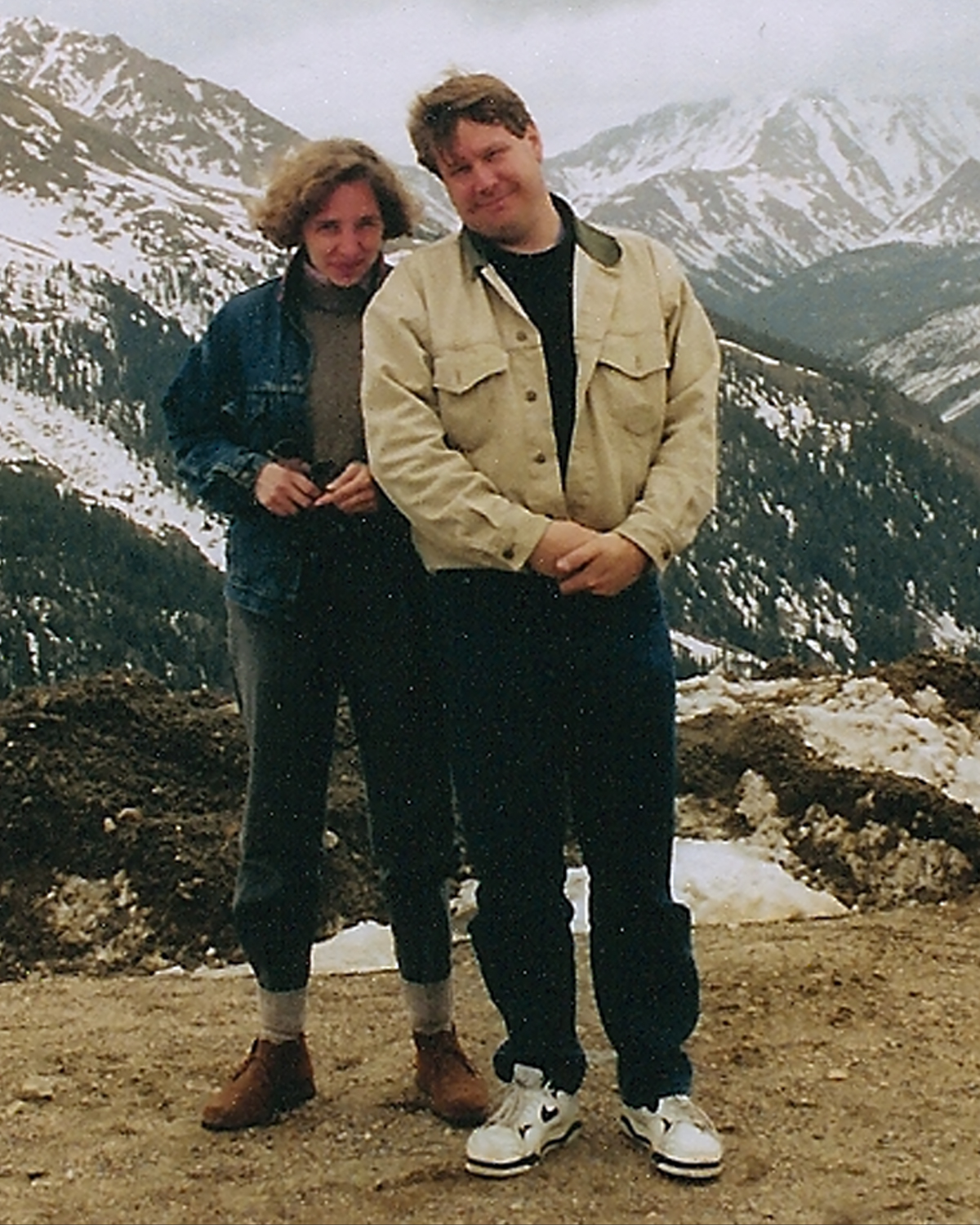
Note: The images of us are poor because they are taken from 35mm color negatives made in 1991, some of which were double exposed when the camera malfunctioned, and not printed until 2008. In the intervening decades, they acquired the dust which appears in the prints and subsequent scans.

You Are My Sunshine

Miniature painting, probably 1815-1820. Private collection.

The best things turn up when I’m looking for something else entirely. First came the miniature, now in a private collection, with the lovely carnelian or coral jewelry and the bright yellow dress. I’ve got some yellow cotton with a red and black print pattern in the cupboard, so this dress seemed within reach.

And then, while looking for something else, I found the right fabric! Not that I can buy it, mind you. It’s already owned and in use, in a gown at the Philadelphia Museum of Art. And not that I haven’t spent some quality time searching the interwebs for similar fabric, which can be found if you look hard enough. Fortunately, better sense prevailed and no cupboard will burst with an additional five yards of block printed silk.

Woman’s Day Dress, English, ca. 1820. Yellow silk brocade exported from India. Philadelphia Museum of Art. 1996-164-1a,b

Still, the fun bit is finding two such similar thoughts, one in paint and one in cloth, without even looking. that means there are more bright yellow Federal or Regency gowns out there. All it will take is the looking.