
“shop medicines, ointments, and salves”

Part three of a series
So what did Elizabeth Weed prepare and sell? What remedies were used and preferred in 1777 Philadelphia? And where to look?

The ad is explicit: “The Syrup and Power for the flux, the Syrup of Balsam for coughs and colds, the Royal Balsam, the Bitter Tincture, the Essence of Tar, etc.”

Margaret Hill Morris used William Buchan’s Domestic Medicine as one of her references, but receipts for cures can be found in The Compleat English Housewife, and Hannah Glasse as well. I’ve held a fascination with tooth cleaning and hygiene for some time, so this project was a natural outgrowth of those interests.

Fortunately, ingredients were pretty easy to come by (many already in my kitchen), and a sacrificial pan had been created making wax blocks for sewing kits. We started experiments in earnest October 6th, after coming home from the Draken Harald Harfårge. We did not fully anticipate how much one of the decoctions would smell like the Draken.

Tar Water was particularly intriguing, since it had been prescribed to John Francis, son of Ann Willing Francis (and eventual husband of Abigail Brown). Francis suffered from poor health, and he and his wife, and mother, all recorded the use of “tar water” in diaries and letters. Eventually I found a receipt that cured me of the notion of drinking tar itself: Tar, two pounds; water, one gallon. After standing to settle for two days, pour off the water for use. 

Well, there it is: water infused with essence of tar, which turns out to be “best Norway Tar,” or pine tar. Decanted, it smells like ships’ ropes coated to protect them from sea water.

So there are recipes to follow (even some of Elizabeth Weed’s own, recorded in the back of Thomas Nevell’s day book); but what does a shop look like? What bottles, pots, jars, and labels are used? The backgrounds of satirical engravings provide some guidance (and some hilarity).

In the background of the print at left, we can see some of the furniture and equipment of the pharmacists’ trade. Wooden pharmacy chests with drawers for ingredients; glass bottles above, with round-topped stoppers; above that, ovoid storage jars, possibly Delftware, for the storage of additional dry materials. A large mortar and pestle sits on the counter in front of the drawers.
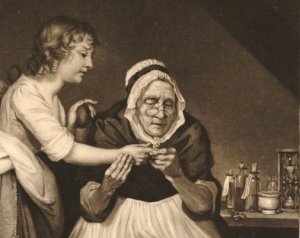
Smaller, labeled bottles sit on the table of the Village Doctress, along with an ointment pot (gallipot), as well as scissors and an hourglass. These similar, but simpler, tools help us recognize the lower status of the “doctress” relative to male doctors (as do the way she’s depicted, hunched over her patient, in lappet cap and black neck handkerchief or mantelet, placing her as widowed and aged). With the inheritance of her late husband’s medicines and goods, where does Elizabeth Weed fit between the doctor and the doctress? While it is impossible to say with certainly, it’s likely her material surroundings, and the equipment she had to use, was closer to the well-kitted pharmacy of the “Quaker doctor” print than to the “Village Doctress.”

“may depend on being supplied”

Lady Anne Stewart. oil on canvas by Ann Forbes, 1774. National Gallery of Scotland, NG 2036

Part two of a series

A newspaper ad can be a rickety thing on which to build a persona when it’s not a runaway ad. Those will give you what the person is wearing, who is advertising for them, and sometimes the skills they have. To better understand Elizabeth Weed, I turned to genealogical and contextual research.

George Weed’s estate was settled by Elijah Weed, his son by his first wife, Esther. Altogether, it was worth £1268.19.7, a considerable sum in 1777. Granted, £775 was book debt, but that cash could be called in. The remainder consisted of £132.15.2 in Medicines etc.,£100 cash, and £261.3.9 in Goods and Chattels. Of this estate, widow Elizabeth kept £55.8.3 in Goods and Chattels, all of the Medicines etc. and £50 in cash. That’s all of the medicines, 20% of the value of the “Goods and Chattels,” and half the liquid cash of the estate. This would certainly provide the supplies and capital necessary to continue the pharmacy business.


Morris, Margaret Hill, 1737?-1816., Margaret Morris / Morris Smith, pinx’t ; eng. by J.M. Butler. Library Company of Philadelphia.

But what was life like as a woman in business? How many women were in business in Philadelphia in the last quarter of the 18th century? More than you would think– mostly as shopkeepers selling dry goods, some as tavern keepers, and others as nurses, midwives, and healers, including women acting as pharmacists and “doctresses.” Patricia Cleary’s article “‘She Will Be in the Shop’: Women’s Sphere of Trade in Eighteenth-Century Philadelphia and New York” published in the Pennsylvania Magazine of History & Biography Vol.CXIX,No. 3 (July 1995) was particularly helpful in understanding women in trade.

Another useful resource was Susan Brandt’s “‘Getting into a Little Business’: Margaret Hill Morris and Women’s Medical Entrepreneurship during the American Revolution,” published in Early American Studies, Vol. 13, Number 4 (Fall 2015). Margaret Hill Morris practiced as a pharmacist and healer in Burlington, New Jersey, worried lest she “spunge” off her relatives, and anxious to support herself as a widow with a son. (Morris was the sixth daughter of Dr. Richard Hill of Philadelphia, and presumably learned some of her trade from him. Quaker women were well-educated, and participated in the scientific and philosophical life of the city. )

Brandt’s article raised helpful questions to ponder: would Elizabeth Weed have taken food and firewood in barter for medicines? During the Occupation of Philadelphia, food was scarce and exorbitantly priced, and she was feeding not just herself but also her son George, born in 1774. How difficult was it to obtain medicinal supplies when the harbor remained closed (in part because of chevaux des frises built by Thomas Nevell)? When patriots fled the city ahead of the British, did Weed’s trade suffer? Did she conduct business with the British, and how did her friends and neighbors react if she did? Only some of those questions can ever be answered. For the rest– about Weed’s particular business– we can only make inferences based on other accounts.