Down and Out in Upstate New York

Other folks have covered aspects of this past weekend at Fort Ticonderoga, leaving me with little that needs adding but much to look into. Portraying a British servant is more intuitive for me than portraying an American: the hierarchy of the British is more explicit than the American, especially in a military context. We mimic the British structure, and while I considered that running a fort’s servant set might/should/would mimic that of a Big House, I wonder if that’s true.
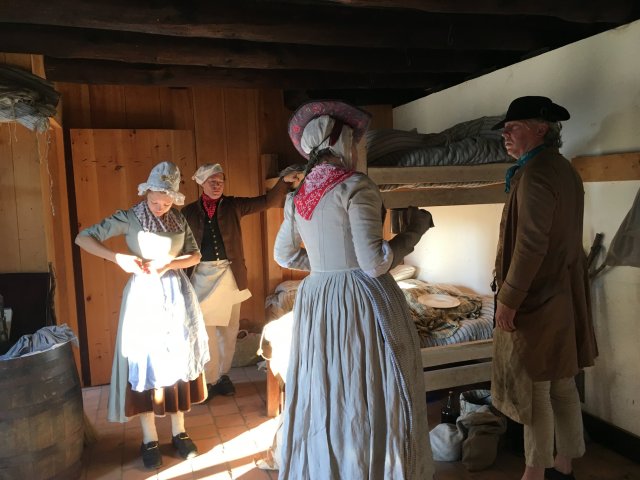
 

Miss S, Mr. B., Your Author, and Drunk Tailor

How did a set of servants from different places, answering to different masters, interact? What  kind of rivalries developed? And who had ultimate below-stairs authority? It’s been a long time since I experienced workplace politics, so the past weekend gave me much to ponder about how the lower sorts managed– and managed up.

For me, the name of the serving game is managing the people you serve to make your own life easier. Servants had so much to do– as many of us do in real life– that the only way to manage the workload was to– well, manage the workload, or at least the person who set it.

As John Brown’s housekeeper, I ran a household of several (three+) servants and six residents. Even a household that small required extensive stair climbing and coordination, even without a working kitchen! The Browns never had more than three or four household servants we could document, which again makes me wonder about the actual number of servants a complement of New England officers would have.
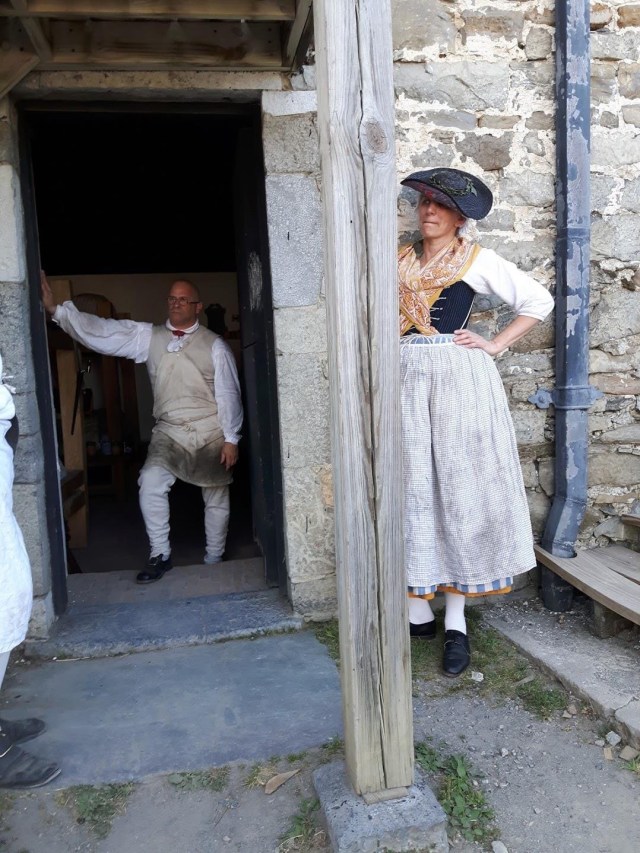
Ow. That’s what my face means. Pierre was a trooper.

Thus far, I’ve found good quantification of servants in Philadelphia households in 1775, but have yet to crack the code on New England or Continental Army servants, so more hours on JSTOR await.

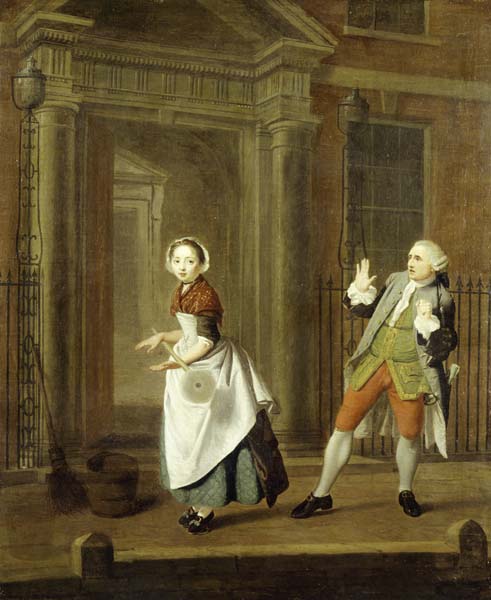
Paul Sandby. At Sandpit Gate circa 1752
Pencil, pen and ink and watercolor. RCIN 914329

No matter what one ultimately decides the research shows about the number of servants and their roles in an American occupied fort, I know I spent the day more immersed than I have been in a long time. Fort Ticonderoga provided a picturesque backdrop, and my body provided a four-dimensional pain experience reminding me of the tribulations of women in the <cough> period </cough>. I spent the majority the day (the part I was awake, anyway) experiencing the full joys of being  female and still fertile. The more I read about archaeology of the 18th century, particularly in the privies and trash pits, the more I think nearly everyone in the past felt pretty awful most of the time. If that hunch is correct, I nailed Saturday despite appearing in undress (which I can at least document to Sandby at Sandpit Gate).

Luxury and Fashion


Sometimes this is a hard hobby to love. My hands hurt, my creativity feels dead, and there’s no place to go all dressed up. After a long, unpleasant spring, I finally feel like sewing and playing. Drunk Tailor and I definitely missed some things we very much wanted to do, but now we’re reinspired, we could take baby steps back to our normal semi-hectic pace– except of course, we are plunging back in with three events in August after a whirlwind trip to Ticonderoga.

Wedding dress in cotton muslin ca. 1797. Nationalmuseet Danmark.

With the summer heat in mind, I ordered batiste and voile, thinking I would make the Tidens Toj gown, but when the fabric arrived, it seemed that the purveyor had confused the two fabric types, so a new plan was required. Alas, the trials of costume research and falling down the fashion magazine rabbit hole for hours at a time…

1798 Gown, watercolor by Ann Frankland Lewis, 1798. LACMA, Costume Council Fund (AC1999.154.1-.32)

Next up: an open robe or wrap-front gown over a matching petticoat, trimmed in blue-and-white Greek key trim, with a pair of pointy-toed ribbon-tied slippers and a sleeveless blue silk waistcoat, in three weeks or so.

The waistcoat construction is finished, scaled up from the original garment patterned in the DAR’s “An Agreeable Tyrant” catalog. I chose to line mine, possibly from pure habit of making men’s clothing, possibly because I’m not that great a teeny-tiny hemming and require a lining to hide my sins. With gold silk cord trim and covered buttons, I think it will have a pleasantly military vibe.

For the gown and petticoat, cotton in Virginia’s August heat seems like a solid choice, though by the time the layers are on and the sun is up, it’s possible that nothing will be really cool. (The majority of the day will be spent in air conditioning, so really, anything would be okay.) The trim arrived last night, and has a body that will need batiste (and not voile) for support. The combination causes me to entertain fears that this aesthetic is a little too boat-shoes-and-belts-with-embroidered-whales for 1797-1799, but when topped with something not unlike Drunk Tailor’s militia cap, the aesthetic will tilt from yachting to the Good Ship Lollipop.

In Defense of Bad History

A City Shower. Oil on canvas by Edward Penny, 1764. Museum of London

Not inaccurate or badly researched history, of course, but the “Mad, Bad, and Dangerous to Know” kind of history.

Without wading into the murky waters of canceled reenactments (not my time periods– yet!) and the politicization of historical facts, I advocate the recreation of the “bad” people of history. Not the Hitlers and Himmlers and Stalins and Amins, but the everyday bad. The lazy. The feckless. The annoyed. The I’m-just-now-waking-up-to-the-bad-choice-I-made.

The Female Orators. Printed for Jno. Smith, No. 35 Cheapside, & Robt. Sayer, No. 53 Fleet Street, as the act directs, Novr. 20, 1768.

I think about these people– the ones who slack off while working, the ones who steal shirts, assault officers, throw bones out of barracks doors— periodically, especially when an event is being planned. It’s not that I don’t want to work, mind you: I enjoy working, even the cleaning and scrubbing of history. But it strikes me, especially in summer, that we approach the recreation of history with such excellent intentions. We will Do Our Best. We will Lend A Hand. We will be Always Cheerful.

Why? Why do we not represent the people who shirked? Why do we not represent the people who resented being told what to do, and when? Why do we not take into account our industrialized notions of labor (shifts, clocks, production levels( when we step backwards into a period where there was no factory whistle to set the pace?

painting of a shabbyily dressed family in a decaying room
The Miseries of Idleness. Oil on canvas by George Morland ca 1788. National Gallery of Scotland, NG 1836. Presented by Alexander and Lady Margaret Shaw, later Lord and Lady Craigmyle 1935

Granted, within a military environment, there are rules, regulations, clocks, and enforcers. But I cannot help thinking that the pace of labor, the speed and drive with which people tackled tasks, was different one hundred, two hundred, three hundred, years ago. Of course there were strivers and doers: the American army in the Revolution was populated by adherents to piety and discipline. But it’s clear from the orderly books that there were miscreants and slackers, too.

painting of a well dressed family in a cozy farm house kitchen
The Comforts of Industry. Oil on canvas by George Morland, before 1790. National Gallery of Scotland, NG 1835. Presented by Alexander and Lady Margaret Shaw, later Lord and Lady Craigmyle 1935

And I’m not saying everyone should be a slacker, but you know as well as I do that every workplace today has a slacker or two: the long-term federal employee who watches football at work; the retail clerk whose breaks last a little longer every time; the shelver in the library who catches a nap whilst shelf reading. There are consequences (usually) for those (in)actions, and that’s kind of the point. The slattern and the slacker of history throw into higher relief the purpose of the discipline an army (or housekeeper or master cabinet maker) is trying to maintain. When we all strive to do our best, we lose the depth of interpretation that doing “bad” history can provide.