A Six Word Story

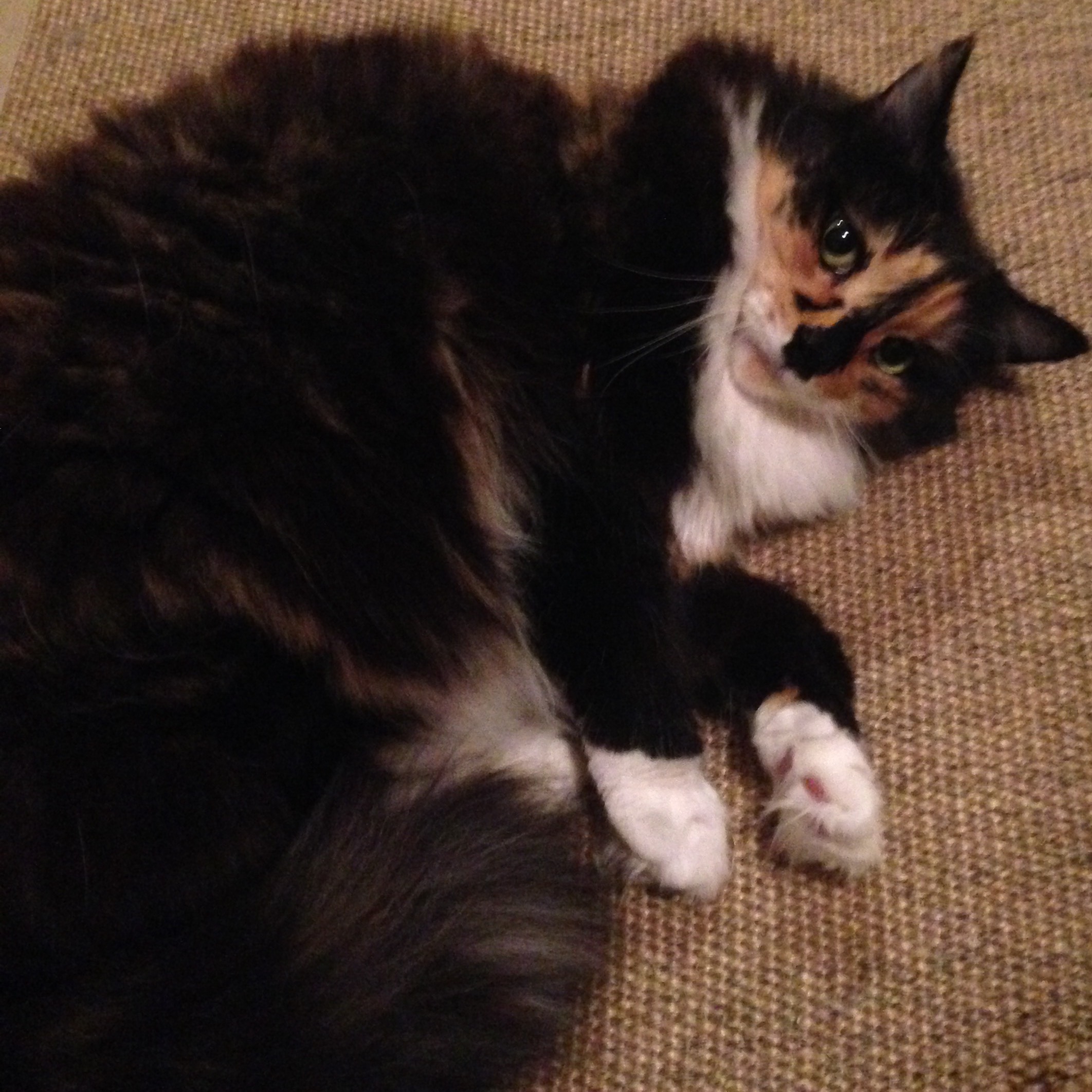
Lady Cat, AKA Lucky Edie, in her floofy prime

Six word stories. They’re foundation exercises in many writing classes, especially flash fiction classes. The most famous is probably Hemingway’s: “For sale: baby shoes, never worn.” So much packed into those six words, eight syllables. You can imagine a family, a room, clothes, a place of worship, a coffin, emotions. (Or a family, a room, an angry child, bare feet, and a pair of rejected multi-coloured sneakers if you’re me, who had a child who channeled his great-grandmother and thus was incredibly picky about his shoes at 16 months and refused to wear anything except solid red Keds.)

But I digress.

I have a six word story for you: My cat is dying of cancer.

Lady Cat on Sunday

Lady Cat, Lady Bird, Flirty Birdie, Lady Fat, Lucky Lady, Lucky Eatie: She has had many names since we scooped her up from the back yard of our Smith Street 3-decker in 2005 and brought her on up to the East Side (it is possible to literally re-enact The Jeffersons’ theme song in Providence). She was born under a sheet of plywood against a garage behind our house, one of three fluffy kittens born to a short-haired calico mother. She and her litter mates were like a dessert tray: one fluffy and biscuit coloured, warm, light brown; one, vanilla-cream coloured, soft ecru; and Lady, rocky road ice cream, pastry, caramel, cream, and chocolate, with a stripe down her nose like a monkey.
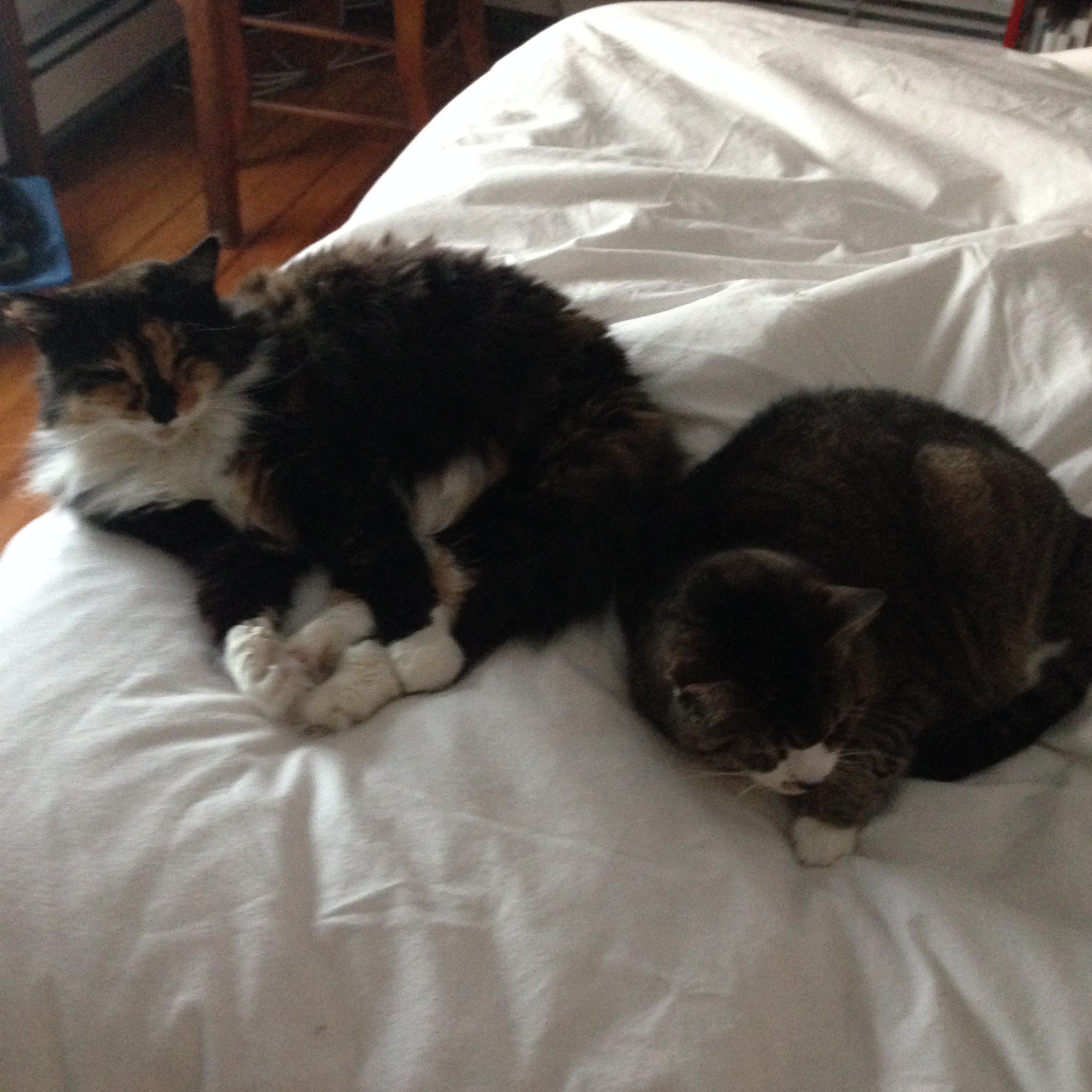
Lady and Socks: prelude to peace

She wasn’t easy to catch, but I managed, on the very last day we would ever be in that apartment, caught her and wrangled her into a cat crate where she spun around like the Tasmanian Devil in the Bugs Bunny cartoons. Eventually she settled down to watching me and the movers hustle the last pieces out of basement on onto a truck, and made the trip over the river and up the hill to a new, larger house.

As my son struggled with spelling homework, Lucky Lady and her arch-nemesis Whiskers (the cat who lived in the house behind us) became the stuff of legend– Whiskers more than Lady, but every week, as Whiskers stole doughnuts from dinosaurs, was stopped by the police, or generally misbehaved, Lucky Lady would often save the day, once by socking Whiskers with her powerful paw. Whiskers and Lucky saved us from second grade.

Dignity. Like Gene Kelly– and just as acrobatic.

Found feral, she was never fully tame, though she made decisions about not venturing outside in the snow again (after a night out in the cold) and she learned not to jump against the screens trying to get at Whiskers (she fell out of the first floor window once). We brushed her, and she adapted after the first few times, when she hissed and bit at the brush. She loved catnip, and eating feathers (I learned to keep my millinery supplies in a cupboard), and chewing wool (I learned to keep my wool in a cupboard). She learned, and we learned, and she is ours and we are hers.

One year, she got lasers for Christmas.

Now that she is terminally ill, we do what we can for her. She eats Trader Joe’s tuna for cats because she can keep it down; she drinks CatSure (she prefers premixed to powder mixed); we give her catnip. Sunday night she did not know what to do with the catnip, and ultimately fell asleep in the catnip without enjoying it.
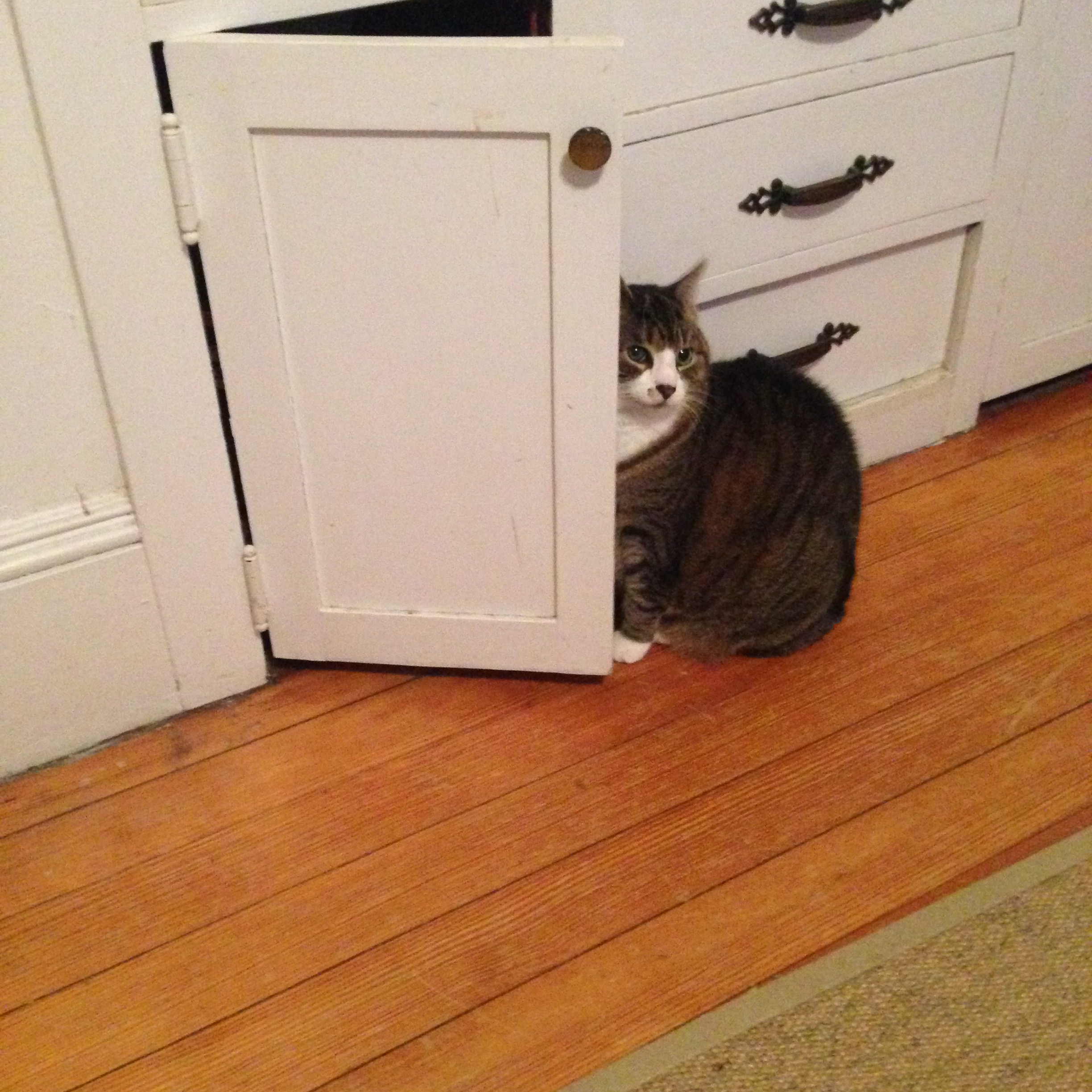
Socks, checking on the Time Machine

Her adopted sister Socks (the one-eyed, wobbly, film noir-loving, Nazi-hating tabby cat known as the Howling Assistant) died last summer. Lucky Lady will die soon, too, though we will keep her as comfortable as we can as long as we can. It’s hard to say how long it will be, and I feel wrenched and torn as I contemplate what Lady must endure and how much I will miss her, the last living connection to Providence I have with me in Alexandria. She’s more than a symbol, of course; she’s an independent being. But when Lady dies, a little part of me will go, too, and the past, and New England, will seem even farther away.

Living Deliberately

WCD: The Original

A friend of mine recently wrote about replicating the domestic life of the past (specifically the 18th century) and how much meaning that had for her.

Being so deeply embedded in the rhythms of life there, it became my home in a very real sense that has never left me.

I read that quickly, and what I read was that the place she had spent so much time was home to her because the place never left her– she carried its rhythms and seasons within her. Perhaps that isn’t quite what she meant, but that’s the risk of writing: the reader reads what they need to.

It made me think of home, and of living deliberately, and of a very bad year I had a long time ago, before I even imagined doing living history, when I thought I would spend my life making new things, like cities and buildings. (This makes me think of an album I listened to at the time, More Songs About Buildings and Food, which seemed all the more important because I’d gone to RISD, too.

Food, in a Building, in Rhode Island

The year I turned 25 was particularly bad not because a man broke my heart, though that didn’t help, and not because I had a miscarriage, though that was the catalyst that led to the man breaking my heart, but because the miscarriage shattered my sense of purpose and self. Somehow, everything that I had ever wanted to be — a sculptor, an architect, a writer– was gone, and I didn’t know what to do or how to be. (Read The Year of Magical Thinking if you want a well-written take on this kind of loss.) I didn’t know what to do next, but the man who eventually broke my heart gave me a book to help me figure it out: Chop Wood, Carry Water

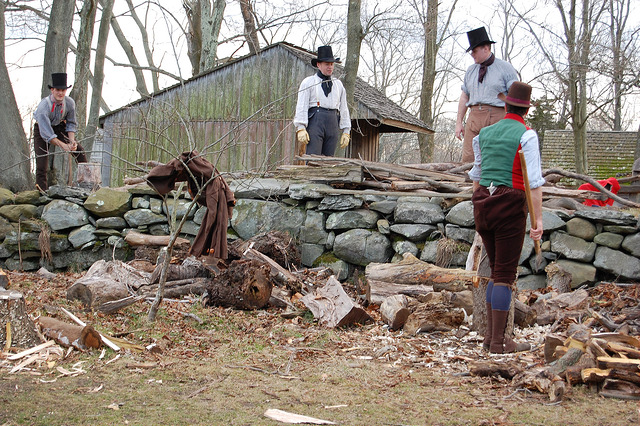
Chopping wood.

Two years ago, I wrote a piece called Zen and the Art of Living History, in which I extolled the virtue of the everyday: Embrace the everyday, bring everyone back into history. Since then, I’ve thought more about how history and historic house museums can be a catalyst for change, how domestic sites can create “homes for history,” where we can have the difficult conversations that must be had to make the change I think we need as a nation, and as humans. These changes are happening, slowly, in museums and at historic sites, but even at the personal level, there’s meaning and change to be had through the business of “doing history.”

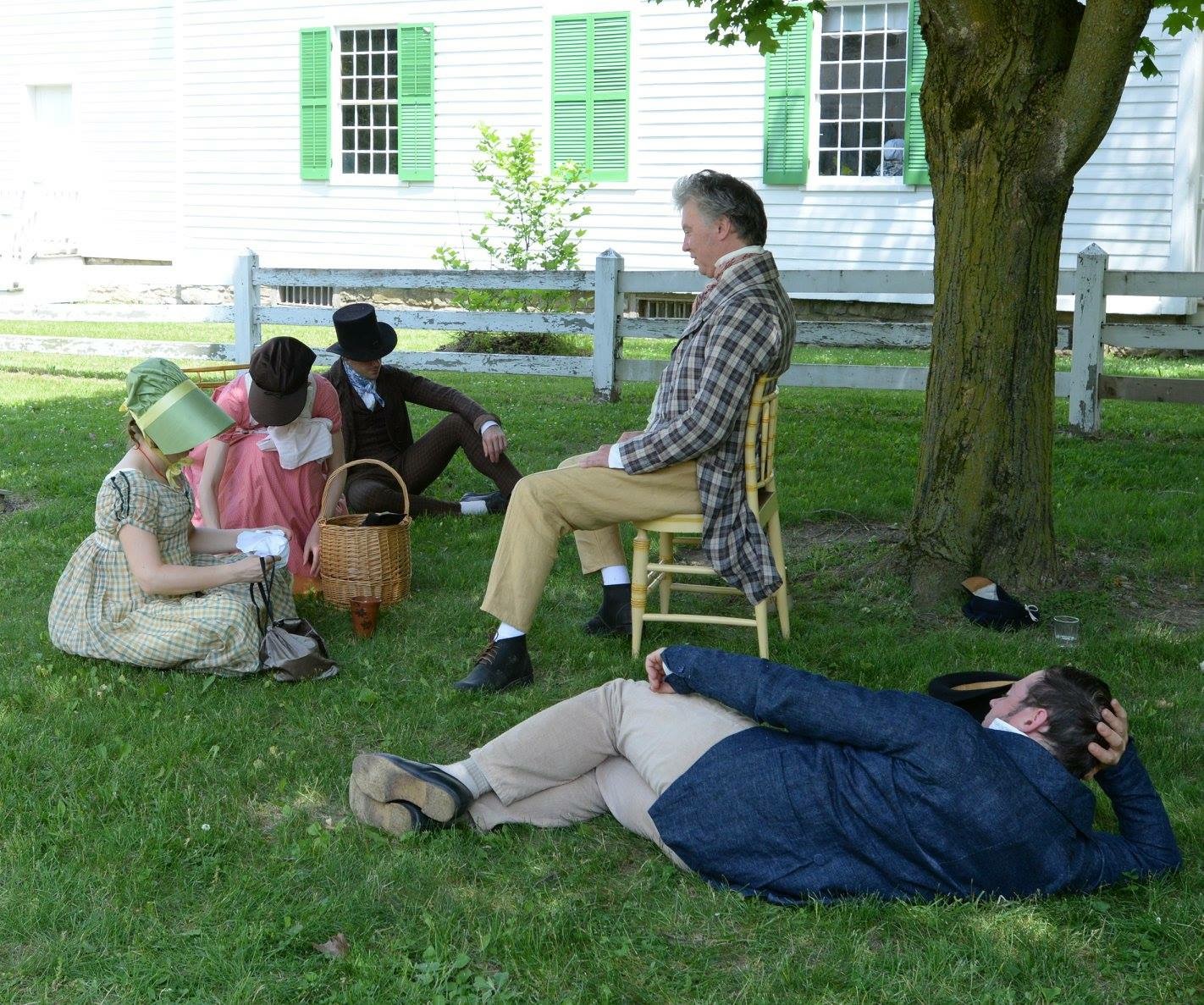
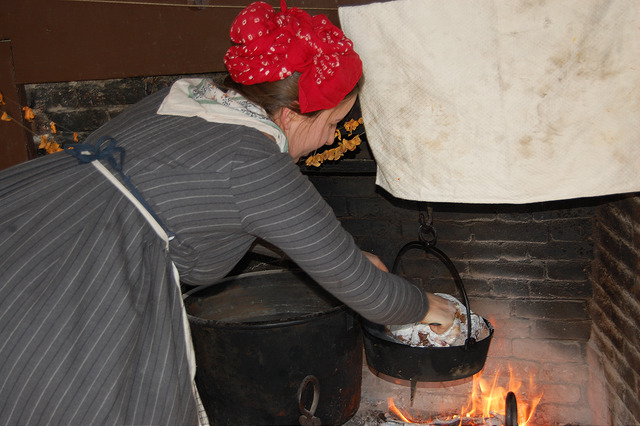
I suspect that among the reasons people really enjoy immersive, civilian (non-musket) events is because the work brings them into the rhythms of the natural world in a way that industrial life precludes or even prohibits. Consciously or not, interpreting the domestic life of the past forces us into mindfulness, into being as much as or more than doing. That’s the point of “chop wood, carry water:” to live deliberately. To cook without a clock, with only the color of the coals and the smell of the food to guide you; to notice the changing light because, as it fades, you must act to create light; to find the flaws and shifts in a floor as you scrub it, because there’s no machine between you, just your hands and a brush or a mop: all these tasks force you to be in the moment, noticing your environment, noticing yourself. You. A corporeal presence in a material world. How does that feel, moment to moment? Physically, emotionally: the challenge of living in the past is to live an unmediated life.

To go back to basics the way we do with civilian or domestic-site based living history brings us back to our base: we face our physical needs and the challenge of meeting them. We face emotional tests that help us imagine how people in the past endured– I often wonder how everyday people coped with “melancholia,” grief, and disappointment– and help us endure. It brings us home to ourselves, to our individual histories and our shared histories, and that’s what really matters. The connection to the everyday that we experience in a place in time puts us in a continuum with the people of the past, and gives us a place to be, a thing to do, a meaning. And that is what every one of us needs.