Kits, Boxes, Sticks, and All

Jens Juel, Self portrait at an easel. Oil on canvas, 1766. Royal Academy of Fine Arts, Denmark.

Once again, I’m looking into artists’ materials and techniques, though instead of trying to kit myself out for the early Federal era, I’m digging into the last half (quarter) of the 18th century. It seems to be a time of rapid transitions in art materials as new pigments and media are developed. While Mr. Juel is beginning a work in oils, we still see some of the same tools that a watercolorist would use. Brushes, though his are shaped for working in oil; a shell, perhaps to combine pigment with medium, and bags of paint.

Before collapsible tubes were invented in 1841, artists scooped or scraped pigments mulled with medium into skin bags, secured them with twine or string, and then poked a hole in the bag to extrude pigment. Some more clever sorts would plug the hole with a cork– untying the bag would make more of a mess than a distribution system– but otherwise, you risked having your paint dry before you could use it up. Clearly there were some inefficiencies built into the system. (I think it also helps explain why “thick” paintings, that is, paintings using exuberant and textured layers of paint, do not appear until after collapsible tubes are invented and in wide use.)
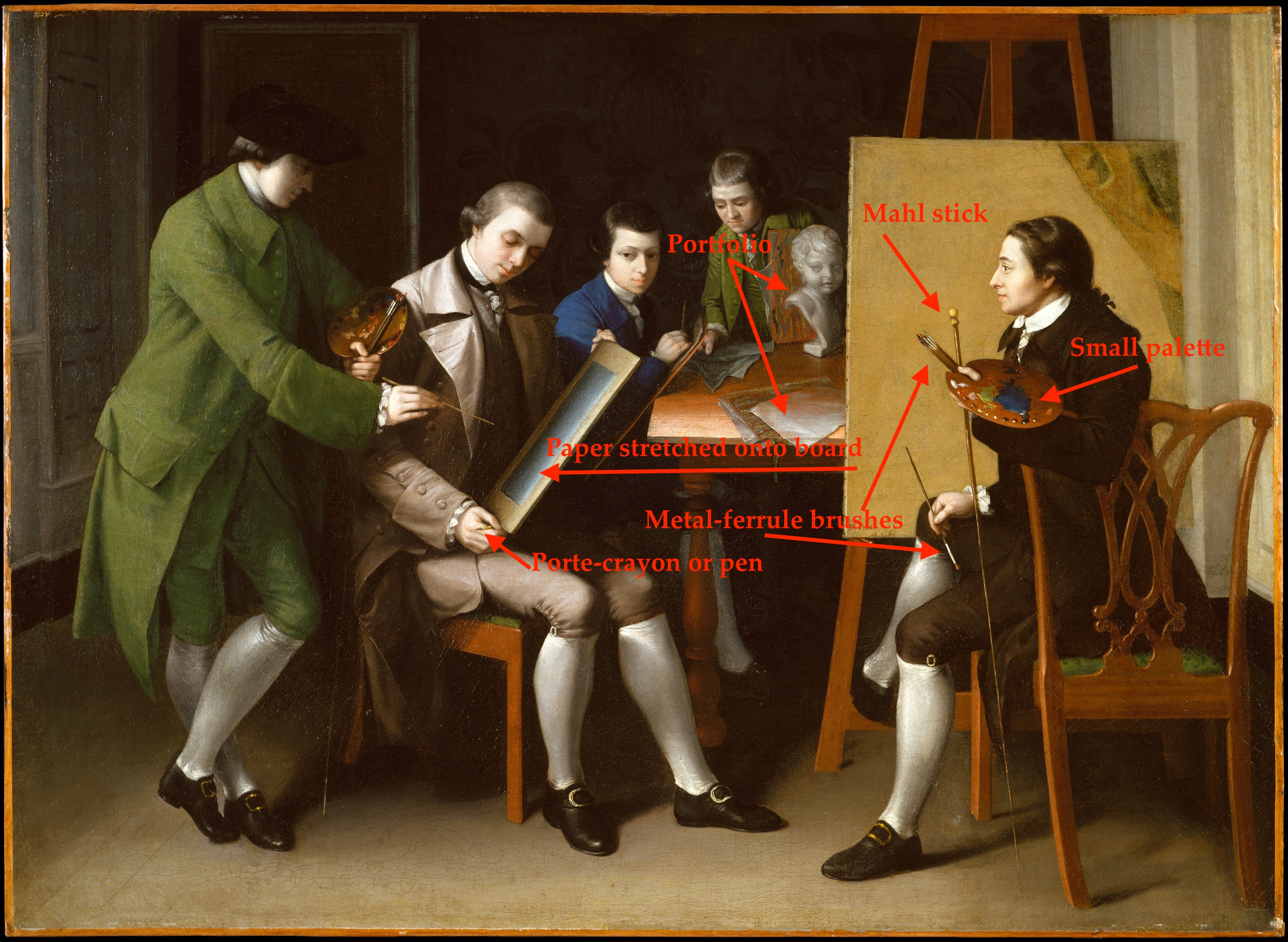
Matthew Pratt, The American School. oil on canvas, 1765. Metropolitan Museum of Art, Gift of Samuel P. Avery, 1897, 97.29.3

In Pratt’s American School, we can see how small the palettes are, and how small the dots of paint are compared to the pools where colors have been mixed. The easel, presented from another angle, offers clues to the adjustable pegs and triangular/tripod shape of the main support. But what of watercolors?

Winsor & Newton Old Paints: note the tiny bags of paint.

To date, I’ve found conservation reports more helpful than anything else, especially those analyzing paint content for sugars and gums. (One of the keys to watercolors was the re-wettable aspect of the colors; gum arabic, gum tragacanth and honey or sugar were ingredients used in varying proportions to achieve what we now take for granted.) The first watercolor cakes or blocks are introduced in 1780 by William Reeves; often, these were very hard, and had to be agitated in water (ground on a surface) to be used, much like sumi-e ink. Once paint was ground with water, it could be dried in a dish or container for re-wetting and later use. The question of course is, what do dry it in? How do you mix and use the paint?

Caroline Schetky Richardson’s Paint Box
about 1820–30. MFA Boston. 1995.156.1

Mixing is simpler to solve: a palette, of course. The small, dirty-looking oval in the image above is the ivory palette used by Caroline Schetky Richardson; while her box is 1820-1830, it’s still very similar to box in Charles Willson Peale’s portrait of his brother James (below). The box is 21 inches wide, 10 inches high, and 13 inches deep. That makes the palette something like 3 inches wide, if we take a drawer as five inches wide.

James Peale painting a miniature. Oil on canvas by Charles Willson Peale, 1795. Meade Art Museum, Amherst, MA

In the CWP portrait of JP, the slightly open drawer of the painting stand may be giving us a peek at his palette; the simple tumbler of water helps confirm that he is working in watercolor on ivory, and give us a sense of what kind of water container artists used– which, happily, can be more easily sourced than Mr Peale’s box.

Wrap it up, I’ll take it

To be honest, I would love to wrap my self up and take this silk, but it is for a museum to display, so instead the box is wrapped and ready to ship.

I was lucky to be included in a message group started by a friend asking if any of us had a banyan or wrapping gown to loan. Well, no… but I can make one!

So I did.

My version is based on this 1750-1760 example at the Victoria and Albert Museum, of silk designed by Anna Maria Garthwaite ca. 1740-1750. To be honest, this is one of my favorite gowns, despite the fact that it bears no practical relationship to any part of my daily or living history life. A girl can dream, though…

Just a little bit scary, despite being able to get more silk if I really messed up.

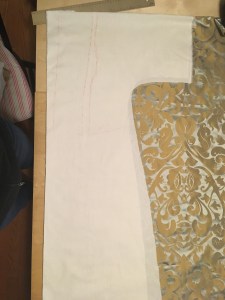
In particular, I like the way the style combines the t-shape of a basic banyan with the pleats used to shape European women’s gowns. Tricky, right?

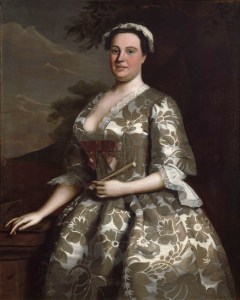
Ann Shippen Willing, oil on canvas by Robert Feke, 1746. Winterthur Museum Museum purchase with funds provided by Alfred E. Bissell in memory of Henry Francis du Pont. 1969.0134 A

I made a pattern in muslin (it took two) primarily by draping, reading the V&A description, and looking at the original images as large as I could get them. By the time I had a pattern, I was mostly convinced, but still intimidated by the silk. I’ve had my eye on this ever since I saw at the local store, for it reminded me strongly of the Anna Maria Garthwaite silk worn by Ann Shippen Willing (Mrs. Charles Willing) of Philadelphia in this portrait by Robert Feke.

In the interest of economy, I machine sewed the long seams and the interior (lining) pleats, though I would not if I wear to make this for myself. Once the main seams were done, I pleated and pinned again.

Then it was time for my one of my favorite activities, hand-stitching pleats. It’s impressive how the look of a garment changes (and improves) as you continue to work on it. The fullness of the gown with the inserted pleats is pretty impressive and very satisfying to wear. It sounds fabulous as it moves with your body.

Once the gown is fully dressed on a mannequin (that is, over a shift and petticoat), I know it will assume the more correct shape of the green gown at the V&A– it looks better even on me, although it is too small, being made for a mannequin representing an 18th century woman.

Portrait of a Woman Artist, c. 1735
Oil on canvas
40 x 32 5/16 in. (101.7 x 82 cm)
Restricted gift of Mrs. Harold T. Martin in honor of Patrice Marandel, 1981.66
Art Institute of Chicago

Along the way, I found another green silk wrapping gown or banyan, this time worn by a French artist.I can guarantee you I would never wear silk to paint in, but your mileage may vary, and if I had a maidservant and unlimited cash in 1760, perhaps I would emulate the Mademoiselle at left.

Same as it Never Was

I wrote this two years ago and never published it (I was still looking for a job at the time). It’s still relevant. 

Every time I go to a museum, I see a lost or wasted opportunity: galleries where connections aren’t made to collections I know an institution owns, changing galleries featuring a seemingly endless rotation of amateur local artists instead of meaningful interpretation of local objects– or, better yet, a show challenging those same artists to react to a museum’s collection. The same is true of many reenactment events.

Pepper-Pot: A Scene in the Philadelphia Market
John Lewis Krimmel, American (born Germany), 1786 – 1821. Oil on canvas, 1811. Philadelphia Museum of Art, 2001-196-1. 125th Anniversary Acquisition. Gift of Mr. and Mrs. Edward B. Leisenring, Jr., 2001

I remain deeply frustrated with the way reenacting can use documentary evidence– which rarely includes women– as a means to perpetuate 18th century misogyny in a 21st century setting. The same evidence means events often lack enough children, African Americans, American Indians, and other non-white people to create an accurate vision of the past. We know this because the demographic evidence exists, even when a manuscript fails to mention a mixed group of people in a specific place and time. (When an 18th century newspaper account uses the word “people,” you can bet that the group described included women and non-white men; if the account is about “men,” then it’s white men. Language is always coded.) The changes in the past years to include more accurate working class impressions go a long way towards creating a more nuanced vision of the past, but we’re still stuck with scenes that lack the complexity of the past.

My discomfort with this bothers me greatly. To what degree is my dissatisfaction also grounded in the understanding that recreating events in small, stagey spaces and times can de-contextualize a historical event, ultimately rendering the experience shallow and ritualistic, leaching it of meaning?

To what degree does our fixation on the appearance of participants (clothing standards) over interpretive standards or research materials serve to perpetuate shallow, surface-only events? And does the smallness of events create a zero-sum game in which someone’s talents will always be wasted, unused, and unrecognized, further feeding resentment of the “progressive” reenacting culture, sometimes even by its adherents?

All of that seems so over-thought, but in the midst of overthinking, and while deeply admiring Not Your Momma’s History on Racked, I thought about the critiques I read on @twitter, especially the part of #blacktwitter I follow, and I had a more important thought: Lead, Follow or Get Out of the Way.

Maybe it’s time for the white women to get out of the way, and to expend our energy supporting the people who aren’t included at all. Maybe I need to STFU and invest my energy where it matters more: helping ensure the really unheard voices are heard. Cheney McKnight, Dread Scott, and Michael Twitty all have important things to say about history- American history, African American history- that, at this moment in time, matter far more than what I have to say. Go follow them. Make a difference.

Night Clubbing

Mountebanks at night. watercolor by Paul Sandby, 1758 Royal Collection Trust/© Her Majesty Queen Elizabeth II 2014

Mountebanks and miscreants: how we love them. I have found myself in a situation of late that feels altogether too much like high school, and as a means of understanding it, I have a story to tell. It will, sadly, confirm what my parents thought was happening, but hoped was not.

Let’s step back to the time when I was known as the Rat, when I spoke truth to adolescents and paid the price of ostracism and harassment. I was already largely outside whatever cliques there were in high school, for I’m not certain you can call an assemblage of despised literary hopefuls in a hallway window seat a clique, so the harassment hurt more than the exclusion. Harassment these days comes not in the form of people chanting at you in person, but rather in online trolling, which can be deleted, unless people take the energy to rise to doxing or swatting, and few in the living history world seem to– and that’s not a challenge, kids.

So, operating within a loose-knit band of misfits more Donnie Darko than Ferris Bueller, I began breaking the rules, taking films back to the public library for my teachers and spending the rest of the day at the art museum or bookstore, or combing thrift shops for my nearly-all-vintage wardrobe. I could not find a place to be, so I stepped out.

Naked Raygun at the Metro (not the club in question)

Along the way, I met some very interesting people: punk musicians, artists, dancers, and students who introduced me to a very different world than the one my classmates lived in. It was a kind of mid-western Desperately Seeking Susan, or perhaps Something Wild, only I suppose I was Susan seeking myself. I saw great bands and terrible bands, and continued my forays even after I’d left the city for college, which leads me to a moment that resonates fiercely with me in light of the past few days of highly localized re-enactor drama.

portrait of a wanna-be-artist

I had a sometime-boyfriend who was ahead of me in college, at a different university, who worked as a DJ in northside night clubs. On one summer trip to the city, I found myself walking out of a nightclub where I’d been dancing, eager for some fresh air. At the door were two of my former classmates– too much acquaintances to be called frenemies– trying, and failing, to get in. I caught their eyes, agog, as I walked out.

“You come here?” one asked. “How’d you get in?“
“I know a guy,” I said. “I’ve been coming here all summer,” and walked up the street to catch the bus to the next party.