A selection from the box, mostly documenting the first two decades of my mother’s life
Mumblety-odd years ago, my first museum job was in a photograph and print collection, working as a photo researcher both finding and processing collections. There was a voyeuristic quality to the work, sometimes when going through a photographer’s more personal images, but especially when working on a family collection.
As I continued to work in the field, I started meeting with donors, and learned to talk them into giving their collections to the museum. It was easy enough to talk to them about making their memories tangible, creating and preserving a legacy of their lives so that others could understand the past and the contribution they, in particular, had made. How they typified an important part of a state or region’s history.
Susie the Cat makes many appearances
Sporadically, I organized my own photos and ask my mother for images of our family. I certainly took plenty of photos of my own son, but as time went on– and whether this is due to smartphones or trying to live in the moment, or not wanting to break the magical spell of an experience– I stopped taking pictures. I could still talk people into donations, and still enjoyed going through their family albums, but recording my own life didn’t make much sense to me, and I began to consider pitching images and letters and postcards, especially as I packed to move south. Keeping photographs for myself didn’t make sense.
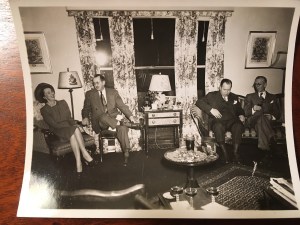
Federal furniture: always central in my family
Sitting in bed on Friday night, Drunk Tailor and I looked through a box of snapshots my mother keeps in a fabric-covered box. He said, “Photographs are what you use to show people what you used to look like,” and to a degree that’s true. They are also proof that you had a life before this moment (think Blade Runner) and proof– perhaps– that you are who you think you are (think Blade Runner 2049). But even more like the Blade Runner movies, photographs of your past, or your family’s past, tell you where you come from, and where you might belong. Love them or leave them, you fit in somewhere in a larger story of people, and that shapes your identity, what you do, who you love, and how you live.
1936: My grandmother’s wedding.
As every year ends, I look back with some sadness at things I wish I had done differently, people I wish I had not hurt, people I wish I’d hugged more. The box of snapshots reminds me that I’m all too common, all too normal. Everyone has those pangs of nostalgia, the words they wish they’d said, the loss they feel as they lose the people they love.
Francois-Robert Ingouf after Sigmund Freudenberger (French, 1747 – 1812 ), La soiree d’hyver, 1774, etching and engraving, Rosenwald Collection 1943.3.4377
Details. It’s all in the details, right? I see this print multiple times every day, and contemplate the little stories in the details of the room.
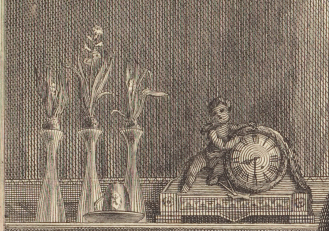
Francois-Robert Ingouf after Sigmund Freudenberger (French, 1747 – 1812 ), La soiree d’hyver, 1774, etching and engraving, Rosenwald Collection 1943.3.4377
Perhaps the first thing I noticed that jarred my eye (and my thinking) was the row of glass vases for forcing bulbs. They look so modern, don’t they? But the shape is classic– form following function– and findable today. How pleasing that my mother’s winter ritual of filling windowsills and mantles with forcing bulbs can be visually documented to one of my favorite eras–and was, indeed, common in the past. This is one of those “everybody did it” ideas I can endorse.
French François Linke Louis XVI Style Gilt Bronze and White Marble Clock
Francois-Robert Ingouf after Sigmund Freudenberger (French, 1747 – 1812 ), La soiree d’hyver, 1774, etching and engraving, Rosenwald Collection 1943.3.4377
What else is on the mantle? A clock, undoubtedly ormolu– though it could be much worse. And yes, the cupid on the clock has meaning in this print.
And then there’s this: the hot water urn– or is it?
Tucked into the fire place, I was initially pretty sure that’s a hot water/tea/coffee urn, meant to go with the tea or coffee cup on the mantle (see above; it’s in front of the bulb vases). Hot tea or coffee would be welcome on a cold winter’s evening, and the water would stay warmer tucked close to the fire.
Francois-Robert Ingouf after Sigmund Freudenberger (French, 1747 – 1812 ), La soiree d’hyver, 1774, etching and engraving, Rosenwald Collection 1943.3.4377
Tea urn. Silver, by John Carter II. 1773-1774. Metropolitan Museum of Art, 11.28a–f
18th Century Cast and Wrought Iron Fireplace Fire Grate
But it could also be a decorative fender, ornamented with urns at the ends. The fireplace grate shown here is English, made ca. 1780 according to the seller) but should you have space cash burning a hole in your pocket, there’s a similar 19th century reproduction of the one in the print for sale on the interwebs, should you care to recreate this image (I know some of you have the clothes). In fact, there are quite few fenders-with-urns, once you start looking, some in bronze and some in steel.
And what of this? Is that an 18th century dog house or covered dog bed? Yes, it is.
Dog kennel, by Claude I Sené, 1775-1780. Metropolitan Museum of Art, 1971.206.18
The bouillotte candlestand on the table is another nice household detail, illuminating a book lying open on the table set against the wall.
It has taken me some time of looking at period images to accept these candle stands as correct, since my experience with them was grounded in electrified reproductions in suburban Colonial Revival dens and family rooms– a location I will admit I was prejudiced against to begin with, having grown up in a city surrounded by architects devoted to (and buildings by) Mies van der Rohe.
But therein lies the point of looking: what initially seems absurd (Versailles-quality dog beds) or simply anachronistic (candlestands with shades) slides into place when seen and understood, within its proper context.
3. Be prepared to struggle.
The museum education field is not for the faint of heart, or people who want a 9-5 job. One of my mentors advised me that the days are long, but the years are short. The hours will hurt, you will get tired of the near-constant balancing act, and you might even question if you’re making an impact. Hang in there. Find your network (local, regional, or national). Share your vulnerabilities with people you trust. Delegate if you can. Most of all, document your successes and create a portfolio that illustrates why your efforts matter.
What is hidden between those lines? Be prepared for your life to be subservient to the needs of the museum? Be prepared to give everything– but document all you do because you’ll need to prove your value, no matter how much you sacrifice?
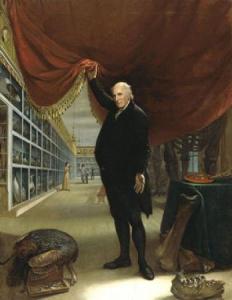
Saint Catherine, by Bernardino Luini. State Museum of Azerbaijan. (c) Stourhead; Supplied by The Public Catalogue Foundation. You will not achieve sainthood by sacrificing your sanity to a job.
Why would you put your work ahead of your life? (YES, I KNOW that’s not exactly what that post is suggesting, but that’s how it often ends up.) Encouraging people to work hard is good, but telling them they should expect to, and will, suffer isn’t good. That feeds the beast that chews up and spits out eager, idealistic young people on a routine basis. The museum is definitely not going to tell you it loves you, or visit you in the hospital. You need the time to build your own life, a circle of friends or family, interests of your own to feed your soul. And that means you will need boundaries, and need to have some “evenings, weekends, and holidays” when work is not required or expected– though I know that those hours are required and that people have to work them because they need the money.
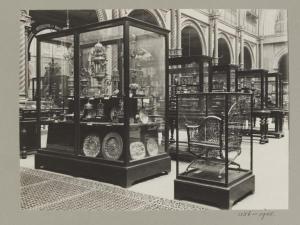
Sculpture Hall, after 1913 installation of ceiling lights and before 1928 installation of fountain, c.1920. St. Louis Art Museum
Museum education staff are on the front lines– certainly more so than the curatorial, research, or exhibition design staff– and their work is immediately recognized and experienced by visitors. Museum education staff include a wide range of folks, depending on the organization. Costumed interpreters, gallery guides, program managers and assistants to develop and run fun but educational activities for all ages, curriculum developers who work with teachers to ensure that museu visits and activities for school groups meet the local or common core standards, and lots more. Sometimes the education staff are paid less than the curatorial and collections staff– and they’re pretty underpaid to begin with. Education staff are, to a larger degree than collections staff, expected to work evenings, weekends, and holidays, often without holiday differential pay, and receiving “comp” time instead of overtime.
Now, all that said, the blog post also contains these points
1. Gain skills outside of your intended field. Learn how to budget. Like, really budget. What would you do with $2,000? How about $250,000? Know the numbers, and know how to speak business. If this isn’t your comfort zone, join the club. Take free online courses (edX is my go-to), and expand your skillset to include some productive surprises.
Victoria and Albert Museum, interior view (South Court), late 19th century (V&A PH.1156-1905)
Guess what? Budgeting IS part of your intended field. Sure, educational methods for reaching kids is directly related, but there is hardly a museum job in the world that doesn’t need to deal with money to some degree. The better you understand the way a budget works, the way grant budgets work and what you need to account for, the better you will understand the place you work and why things are the way they are. (Translation: the better you will understand how you are being rewarded– or not.
2. Work hard, be nice. One of the best things to do when you’re starting out (or moving up) is to do excellent work and share it with your peers, supervisors, friends, and anyone who can provide constructive feedback. The museum world is a teeny-tiny place, so be nice to everyone you meet.
Be nice. As a woman, I often hate hearing that. I’d rephrase this one to “Do the best work you can without killing or compromising yourself, and be generous to the people who help you.” Develop the radar that lets you know when your colleague is using you– and someone will, trust me. Eventually someone will take credit for your work (ask me how I know), or betray a confidence, or a boss will keep moving the goalposts for a promotion, raise, or title change.
Museums aren’t easy to work in– there’s no field that’s always easy to work in– but we accept far too much because we love what we do. We are charmed, seduced, by the beauty of the objects, the mystery of the concepts, the scale of reach. But like a bad lover, museum administrators and boards can exploit our passion and use it against us. Don’t think they won’t.
If you don’t work in a museum, substitute your position title and/or field for the museum-specific words in this post. I believe everyone should be paid a fair wage, have decent working conditions, and the ability to have a robust and satisfying personal life as well as a job they find meaningful.
Collections staff climb wobbly ladders all too often
Someone brought up the Plimoth Plantation workers concerns for safety, and how those outweighed the low wages in their drive to unionize. Uneven streets, low staffing levels and safety requirements placed on them– watching open fires– meant that they were unable to leave the houses even for “nature breaks.” These are all legitimate concerns and the expectation that workers will tolerate unforgiving, dangerous, or humiliating conditions because “it’s all for a good cause” is ridiculous (and, apparently, a darned good way to inspire a union).
The union effort I was part of was not driven solely by low wages. There were other factors, including an executive director with a large but fragile ego, who was inclined to operate rather whimsically. When the drive failed, the need for union was by no means diminished, especially given the retaliations that followed, including the case of a woman who went on maternity leave, only to find on her return that her job had not been saved for her, despite the museum’s need to comply with the FMLA and assurances made before she went on maternity leave.
Bad management makes it hard to get out of bed.
Do not think that cannot happen today, because changes to the terms of employment happen all the time in museums, even when the leave alternate work schedules have been negotiated and put in writing. Museums and their directors are, in general, no more benevolent than any other employer.
But safety seems basic, right? Well….would you like to be the sole person working in a 16,000SF historic house? Granted, no open fires, but you are still expected to answer the door and you will find that people will force their way into the house, even when you tell them the museum is closed. Lucky for you, none of them were threatening.
Some are more equal than others
Except of course the one who was. When the concerns were brought to the executive director, there was a surprising lack of support– It’s one incident. He’s crazy, so what? You’re overreacting. That’s the best neighborhood in [small town redacted]. House staff asked for mirrors at the door and minimum staffing levels of two. Someone suggested maybe Boy Scouts would be good to have come in on the weekend afternoons when the staff person is alone– Boy Scouts need service hours for college applications, after all. In less than a year, the house manager resigned. The exterior lights around the house were not fixed or replaced, and it was pitch dark and empty on the walk to the parking lot. Only when the executive director’s husband said, “Gosh, the parking lot seems kinda rapey when so it’s so dark” did the parking lot lights get replaced– but only the lot, because she used it to park in when she went out to dinner with board members.
The same employer expected staff to come to work even when the water had been shut off at the site all day for repair work; fortunately, they could be convinced to close sites to the public on those occasions. I have worked in modern museum and research facilities without heat, light, or water because no quarter was given, and no exceptions were made for you to work at a different, functioning site.
Toodles might as well have been on security
For years, I was the on-call person for all alarms at the collections facilities. This meant that in the middle of the night, I had to go to the sites if the alarms were tripped. I had to go in alone, and was expected to sweep the facility and site for intruders. Eventually, I talked the police into a policy of staying with me until the sweep was complete, but I can assure you that a 16,000SF facility is creepy AF at 3:00 in the morning when the security alarm has gone off and you don’t know if someone has broken in or not.
Employers send very clear signals about how much they value employees and they punish employees in ways both small and large. Punishing an entire division, and putting the director put on six months probation because the director and division staff tried to follow the employee handbook and procedures to deal with a new hire who turned out to be incompetent and unwilling to work? Not great. The new hire was transferred to another division where the same behaviour played out, and caused great frustration to her new supervisor and colleagues. Eventually, she quit when it became clear that she was going to be let go and could no longer manipulate the system. For a division director to be told, in a meeting with the executive director, that “This isn’t your fault, and this isn’t about you– you’re here because of what other people did,” is not reassuring in the least. Punishing people for trying to follow the rules when the HR staff won’t will not generate good morale, or retention.
Because I said so, that’s why
Employee leaves are another serious pressure point in museums. Often no one extra is hired and no tasks are reduced, but are instead spread across a variety of people. Sadly, when someone like a registrar takes an extended leave, and the museum refuses to reduce collecting or loans, someone has to process all the paperwork. Asking people who are already doing two jobs to take on a third is not uncommon. Directors reveal a great deal about themselves in the response they have when they’re approached with a request to reduce some of the workload because the person covering is burning out. Dismissing the request with “It’s just a few more weeks,” 10 weeks into a 16 week leave with major program planning starting on top of all the other tasks is not helpful, supportive, or collaborative.
Directors who say, “I’m the director, I always win,” when direct reports disagree with them, may find their direct reports seeking work elsewhere. I’ve heard directors complain about having to “seek consensus,” and chafe at having to convince boards to support changes to staff structure. Directors who chastise front line staff in front of the public and shake their fingers in the staff member’s face– and then turn out to be wrong about what they’re upset about, but refuse to apologize– are not as uncommon as you might hope.
Safety. Consistency. Respect. That’s all employees want, no matter where they work. They want policies that are applied equitably, and workplaces that do not place them in danger either by condition of the site or the attitude of the management. When any employer fails to provide those conditions, the result will be low morale and high turnover. The cost of those is significant, both in declining visitor experience and increased training.











 Kirsten Hammerstrom
You must be logged in to post a comment.