To Breakfast In

http://agreeabletyrant.dar.org/gallery/1810s/polka-dot-printed-dress/
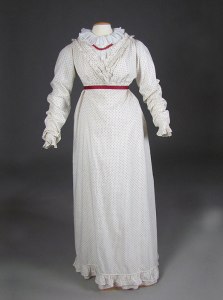
Dress, cotton, United States, private collection; reproduction chemisette, private collection; coral necklace courtesy of Dames à la Mode.

I get ideas. And like a cat I once knew, once I have an idea, it’s hard to shake. Luckily for me, my judgement is better than the cat’s– he had a tendency to pounce without regard to results, and scars do show on furry white noses. But in this case, at least, there are no scars, just some pricked fingers.

Like so many of us early-Federal era obsessives, I fell in love with An Agreeable Tyrant, and demanded the book for Christmas. It’s not just the essays or images, it’s the patterns. Scaled patterns take at least some of the guess work out of recreating historic costumes, but not all of it. And never for me– if there’s something to mess up or guess wrong, I am right on top of it– which is to say, I learn to adapt my errors and adjust my methods to fit my materials.

Surplice-front gowns have teased and delighted me for years: My first foray was with the silk “Quaker” gown of three (!) years ago, a gown I based on digging into Quaker portraits and Nancy Bradford’s Costume in Detail. It worked well enough then– not brilliantly, but close enough for my purposes. But then the polka dot dream appears, and of course, I need one to fulfill my dream of living Persuasion and having a morning dress to breakfast in. Beats the heck out of what I eat breakfast in now, and perhaps the company would improve as well. (I’m looking at you,cats.)

Well, so, what to do? Attempt my own, of course, since I found some fabric that seemed plausible enough and matched the color my dried blood. It’s a sheer block print cotton from India, more sheer than the original fabric, but capturing the feel well enough– and better, I suspect, than the stiff quilting cottons one is likely to find with polka dot prints. Construction and patterning fun next time on “True Confessions of the Frivolously Fashion Obsessed.”

More Color, Brighter Color

Not the side I ended up using.

“More colah! brightah colah!” was the refrain of one of the printmaking professors at my undergrad program (hilariously, I met him again last summer here in the Ocean State, and nothing much had changed). This is useful advice for someone stuck in the doldrums of late winter New England. It was late January when I got some disappointing news and set off to cure my blues at the fabric store. There’s a bodice in the plaid underway for another silk gown (eventually to be sold, I think; how many can one have?), but I grew dissatisfied with the fabric. Too pale. I wanted More Color. Brighter Color.

Lucky for me, it was on sale. Fabric Mart Fabrics has been good for me in the past, and a silk sale was a success this time, too. The bright and bold dress in the FIT collection was my inspiration, and I dearly hoped I would not manage to cut the cross-barred pattern to match, so of course I pretty much did.

My tried-and-true pattern based on the 1815 roller print gown at Genesee Country Village was the base pattern for the silk gown: I know how to adjust it so that I can get dressed on my own, drawstrings the saving grace for the solitary woman who wants a back-closing gown.

I didn’t alter my pattern enough to really capture that neckline, because, in truth, I wanted to get this done! I did concede to trim, of course, and while conducting Drunk Tailor on a (fruitless for him) tour of regional fabric stores, found, at last, the trim I wanted, at the Fabric Place Basement in Natick. Good thing, too, because I was convinced that we were going to die in the traffic backup on whatever that road is in Framingham that creeps in at petty pace from day to day,To the last syllable of recorded time. But no, we lived, after I was fed, and trim was found, saving the day. (Seriously, I don’t think I have ever been on that stretch between Natick and Framingham and not been in a traffic jam since I first encountered it in 1988.)

But the dress, that’s the point. It’s done, at least enough to wear, though I did not buy enough trim for the hem and will have to trek back up to Natick for another few yards with which I can trim the hem. A lovely young woman named Tanya did get a photo of me in full regalia, down to the gloves (yes! leather opera gloves!) but I haven’t found it yet out on the interwebs, so my hotel room selfies must suffice.

What I find most satisfying– aside from the dancing– is how versatile a very simple dress pattern can be. Fabric choices, trims, hem length, minor sleeve alterations, and accessories make this one pattern work both for a day dress and a dancing dress.

Circles and Lines

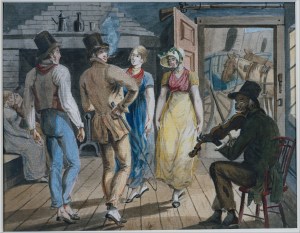
Merrymaking at a Wayside Inn, watercolor on paper by John Lewis Krimmel. 1811-1813. Metropolitan Museum of Art, 42.95.12

By some miracle, I did not have the Polecats in my head all weekend, despite spending most of Saturday only dancing. It has been some time since I danced (February’s adventure notwithstanding) and after two hip replacements, my Giant son is correct: I’m still re-training my muscles. My feet remember more than my hips do, but at least some of my muscles remember!

The Commonwealth Vintage Dancers Regency Weekend was this past weekend, and while I could only manage Saturday (Sundays are for chores when you’re expecting houseguests for Easter), I had a wonderful time and sincerely hope I can retain what I was taught. The company was very friendly and quite genteel, though I can report that I did experience a variety of partners, and, in one unfortunate case, became so confused I had to step out of the dance entirely. (Mixed rhythms and mixed-up steps became far too jumbled in my poor brain.)

The Five Positions, from An Analysis of Country Dancing, T. Wilson, 1811.

The entire day reminded me strongly of being in a novel, or, as Drunk Tailor said on hearing the description, a movie. Let us merely note that some gentleman are more enthusiastic appreciators of music than others, and that a partner can be left feeling a bit flung about in some of the figures that involve the mouliner. My rusty memories of French came in handy: mouliner and mill connect easily enough for me (seen here, in Prince Kutusoff) and the Boulanger made much more sense when I connected it to mixing bread dough. Hey– whatever gets you through the set without stepping on your own, or anyone else’s feet!

I’d like to think I will remember something of this business the next time I get to dance, whenever that may be. The patterns can be found on line in manuals (as in this description of Sir Roger de Coverly) with some occasional, bearable, videos— and, as always, resources close to home.

Next time: the dress. Until then, I’m posting more on Instagram.