The ‘Nancy Dawson’ Dress

Miss Nancy Dawson, aquatint print. Victoria and Albert Museum. E.4968-1968

Hat tip to Mr B for pointing out the resemblance; I know the print and never connected it to this fabric.

It’s been almost a year in the making, this bright yellow billboard of a gown. I’m not sure why I dawdled over the making; usually I’m pretty quick with a needle, but perhaps it was in part because the goal kept changing: first December, and then, it seemed, never, would I have an occasion to wear this. Federal exploits intervened, work intensified, things changed. But late April presented itself as an opportunity, so finally I had a goal, a deadline.
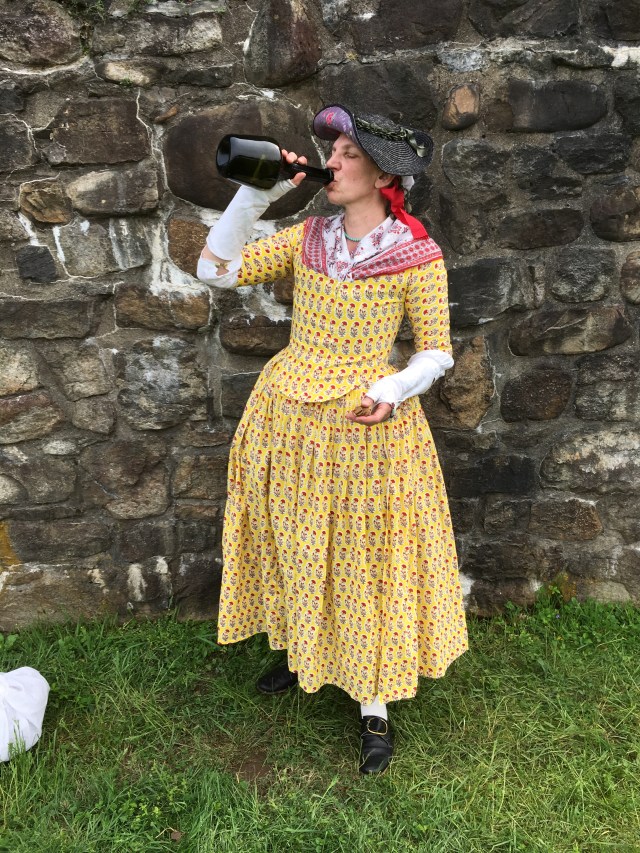
It was hot. And humid. That’s only water.

And I met it, with Drunk Tailor’s help (setting hems by yourself is a pain).

This is a fairly straightforward affair. I did use the Larkin and Smith “fashionable gown” pattern because I know how it fits me, but the front is modified to a simple closing and the skirts aren’t meant to be drawn up. This gown aspires to pretensions– though you can tell I’m fairly prosperous by the number of different prints I’m wearing.

The petticoat did require piecing– at my height, 44 inch wide fabric often needs to be pieced to achieve the lengths or width I need in historical skirts.
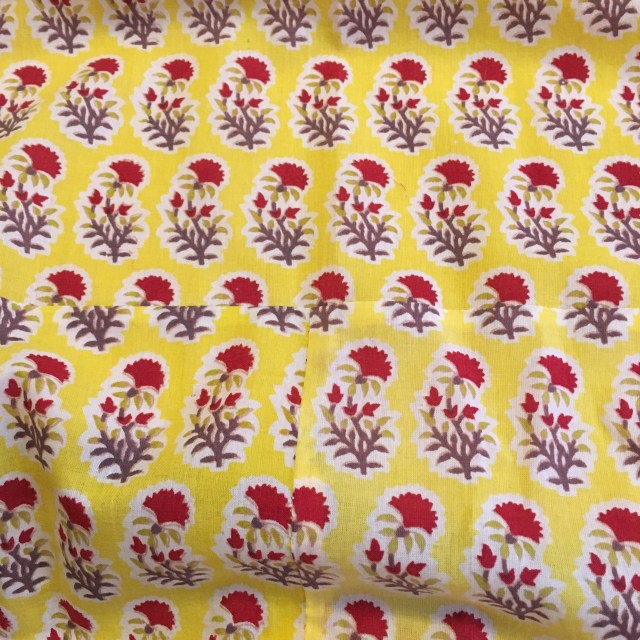
Happily, the piecing matches and doesn’t match, in a fairly satisfactory way. When this fabric arrived on my doorstep, I determined that it needed to be used in the most obnoxious manner possible– and since I’m not a small woman, a gown and matching petticoat seemed the best possible use. (I have other obnoxious fabrics for later time periods).
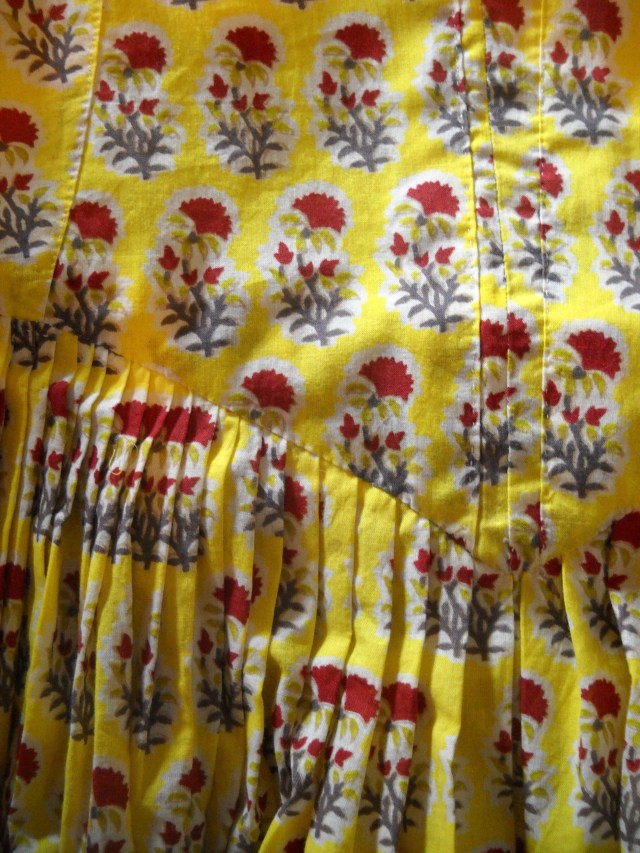
I did take care as I made it up, though, stitching with white thread and trying to make the pleats small and correct to the fashion and fabric. Any failures or flaws make it, to my eye, better as an article of aspiration to a rank and style I really can’t pull off.

One thing I forgot to pack was a bum roll– though wearing that on the drive to Fort Frederick would have been extra interesting– which was unfortunate, as it is truly required. These new (they’re a year old, and I expect to call them “new” for a long time to come) stays make a different shape in the back than the old stays, and now my own padding no longer negates the need for a bum roll. Still, I’m pleased with the result, even if it still wants cuffs. Not bad for eleven months of work.

Cross my Heart

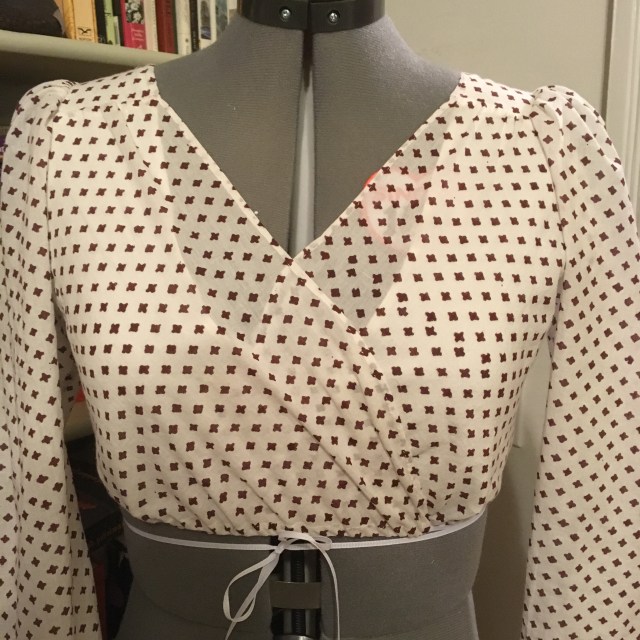
The goal is on the left. How far have I made it? Well… I have been busy. We started on the right, remember?

In executing the final plan, I did choose to cut a lining to support the lightweight fashion fabric; I didn’t think it would look, drape, or wear well without a lining.

The adaptation is truly that, and not a copy, in this instance. The lining means that the finished piece will have more of the appearance of a drawstring fitting than an actual drawstring across the back.

The sleeves, thankfully, were pretty straightforward, and I’m one of those odd people who really enjoys cutting and setting sleeves, so there you are. It took me about six days to get to this point, and then work came to a halt. I have other centuries I’m playing in, and am determined to finish that yellow dress to wear this weekend. When and where else can I look like a person of means than the Fort Frederick Market Fair?

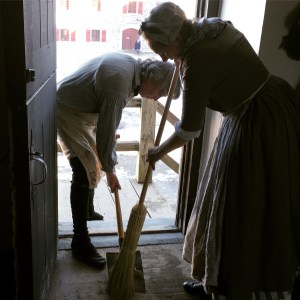
Rethinking Reenacting Redux

Some of you may recall my friend from the antediluvian age, Dread Scott. He was in town briefly and while I wasn’t able to attend his talk, I got my own special artist’s talk over breakfast.

Scott’s working on a Slave Rebellion Reenactment, (additional info here) so we had a lot to talk about.

Scuffle in the Square, Princeton, 2017. Photo by Wilson Freeman at Drifting Focus Photography

He had some great questions about what we do, and why we do it, especially around Princeton, and in talking about my end goal (getting the public to understand how the past informs the present), I said something about how in Newport in 2014, the cars disappeared and we forgot we were in the present.

Scott’s great reply was about keeping the present present, occupying two time periods simultaneously, to recognize that the past made the present. I know that seems obvious, but it isn’t always when we’re out in our funny clothes. It’s another layer of interpretation that we can build onto our reenactments and recreations, particularly when we are trying to talk about slavery. Slavery built the institutions we have today– like Aetna Insurance and Georgetown University– so if we acknowledge our surroundings in a place like downtown Princeton or Newport, we can talk about more than just the moment we are recreating.

Some of us seek historical transcendence. Some of us enjoy a social experience. And some of us seek ways to connect the present to the past in ways that help us understand how we got here, and how to make a better future.

The more I contemplate what matters to me, the more I think I’m seeking that last more than I am even transcendence.

True Confessions of the Frivolously Fashion Obsessed

Skeptical cat is skeptical

I promised you something, didn’t I, the last time I wrote?

Well, set your skepticism aside for the cat, because here’s the scoop on the messy process of getting from page to pattern to garment.

I started with the pattern from the book, which furrowed my brow a few times until I became accustomed to the style. Everyone drafts and scales patterns a little differently; it’s like getting used to local idioms. (It’s a bubbla, here, not a water fountain and not a drinking fountain. Go figure.)

But I digress. It seemed pretty simple, especially since I have some experience scaling things up, both from Sharon Burston on taking a pattern from an original garment (plot your points like an archaeologist) and from architecture school (redraw Le Corbusier’s maison from these two tiny drawings, draft an axonometric, and make a model). With Corbu behind me, you’d think this would be a piece o’ cake.

Delightfully, you would be wrong. Creative swearing, brow furrowing, and endless distractions (yes, some 28mm 17th century soldiers will be wearing Timberlands) provided the usual soundtrack and experience. Challenging, not easy, which means I hope I might actually have learned something.

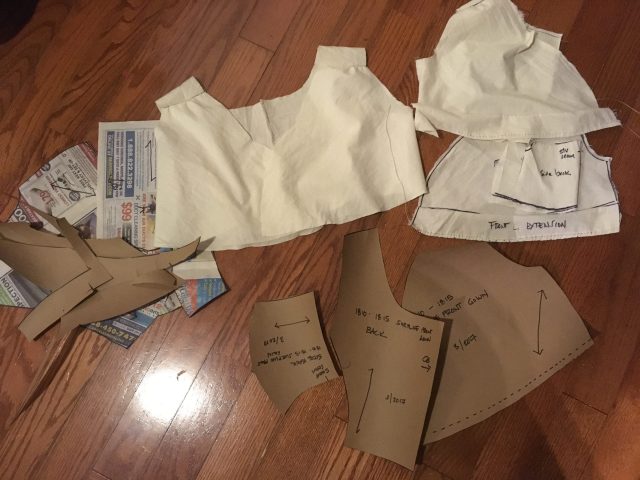
Kind of a mess, right? Here’s what I did: I scaled up the pattern in the book once I’d figured out that the measurements were, incredibly, just about what I make my Federal-era dress pieces. I used the newsprint ads that come in the mail because they are abundant and free. That’s more challenging than gridded or plain paper, but free is free. With a ruler and a pencil, you can make your own grid.

After the paper patterns were drafted, I checked them against the drawings in the book, and made free hand corrections. I’ve learned that my eye is sometimes better than my math whether I am hanging paintings or making patterns.

From the tweaked newsprint pieces, I cut muslins to stitch up and try on over my stays. You MUST fit over the proper undergarments, or the exercise is pointless. These resulted in some additional tweaks and alterations accomplished at first with pins, a Sharpie, and Drunk Tailor’s patient assistance.

What then? Another round with some adjusted pieces to yield another muslin. It’s from that final fitting muslin that I transfer changes to the newsprint and then, finally, to craft paper. I was ably assisted once again by the Most Dangerous Cat in the World.

That’s what you’re left with: scraps, a muslin that’s true, and the pieces to make it. But have I made real progress on real fabric? Of course! But that’s another post.