Details: we sweat them in our historical clothing, our impressions, our writing. I try hard to pay attention to them, but in my work, I have a lot of details to manage. Some fall away– I can no longer tell the ranks of men in daguerreotypes immediately, or recognize a Colt revolver at 10 paces, but there was a time when I could. I have managed to retain at least a general understanding of how military units are organized, a general sense of various units from my state in wars before 1939, and the uniforms associated with those units. (And I know which side a man’s coat buttons on.)
What’s wrong with this image? Missouri State Guard uniform coat of Col. Austin M. Standish (Confederate). Missouri Historical Society 1916-045-0001
This helps in my work: knowing what HBT is, knowing what various patches signify, knowing how units were structured and the campaigns they were part of helps me be a better cataloger, curator, and exhibit developer. My job is take the details and make them matter by telling stories about the people who wore the HBT or the machinists’ mate patch or carried an ensign or wore an officer’s coat as part of the 14th Rhode Island Heavy Artillery (colored) in the Civil War.
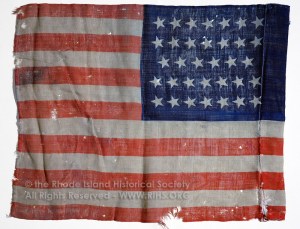
U.S. Flag, regimental. 14th Regiment Rhode Island Heavy Artillery. Belonged to Joseph Carey Whiting, Jr., 1st Lt., Co. B 14th R.I. Heavy Artillery. RIHS 1962.24.1
People matter more than things, but 154 years later, all we have are things those people owned, used, wore, and carried. The things now represent the people. So when someone working on a exhibit says, “any epaulets will do” while pointing at the shoulder boards on a Lieutenant’s coat, I’m not just taken aback, I’m upset, and reply, “If it’s just for color, you can buy them.” Because “any old epaulet [sic]” being loaned by a museum goes through a laborious process of loan approval, packing, delivery and installation. For that time investment alone, “any old epaulet” should not do: museums are not prop closets.
General’s Epaulets of William Clark. Missouri Historical Society. 1924-004-0006
We can’t assume that the public doesn’t know or doesn’t care– they often know more than we do, just think of the wildly detailed knowledge some of us have about very particular things– so we owe it to them, and to the people of the past, to use museum objects as more than visual accents.
If you are a historic costumer, living history interpreter or enactor and tell me you don’t have a problem with shoes, and I will laugh at you. Even if you don’t have way too many shoes, chances are good you look at them in museum collections, even if you don’t order them. Shoes are basic to any impression.
I have history with shoes, myself. Not only have my feet always been generously proportioned, but my Grandmother possessed a singular fondness for, and an expansive collection of, shoes.
Shoes. Slippers.
Pair of slippers. 1825-1849. Paul Hase, Paris. V&A 1153&A-1901
Call them what you will, when you hanker to dance, you need them. So, I find myself in the happily distracting position of needing (wanting) dance slippers for April. I thought my search might be fruitless, what with my pedal extremities, but reader: I was delighted and surprised.
Yes: they fit! Now the tricky bit is to dye and decorate these slippers to achieve maximum eye-watering potential. There’s a length of silk headed my way that should provide plenty of inspiration.
For tamer times, classic black will always do. Whilst replacing my worn-out sneakers, I came upon a pair of slippers that seemed ready for alteration, so I bought them as a backup, in case the Brontes didn’t fit.
They were inexpensive enough that I didn’t mind taking them apart for modifications.
A grosgrain rosette and ribbon ties later, these will do well enough to extend the life of my irreplaceable Robert Land slippers. I looked at shoes last night, and drew inspiration from some examples through the first half of the 19th century. With the pointy toe, these clearly skew first decade of the 19th century, which is just right for most of what I do. The Brontes will work for later impressions– and I have those as well. All in all, a pleasant mid-week distraction.
Pair of women’s shoes, 1801. Gift of Fred Taggart, 1986.31.1a-b. RIHSWomen’s slippers, 1790-1810. American. MFA Boston. 99.664.12a-bSlippers, 1835-1850. American, wool, silk. Metropolitan Museum of Art. 66-20-1a-b
It’s been one of those weeks, hasn’t it? Up and down, emotionally, as we all prepare for change. Whig or Tory, these are turbulent times.
I’ve been surprised by recent fabric arrivals in the mail, disappointed when I waited a day too long to register for a dance, and now I’m at loose ends. What comes next?
Last weekend I cut out a black wool Spencer to line in lettuce green silk because why not? And teeny tiny backstitches later, I have one sleeve finished. Focus is hard to come by of late.
I meant to join the Historical Sew Monthly to give my sewing life some structure, and I still can, though I cannot seem to settle down. Clearly, I have Firsts & Lasts that could be made (not always in the time remaining, mind you, so I would have to choose wisely).Re-Make, Re-Use, Re-Fashion? Probably much there as well– at least if one counts the quilted petticoat worn at Princeton, which was remade and altered from its original form.
Red. I do love red.
Delicious wool, tasty price.
July: Fashion Plate, could become the shawl gown I’ve dreamt of for years, since, as you can see above, I’ve found one that might work, lured by a fair price on a sizable piece of wool– but wherever shall I wear it? Why can I not get past utility? The Dreamstress’ Kashmiri shawl gown and her research are there to emulate, and explain.
Oh, I have projects and events to research and plan, housework to complete, and plans to execute. But they all seem abstract and unreal at the moment when we hang on the pivot point between the future and the past. It’s been a strange year in many ways and places, and constructive projects help focus.
Art Still Has Truth Take Refuge There
Long ago, in the first turbulent times I was old enough to understand, I lived in St. Louis. Then, as now, I think the Art Museum’s motto holds, and reminds those of us who work in or appreciate sometimes frivolous-seeming fields and hobbies that all our actions have meaning. I’ve thought for a long time about the utility of sewing historic clothing, cataloging objects, and running around recreating the past.
Getting outside one’s own experience is incredibly hard; it’s hard to have an open heart, and to encourage openness to others. But that’s one of the most important roles museums and libraries play: we help people develop imagination and empathy. I know it’s part of why I do the work I do. I like to think that ultimately, helping illuminate the complexity of the past will help us all understand the present and make a better future.
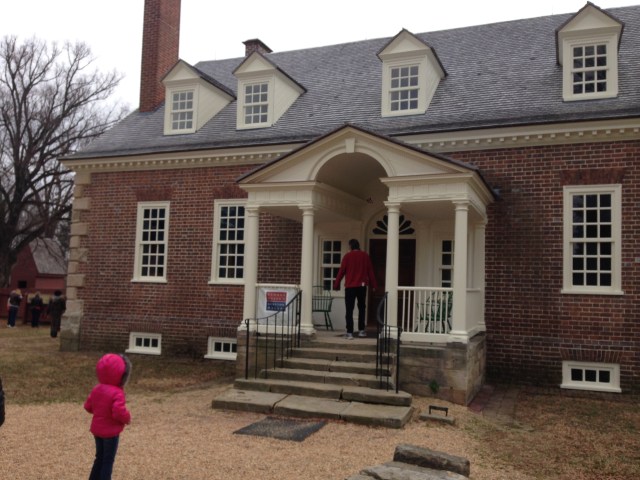
Gunston Hall has been on my list of must-visit places for some time, and now I can cross it off my list. I was impressed by their Room Use Study and remain so. They’ve also done some decent work on slavery, and it shows on their website. So my hopes were high. You know where this is going, right? Yup.
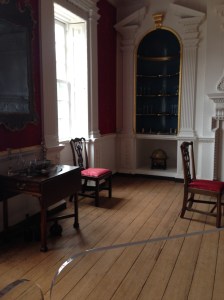
The room in which Martha Washington and Mrs Mason may have had a “chit-chat” about the two Georges.
Pretty sure the guided tour is dead. Also pretty sure most museums need to look long and hard at the actual execution of their mission. Granted, this was another one of those January R&R visits, when it is entirely likely that the multiple “Out of Order” signs were a mere mid-winter fluke. But day-um, I was underwhelmed.
Granted, this house is older than “mine.” And smaller. And I didn’t ask any questions on the tour because I fear my tone will be far too telling. But there was a small, excited-in-a-good-way child on the tour, and several other adults. When asked by the docent what we were interested in, the group settled on “life.”
WHO touched that railing? THAT’S why I should care?
We ended up with the incantation of “many famous people have sat in this room.” “Many famous people have touched this stair rail.” I might have heard an audible intake of breath when we were told something was original; my right eyebrow shot up in an expression well known to my friends.
The house is lovely, of course, Georgian balance and all that, and nicely decorated, whether the chinoiserie paper in the dining chamber or the Virginia-Chesapeake Neat and Plain office. But why the default emphasis is on famous people touched this, stepped here, slept here, I do not know. My docents do it, too, sometimes. But what troubles me more is what I came away without: A sense of George Mason and his family.
Red damask on the walls, because “they could have had it.” Infelicitous phrasing.
Most troubling to me, being Of a Certain Age, was the statement that Mason’s second marriage, to Sarah Brent, was “for friendship and companionship.”
Really?
George and Sarah sign a marriage agreement several days before they are wed, protecting in a limited way Sarah’s individual property. Under the terms of this contract, Sarah gives ownership of her slaves to her husband for the length of her marriage, but regains possession of them should her husband die and there be no offspring between them. Under these same conditions, Sarah is promised as dower 400 acres of her husband’s land at Dogues Neck.
Over the years, it has been pointed out that the marriage agreement between Sarah and George indicates that their relationship was more business-like and convenient, rather than loving. However, the marriage compact also can be seen as a fair solution between two practical people who want to safeguard their property for future generations — Mason for his children and Sarah for the sons and daughters of her sister Jean in Dumfries. In Sarah’s will of 1794, she indeed does pass on to these children and one of their offspring the slaves she regains upon the death of her husband.
Really?
That looks to me like a sensible arrangement between two mature adults. The way that a 50-year-old approaches marriage and relationships in any century will be different. Even in the 18th century, a woman of 50 has an established identity, knowledge of the world, and experience in running a household, if not a business.
Why yes, I do have some baggage, why do you ask?
To suggest that sensibility excludes or precludes sex is to miss the point of Jane Austen completely, and is ageist in the absence of evidence. In all likelihood, Sarah is peri-menopausal at least and menopausal at most (it varies widely; some 50-year-old women are still fertile, shocking though that may seem). That doesn’t mean she’s asexual, and while George Mason may well have (probably did) take sexual advantage of the women he owned, that doesn’t mean he’s not interested in, and expecting, a sexual relationship with his second wife.
What all of this suggests to me is a reluctance in museums to talk about sex, unless there are children from a marriage, in which case one can just assume the couple were busy in bed and not actually address it…all in all, a weird thing, and one that turns up in my own museum from time to time.
This is not to suggest that I didn’t enjoy the tour, the house, or the landscape. But I felt dissatisfied, as if the real meat of the place was not to be found on the tour. Exploring the upstairs on our own was much more fun– I would have liked some object labels up there, and downstairs, too– and had more of an air of exploration and discovery.
And that’s what the guided tour kills: discovering for yourself. It doesn’t have to be a full-blown you-paid-for-it Museum Hack bonding experience. It doesn’t need to be a handout with “How many squirrels can you find?”
Exploring, reading labels, listening, smelling, touching: using our senses to learn about a place, a space, an object, a person, will be engaging enough.
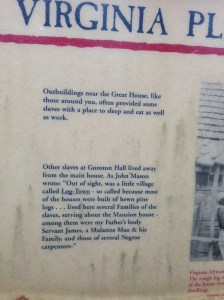
With so much good, deep, content on the website, I know Gunston Hall has the material a great tour and historic house museum is made of. I know, from reading the labels about slavery at the site and reading the text about slavery on the web, that they know more, do more, and understand more about the enslaved people than their permanent exhibitions indicate.







 Kirsten Hammerstrom
You must be logged in to post a comment.