Make Mine Menswear: The finished banyan

Banyan, 1750-1775. T.215-1992, V&A Museum
Banyan, 1750-1775.
T.215-1992, V&A Museum

Banyan or wrapping gown, either will do to wear as the year winds down. This project took longer than I wanted it to, mostly because I have a tendency to take on too many things at once and promptly get sick. I like to think of this ability as a gift.

In any case, this is a simple garment to make, made more fun by piecing– it’s the challenge that keeps you awake, when the majority of the work is in teeny-tiny back stitches.

I measured the subject and made up my own pattern, using the chintz banyan in Fitting and Proper and this one at the V&A as models.
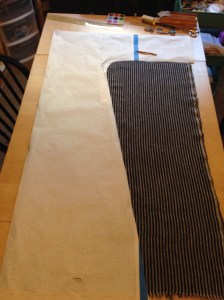
img_6554

Patterning is a simple thing, really. Maybe too simple. Measure the gentleman’s chest, bicep circumference and arm length, neck, and back length. With those, you know how wide to made the body, the center back length you need to achieve, how wide to cut the neck hole, and how wide and how long the sleeves need to be. Really, not that hard.

You can use a diagram like this to start you off. I did wing the bottom width, guessing at the angle to give the garment a fullness similar to the chintz at the V&A.

I didn’t have quite enough fabric to accommodate the recipient’s full height, nor could I get enough of the red print lining material; I had to piece both the stripes and the lining.  Trying to match up the stripes was remarkably satisfying, both when I succeeded and when I was  little off. Life Goal: Dizzying, please.

Again with the two color lining.

It contrasted well with a blue woven coverlet, making a nice bright note as the rooms were prepped for What Cheer Day. This was the effect I had hoped to achieve waaay back in April when I failed to finish anything I wanted for the After Dark program thanks to a bout of strep throat.

By October, though, I was able to finish the entire item and make a matching cap, allowing Billie Bowen to recuperate in style from an evening at the Cold Meat Club.

Next up, using this as the base pattern: a wool bedgown, lined in wool, and pieced. More mis-matched stripes, please!
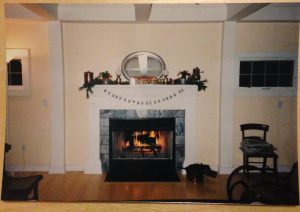
Staging Christmas

The house on High Street, Noank CT, 2000

It’s pretty stagey to begin with, isn’t it? Full of ritual, some so old we don’t know why we still perform them. What I like best is the food, not the cakes and cookies, delicious as they are, but savory meals and the warmth of a full table. Second to that, decorating.

The past year has given me opportunity to reflect on the tasks I love, and why, and the basis for the work I’m passionate about. Curiously, it began in high school, as the props mistress for drama productions, morphed into installations, performance art, and site specific sculpture in college, before metastasizing into exhibition development, installation, and historic house interpretation with a side line in living history because, you know, costumes. Things and I go way back, and thinking about that made getting ready for yet another Christmas more fun.

Providence, 2016
Providence, 2016

Embracing the staginess makes the sometimes uncomfortable family closeness easier; I have proposed celebrating by reenacting a Don Draper Christmas, as long as someone else does the driving. Adding a layer of actual performance somehow made it easier to understand, a phenomenon opposite to what happens when you write a word over and over until it makes no sense. It’s the same distance you feel when you really try to understand someone’s past, and how they think. It’s familiar, but somehow unrecognizable.

This is probably the last Christmas in this apartment, which adds a poignancy to the proceedings, and it’s the first interactions for some participants, so, as with What Cheer Day, I’ve set a stage and we’ll see what happens.

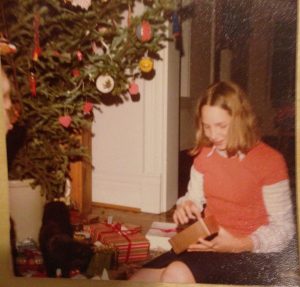
Christmas with Katie, Chicago.
Christmas with Katie the Cat, Chicago, ca 1978

Every year, some things are the same: a balsam fir, candles, apples, cats. The characters and locations ebb and flow, with some consistency. Cats come and go, the boy grows. The love remains the same.

Museum Fail: Icon, not Replica

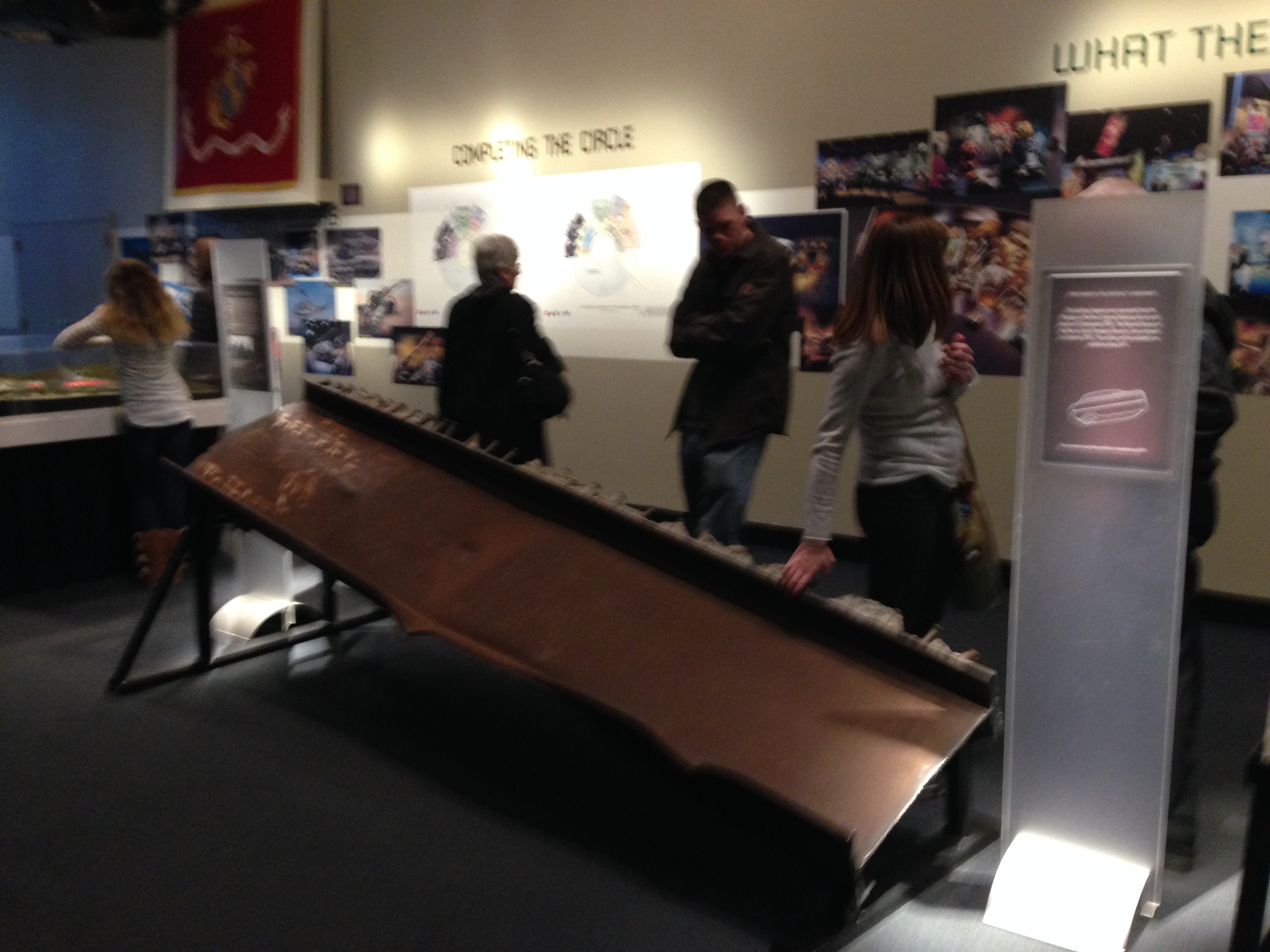
img_8606
What am I?

Do you know what this is? Do you think it’s real? Here’s a clue: it’s a relic of an iconic event in early 21st-century North America.

On the last visit to the National Marine Corps Museum, I watched the tourists circle objects at the end of the traditional galleries and displays, and overheard a woman ask her companions:

What’s this a replica of?

Reader, I cringed– and not for the sentence construction.

What's this a replica of?
What’s this a replica of?

And then I stepped back. I thought that for someone my age it would be obvious. Here, have some additional museum context.
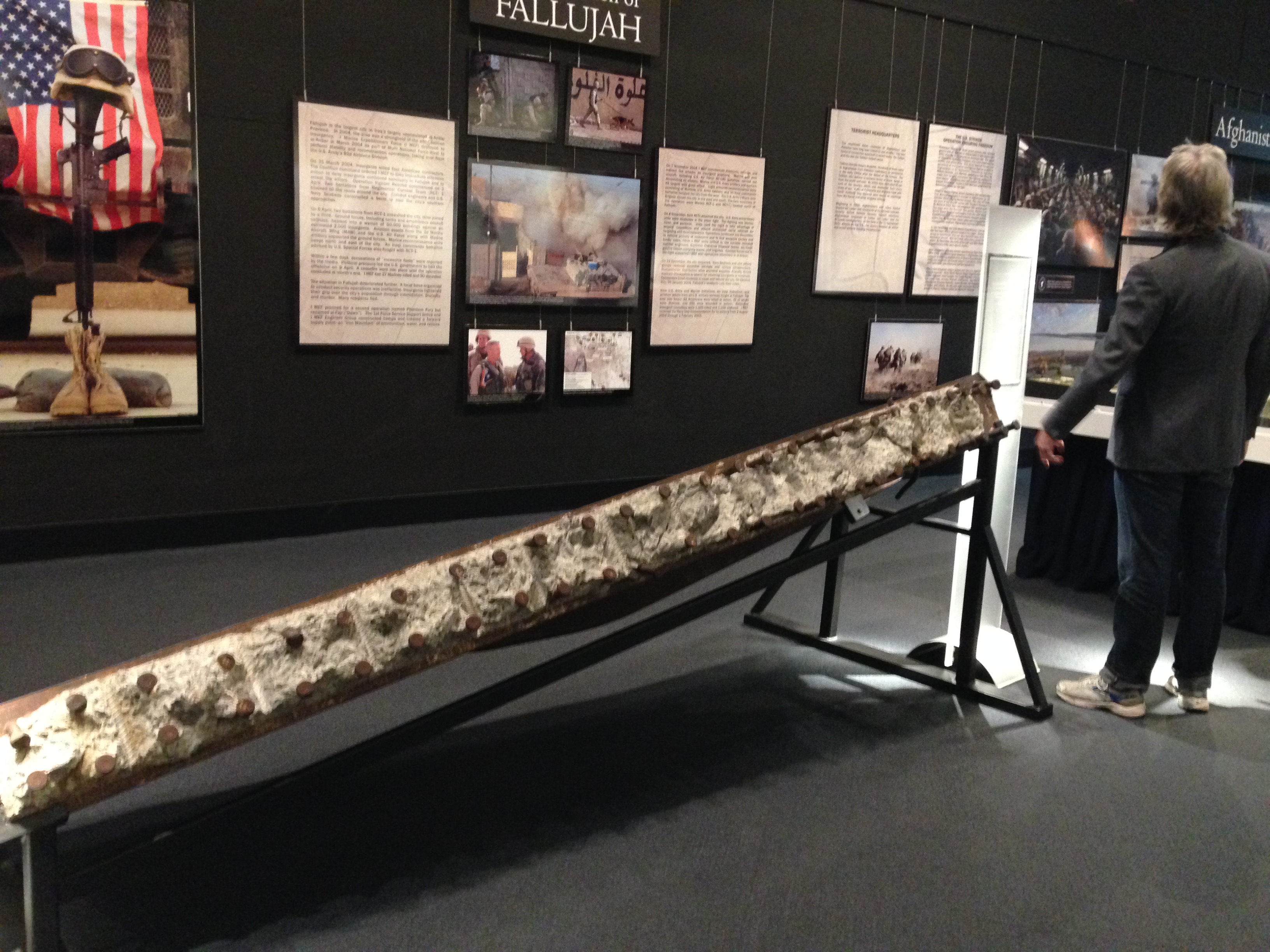
img_8604

In a museum where everything is real, how does a visitor come to ask not only if that World Trade Center steel beam is a replica, but what is it replicating? I’m not sure semiotics can save us here. My first, New York Times-reading, media-soaked, Northeast Corridor response was, How can you miss that? How can you not recognize that, let alone mistake the steel and concrete relic for a replica?

img_8603

Ah, hubris. There is a label, though I have seen better. Would it be more helpful in a larger font, turned perpendicularly to the I-beam? Possibly. But the lesson that’s deeper than label formatting and placement is recognizing how much we take for granted. Our visitors, even those we assume to be educated consumers of media and information, may not share our knowledge base. They may not read objects or images as readily as we think they do; we certainly cannot assume they’re all taking away the same information– and that has nothing to do with education or background.

Everyone truly sees the world differently. How, and what, we choose to put on a label should always be grounded in remembering that we do not all share the same information. Context is critical, and probably would have made these relics more real, and less replica.

Change

my-obama-me_20-12-16-1

Changing seasons, change we can believe in, be the change you want to see in the world.

This dumpster fire of a year is nearly over, and the commonplace is to note how much has changed: that’s our human instinct. But much does not change, most often within ourselves.

It’s our perception or understanding that changes, and, if we are lucky, causes us to act. That’s the mechanism behind the progressive movement in enacting/reenacting/living history. It’s the mechanism behind organizational change, and personal change. Sometimes it’s the sole inspiration to get me to clean my house. Holy cats, that’s a lot of kitty fur! As the sun finally shines in on the rug.

Sometimes we push as hard as we can to make change happen, but lack access to all the levers: then we have to wait. I am waiting now: I have pushed every lever and turned every knob within my reach, and the waiting is agony.

High school seniors applying to college know this feeling: when will I know? People starting new habits wonder, when will I see a difference? As a species, we have trouble with time. But tiny changes and tweaks aggregate, accrue over time like compound interest. We’ll get there.

Think about what you used to know, and what you know now, how you’ve learned more about what (or who) you love, how the way you approach a problem from collar stands to coat names. All those little changes make a difference– all the difference, the only difference.