But here’s the thing: they didn’t carry the shopping, because they didn’t do the shopping– not the big shopping, anyway.
La Pourvoyeuse, oil on canvas by Jean-Simeon Chardin, 1739. Louvre Museum.
La Pourvoyeuse by Chardin shows a woman returning from market in 1739. No basket. A bundle or bag with a fowl in it, head down. Unwrapped loaves of bread. But clearly a servant.
From waste books, it’s pretty clear that people are sending their “boys” and “girls” (servants or slaves) to fetch liquor. That will come home in bottles, like the ones at the feet of La Pourvoyeuse. And I think it comes home just in their hands, but perhaps- and more likely not– in a basket. A floppy basket, usually for floppy birds.
Balthazar Nebot, active 1730–1762, Spanish, active in Britain (from 1729), Fishmonger’s stall, 1737, Oil on copper, Yale Center for British Art, Paul Mellon Collection
After the meteoric rise of consumerism, after department stores, yes: shopping is more like what we do. But in the pre-ice box and pre-packaged era, meat cannot be bought and frozen, and milk will not last all that long. Things were brought home one at a time, or a few at a time, many times a week. And middle class ladies bought small things– ribbons, almanacks, shoes– and bring them home in their pockets, just in their hands, or, I would guess, wrapped in a bundle of paper (a pair of shoes) or in a band box (a bonnet) if the things are not delivered.
A long winded way to say, I don’t know: but I’m pretty sure middle class ladies sent their servants out frequently so the ladies didn’t carry baskets and the servants used bags, aprons, and their hands.
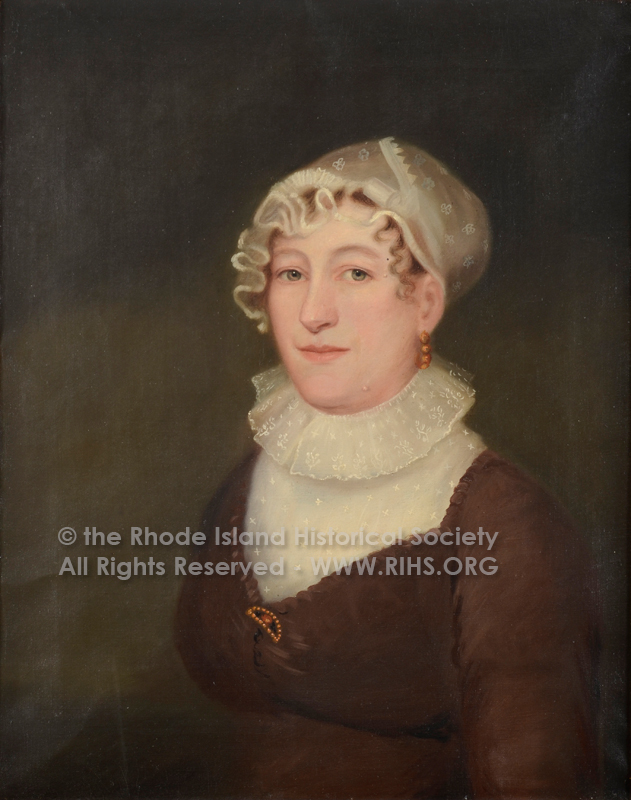
Mrs William (Jane) Pabodie. oil on canvas, 1813. RIHS 1970.60.2
Jane Jewett Pabodie, born around 1771, died 23 March 1846 is buried in Swan Point Cemetery on the Seekonk River in Providence. She was the wife of William Pabodie– which one? Well, it’s hard to tell until I really dig into the genealogy. At the moment I am so besotted with this image that all I can think about is what she’s wearing!
What she’s wearing….about that. I have some work– and some thinking– to do. The cap is slightly confounding. It’s a chance to learn a great deal more about early federal caps, which is good. I don’t understand it, which is unfortunate. The asymmetrical nature of the cap is new to me- or at least I cannot think of another example, so feel free to school me, people. But really: it is asymmetrical! With a ruffle on what is the right side of her head, and a… pinked? Van Dyked? Prairie pointed? band that runs from her left ear around to the back of her right ear? I’m confused. It would make more sense if the cap had slipped, but why would the Pabodies pay for a painting that recorded such a thing?
Honestly, I think the only way to really understand the cap is to make the cap. In muslin first, thankyouverymuch, I’m not that crazy.
Detail, Mrs William Pabodie. Oil on canvas, 1813. RIHS
The chemisette is more straightforward, being made of a sheer figured or embroidered cotton with a slightly gathered collar embellished with floral whitework embroidery. That I think can manage, at least in the basic construction (fabric, well, I’m looking).
Of course, why do I feel the need to manage all of this, with a deadline now less than eight weeks away? For a program, of course– I have only to write the copy for it. The idea (for me, anyway) is to replicate a portrait as closely as I can. Now, Mrs Pabodie and I are not exactly the same age, but I think I can pull this off…the cap, more troubling.
It’s an interesting project for me, not so much from the sewing point of view, but from a conceptual standpoint.
How close can I get? What does exactitude mean?
If I want to represent a character, what’s more important: understanding the clothing, or understanding Jane Pabodie? Constrained as I am by modern materials, unable to match these exactly, how do I navigate choices based on suppositions of what an artist meant to represent? Just my kind of conundrum.
John Singleton Copley.
Portrait of Mrs. Daniel Rogers (Elizabeth Gorham Rogers), 1762
50 X 40, oil on canvas.
Middleton Collection, Wake Forest University
HC1991.1.1
Hmm…. 1762. Does that dress look like 1762 to you? Or does it resemble a 17th century garment? Check out those sleeves: scallops. The shift sleeves: super full. The line of the gown at the neck: a shallow scoop. The front of the bodice: closed.
Are those the hallmarks of a typical 1762 gown in New England, England, or France? You are correct, sir: They are not.
What’s happening here? What is Copley doing, and why?
He’s making his subject look good, reflecting her wealth and status. He’s flattering her by painting her in a faux-17th century gown, a “Vandyke costume, a popular artistic convention in England related to the vogue for fancy dress and masquerade.”* 1762 seems a trifle late for this convention, but in 1757, James McArdell produces a mezzotint of Thomas Hudson’s portrait of the Duchess of Ancaster. Henry Pelham wrote to Copley in 1776 that he had purchased one of those mezzotints, suggesting their use as references for Colonial American painters. Reynolda House has a nice explication of this style of dress in the Thëus portrait they own of Mrs. Thomas Lynch, shown below.
Mrs. Thomas Lynch, oil on canvas by Jeremiah Thëus, 1755. Reynolda House, 1972.2.1
There was also a convention of portraying women in “timeless draperies,” following the school of Peter Lely and Godfrey Kneller, both late 17th-century English painters who produced portraits with generalized costumes.
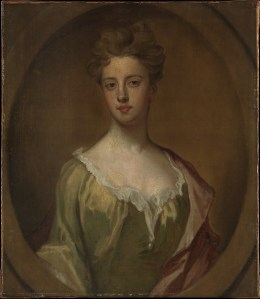
Lady Mary Berkely, wife of Thomas Chambers. oil on canvas by Sir Godfrey Kneller, ca. 1700. Metropolitan Museum of Art, 96.30.6
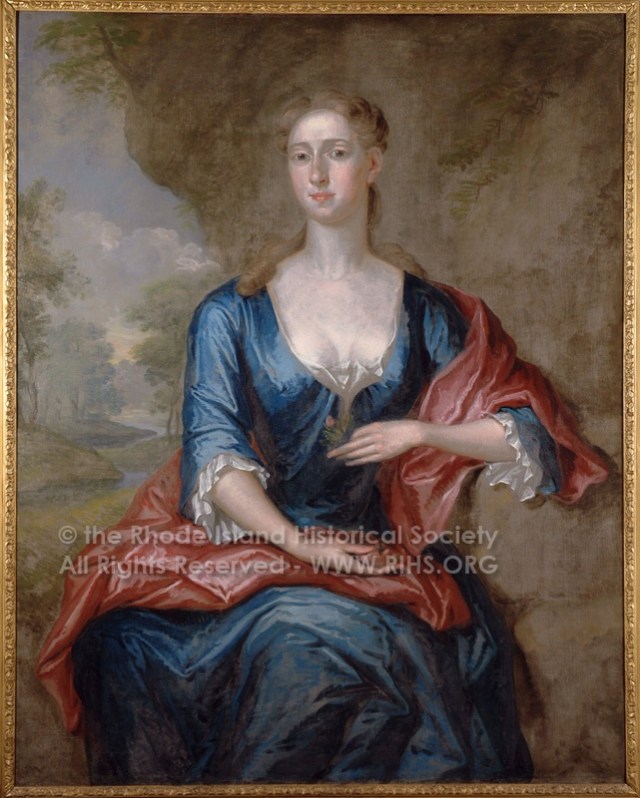
This portrait by Kneller (born in Germany, he worked in England) explains a lot, doesn’t it? And this timeless convention persists for some time, and the stylization of the facial features and hair is copied by English and colonial American painters. John Smibert, long familiar to many of you, was a leading practitioner of this style of portrait, and his work would have been well known to Copley and his sitters.
Mrs Samuel Browne by Smibert, RIHS 1891.2.2
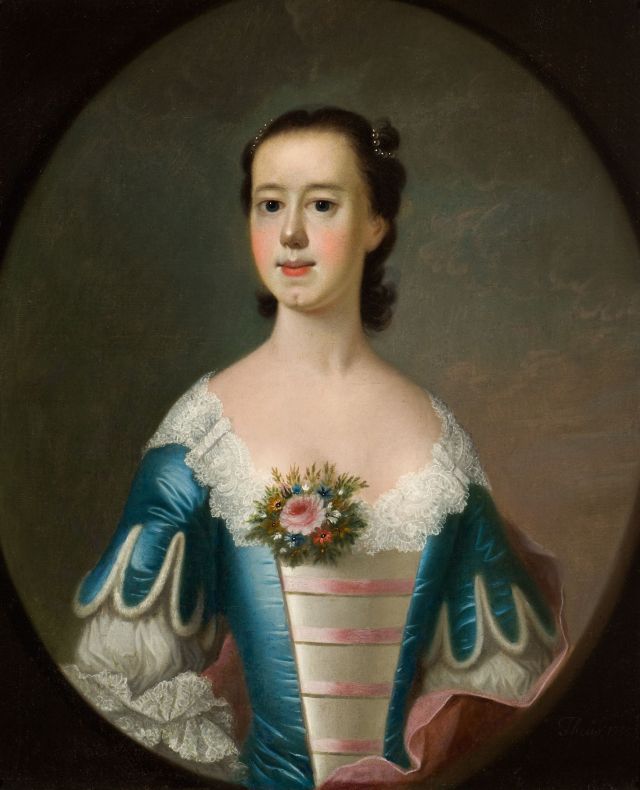
Blackburn’s portrait of Mary Sylvester adopts two conventions at once, in a way: she’s in timeless-style drapery and fancy dress as a shepherdess. Let’s remember, too, that there’s symbolism in the shepherdess imagery, referencing pastoral innocence and Mary Sylvester’s unmarried, presumably virginal, status. Don’t believe me? Read the catalog entry, written (at the very least) under the supervision of actual, degree-toting art historians.
Mary Sylvester, oil on canvas by Joseph Blackburn, 1754. Metropolitan Museum of Art, 16.68.2
Where does that leave us with Mrs. Rogers? She’s portrayed in what is essentially fancy dress, holding her straw hat in her left hand (much as Mary Sylvester is) with a basket over her right forearm. You will note the open work of the basket, the delicate arches and the fineness of the base. What’s in it? Something gauzy, as light as the drape around her shoulders, with a square of dark blue silk and a fine white silk ribbon. Honestly I am not entirely certain — the resolution of the image is dreadful.
But what’s NOT in the basket? A redware or pewter mug, sewing, keys, bottle, food, candy, toys, or, really, anything of a very concrete or practical nature.
Is this image a justification for carrying a [nearly empty ] basket on the streets of Boston? Of course it is–as long as you justify walking the streets of Boston in imaginary or fancy dress.
“Useful occupations: Women’s work, sewing, spinning, washing, ironing etc,” illustration from Basedow’s ‘Elementary Work’, 1770. Etching by Daniel Chodowiecki — at LACMA
Mrs. Boice is at it again, folks: you can register now for a workshop in just a few weeks where you can learn more than you thought you’d ever want to know about getting ready for winter, laundry, caps, games, and dancing. Thought honestly, I think you can never know too much about these things, which is why I keep trying!
Yes, it’s what I think about: how did women prepare houses for winter? How did they get things clean? It was a lot of hard work, and is often underrepresented in historic sites both domestic and military.

_-_WGA04759.jpg)





 Kirsten Hammerstrom
You must be logged in to post a comment.