
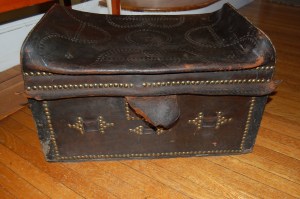
My Grandfather’s Trunk

Some objects you can't shake. And then you buy them.
Some objects you can’t shake. So you buy them.

When I was little, one of the games my mother and I played was “I packed my grandfather’s trunk.” You start with that line, and take turns adding an item in alphabetical order. The trick is, you have to repeat the whole string as you go along, so that by the time you’re packing a zebra, a zither, or zwieback, you’ve got to remember the other 25 things you and your companions have packed. It’s a good game for waiting rooms when you can’t run around, and fun for people who love words. How many nouns that start with “y” can you think of?

After lining the bottom with paper, I packed the linens.

In less than a week, I’ll be packing someone else’s greatx-grandfather’s trunk for a trip westward into the (relative) wilds of New York State to join a Sketching Party. Despite two intense weeks, I’ve persevered on the orange check gown and made significant progress on the Thriller Spencer and finished the second sheet. This is a trip to a different class altogether, one of my two annual forays into the mercantile class of the early Federal period.

It’s quite the thing, packing your alter ego’s equipage for another century, and as I’ve enjoyed a longer commute recently, I’ve pondered the ways in which we stereotype certain kinds of living history practitioners. Progressives don’t always travel light: they travel right, and in this case, it means a quantity of baggage to create the proper simulacrum of an 1814 excursion.

DSC_0401
It’s a quantity of stuff, isn’t it?

While I decry the use of film and television as sources for historical costuming, I do appreciate them for inspiration, and it is remarkably easy to get someone else hooked on a good adaptation like the BBC’s 2009 Emma. The depiction of the picnic on Box Hill is particularly good (i.e. excruciating) and the pile of materials required for appropriate comfort is overwhelming to anyone who prefers to travel lightly. Never before have I considered a turkey carpet a possible accessory to an excursion, but when one intends to ape one’s betters and bring culture to the frontier, anything is possible.
Civil War and Uncivilized War

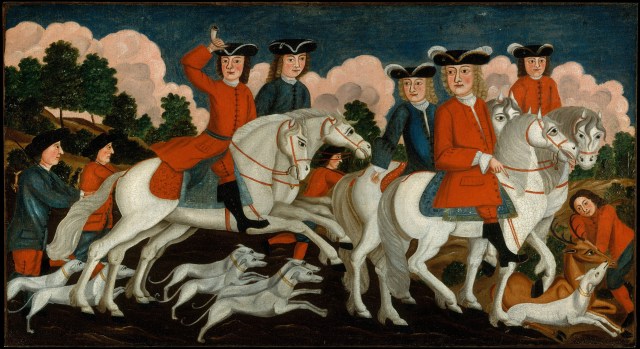
The Hunting Party- New Jersey. oil on canvas ca 1750. MMA 1979.299

Slightly turbulent and busy days chez Calash have resulted in a lack of postings, but work proceeds: Genesee and then New Jersey lie ahead, with some extra-interesting interpretation at Monmouth in late June. For a time, I despaired of figuring out what to do to occupy the time and interpret what was essentially a civil war in Monmouth County. The Craig House, while interesting, is no longer a working farm, so we couldn’t farm a not-farm. Then there’s the tedious issue of the not-home not-farming Craigs: on the day of the battle, John Craig is with the Continental Army and Ann Craig has taken off with wagons of chattel, two slaves, and her child. This began to seem a lot like interpreting the John Brown House without John Brown: they are more present by their absence.

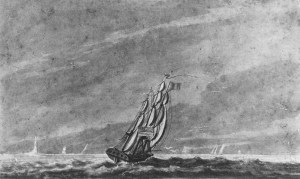
Full Sail off Sandy Hook- Entrance to New York Harbor. watercolor and gouache by Pavel Petrovich Svinin, MMA 42.95.2

What to do? Read more, of course, and talk and talk and talk with Drunk Tailor, who discovered the Association for Retaliation (yes, exactly what it sounds like: vigilanteism) and the Pine Robbers. Much satisfaction there, and finally I listened when he said, “Why can’t we all be refugees?”

Sometimes, you just have to give in to reality. The “London trade” flourished between New York and New Jersey, Sandy Hook providing ready access to the city and Staten Island, where so many Loyalists fled the radical Whigs of New Jersey. Male slaves ran away to join the British army, and the most fearsome and feared in New Jersey was Colonel Tye. The Retaliators promised “a man for a man” for every depredation Whigs suffered, while a similarly-chartered Loyalist association promised the same in return. Chaos reigned and people of all kinds fled the civil war and the uncivilized war. It promises to be an interesting weekend.