Making up Monday

From Jaipur, darling.

Sometimes you’re a jerk without meaning to be, usually because you can’t see past your own limited self. I was that jerk on Friday, when my obsession with a missing package led to unfortunate words with both a supplier and worse, my sweetheart, about an unexpected length of fabric lately arrived from India. Would that my brain would work faster, for by the time I’d figured out what to make of it, the conversation had turned, and an additional 300 miles lay between me and the recipient of my confusion and dismay.

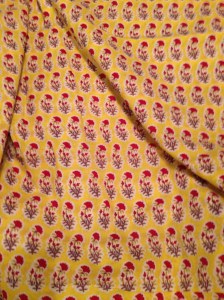
Despite my best intentions and resolve, I am a sentimentalist. This instinct sometimes conflicts with a devotion to honesty, for kindness often lies in elision. Confused? Short story: I don’t wear yellow, but a package arrived Friday with a dress length of printed Indian cotton, red and green flowers on a yellow ground.

“But Kitty,” you say, “Don’t you crave the hideous, the clashing, and the correct? You applaud Our Girl History’s choice of 1770s fashionable pink, though she prefers blue. Yellow is the haute couleur of the 18th century, fashionable everywhere, even in North America. You should leap at the chance to wear it.” (I was not thinking fast at all on Friday evening.) What made me bend my resolve– what will always makes me bend my resolve?

Petticoat fragment. Note yellow, with crudely printed lining. Wintherthur Museum 1959.0118.004
Petticoat fragment. Note the bright yellow, with crudely printed lining. Wintherthur Museum 1959.0118.004

Sentiment, of course, backed by research.

April, that cruel month, brought obsessive searches for Indian cotton print appropriate for the 18th century, as I looked at sample books and extant garments, searching for material to create frankly annoying clothing. Orange and green check with clashing Spencer and bonnet lining isn’t enough: I want to push my representation of the fashion sense of the past closer to truth. People in the past weren’t as matchy-matchy as we are, and their ideas of stylish, attractive, and fashionable were very different from ours. Loud was ladylike, and that’s a style statement I can get behind. Along the way, I ordered fabric in a pink and green (a departure itself) floral print on white ground, yardage now long overdue.

Textile Sample Book, British, 1780. MMA156.41 P34

A friend has been dabbling in these same waters, and made up a new gown for Mount Vernon, satisfyingly loud and clashing with our modern sensibilities about the past. Our mutual friend, also at Mount Vernon, assisted her in choosing a dress length for me, and reader, I was confused and lacking when it arrived. But like any good curator in a social history museum, it was the story that got me. How can I resist a gift from a fellow enthusiast in a pattern chosen by my sweetheart, on the grounds that I don’t wear the color? Reader, I cannot.

Think of Cranford, of lengths of dress muslin requested and never received, and the sentiment embodied in that fabric. Think of women in Providence craving an India print gown, of lovers, husbands, sons, ordering dress lengths at trading ports thousands of miles and long months from home. Think of the affection and thoughtfulness embodied in textiles brought back months after they were requested. Complex meaning is woven into that cotton, giving this dress length interpretive meaning before it is even a garment.

Now what? Now I have to decide which century/event this gets made up for: 1812-1817, 1778, 1804, 1768. There are many choices, but with the meaning embedded in the fabric, I’m most inclined to make something I’d wear often– not that this is particularly housekeeper-appropriate.

And about the research you ask? Yes, small floral print on colored ground is documentable to the 18th century. While early and European, here’s an example of an Indian motif translated by Dutch makers for printing in Sweden. Rhode Island merchants traded in the Baltic, so given the early date of this fabric sample, its arrival in North America could predate 1788 and John Brown’s first ship to China and the far east trade. Possible? Yes. Probable? We can have a lively discussion, in which I will point out the Brown’s love of all things French and French translations of bright, small motif print patterns. The printing factories in Sweden ran until 1771 and produced at least two relevant prints. Would my successful Presbyterian farmer have bought something like this for me in New York or Philadelphia? Would I have worn something so bright and loud? Am I overthinking this? Perhaps, but yellow is a new thought for me.

With especially fond thanks to Miss N and Drunk Tailor, to whom I also owe an apology.

15 Ways to Have a Bad Living History Event

The Enraged Musician. Chaos has a long history, and often I am for it.
The Enraged Musician. Chaos has a long history, and often I am for it. But not always.

For Organizers

  1. Do not advertise. Having no audience makes an event super-lame.
  2. Have no attendance limits on a closed site. Intense crowds and no security makes an event scary. Add alcohol for intensity.
  3. Do not publish participant standards or a schedule. Confusion and laxity breed chaos.
  4. Publish standards, but do not enforce them uniformly. Creating the appearance that standards are only enforced for people you don’t know erodes trust and credibility and discourages participation, reinforcing adolescent clique behavior.
  5. Do not highlight (or provide) participant amenities like water, toilets, or dry firewood.
John Greenwood, Sea Captains Carousing in Suriname. Good times, no?
John Greenwood, Sea Captains Carousing in Suriname. Authentically bad behaviour.

For Participants

  1. Don’t bring your own lunch, water, or powder.
  2. Don’t follow the rules at a new event. Standards are for chumps. Text your friends while minding a rope line and acting as an interpreter.
  3. Get drunk. Who doesn’t love an inebriate around gunpowder? Safety, schmafety. Besides, drunkenness is authentic.
  4. Smoke cigarettes on the field. You can always hide your hand behind your back, next to your cartridge box…what can go wrong? The captain will never notice.
  5. Make critical comments about the public and other reenactors just within their hearing. Don’t smile.

For the Public

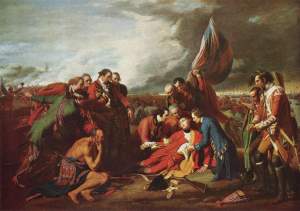
The Death of General Wolfe, Benjamin West. NGC
What, no dogs? The Death of General Wolfe, Benjamin West. NGC
  1. Bring a dog. Dogs love guns, drums, and cannons. “Cry Havoc! And let slip the dogs of war,” right?
  2. Ride your bicycle through the crowd. Make disparaging comments about the crowd interrupting your ride.
  3. Touch things and people. Touch reenactors’ tools, weapons, clothes, children, food. Heck, use their tools. It’s not real, it’s history, so it has to be safe–right?
  4. Interrupt people answering your questions, or better yet, someone else’s questions, and answer yourself.
  5. Get drunk, especially on a hot, humid summer day or night.

Stop.

Breathe.

Think.

Then speak or act. Think about what you’re doing. Is it sensible? Is it kind? Is it how you would like to be treated? Does you behaviour foster a pleasant and welcoming environment?

If not, don’t do it.

Criss Cross, or, My Checker’d Past

Every now and then I look up from what I’m doing (tiny stitches, usually, though sometimes budget math) and realize that Objects in Mirror are Closer Than They Appear. Oops. It was just yesterday I was daydreaming about miniatures, and now I shall want a paintbox and brushes in a mere six weeks– and those six weeks are punctuated by a courier trip, a couple of exhibits, not to mention shepherding The Young Giant through prom and finals.

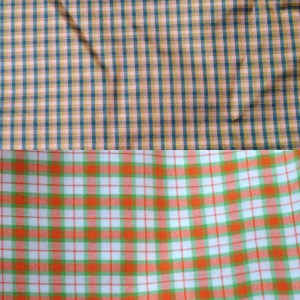
Top: check silk taffeta, Artee Fabrics Bottom: check cotton, Mood Fabrics
Top: check silk taffeta, Artee Fabrics
Bottom: check cotton, Mood Fabrics

This weekend, thanks to the SFR hunt for collar interfacing of an appropriate weight, I realized I’d better get a wiggle on my own sewing, and managed to hunt up the orange check from hell, pop it in the washer, and hunt up the pattern I intend to use.

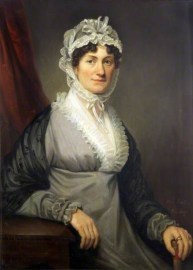
Mrs Catherine Morey oil on canvas by Michael Keeling, 1817. (c) Walker Art Gallery; Supplied by The Public Catalogue Foundation
Mrs Catherine Morey oil on canvas by Michael Keeling, 1817. (c) Walker Art Gallery

I’m stuck on that 1817-1819 range because of someone’s eventual and particular Mode of Transportation, so I was super pleased to find this portrait while trolling the BBC’s Your Paintings site. Actually, I’m pretty over the moon about this image, since it places that cross-over front firmly in 1817. I’ve made a version of this form already, so I can but hope the next iteration will be even closer to correct for the period, once I tweak the pattern a bit.

The pattern: therein lie so many rubs, often going the wrong way. Still, I remain enamored of the check and of the cross-front gown. Any checkered doubts were dispelled when Alison for reminded me of the sort-of-cross front check gown at the Met, whose catalogers are hiding behind circa 1820 which allows leeway back to 1815. Behold, of course, the ruffled neck of the bodice (I do expect mine will fit a bit better since I am squishier than a mannequin, and possess appropriate infrastructure).

Speaking of infrastructure, the appropriate stays are finished, entirely hand-sewn, and ready for deployment in pattern fittings before they debut at Genesee.

File_000 (1)

Six weeks to Genesee: at least one 1817 dress, another sheet, a portfolio and paint box, followed immediately by 18th century stays, a front-closing gown, and a bucket repair. Surely that’s all manageable, right?

Frivolous Friday: All of Everything

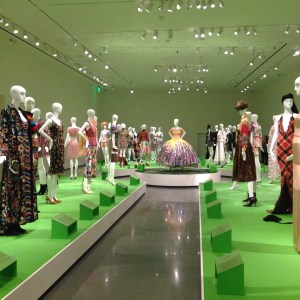
All of Everything: Todd Oldham at the RISD Museum of Art

Some days were made for a bit of hooky. This week, it was Tuesday– though how much can you consider a museum visit hooky when it’s the business you’re in? We took an outing down the street to the RISD Museum, long one of my favorite places in Rhode Island. The Costume and Textiles curatorial staff mount some amazing exhibits, from Artist Rebel Dandy to this latest, All of Everything: Todd Oldham Fashion.

Every time I go to the RISD Museum’s exhibits, I have serious wants, whether mochaware coffee pots or the Chinchilla Outfit– which my grandmother would also have coveted. There was a tinge of nostalgia in the visit, since most of us had lived through the 1990s, and recognized the styles that eventually leached into ready-to-wear from couture. Cropped sweaters. Shrunken jackets. Embellishments. Pattern mixing. Hey– I still dress that way!

Unknown artist Horace Vernet French, 1789-1863 Illustrations from the Journal des Dames et des Modes, ca. 1810 Engraving on wove paper, hand-colored Museum collection INV2004.506
Journal des Dames et des Modes, ca. 1810
RISD Museum INV2004.506

And legit it is, this pattern mixing. Funny how we stick to the same shapes and forms once we find what we like; so much of what I make and wear are variations on similar themes, no matter the century.

For some, dressing in the past is the only time they’re dressing up; their daily style is almost aggressively (or passive-aggressively) anti-style. But when the top hat comes out, look out: they’re dressed to the nines.