Wicked Inspiration

You know that musical? The one you can’t get tickets to unless they were willed to you by your grandmother because she was lucky enough to stumble out of the Tardis right at the box office on opening day, but had to buy them for, like, six years from now, and they’re actually for the Kansas City production? The one in which the founding fathers are, you know, brown? My friends and family assumed I’d hate the whole idea, but I don’t. Like so many people, I love it, and not just for the music, though my preferred method of psyching myself up for GeeDubs1790 or What Cheer Day is listening to the Stones or the Beastie Boys all the way up.

So, what then, interests me in “Hamilton,” and why do I think it relates to interpretation? This: the way that the show filters the concerns of the late eighteenth century through the lens of the twenty-first could make for enlightening listening.

My Shot gives me goosebumps: why? Is it because history and civics are finally sexy?

Maybe. But “Hamilton” as a whole, per Rebecca Mead in the New Yorker, “is a hymn to the allure that America promises the immigrant who aspires to reach its shores; it is also an argument for the invigorating power that this nation’s porous borders, and porous identity, have always offered.”

Porous identity. That’s part of why I’m fascinated. But just as “Sleep No More” and Occupy Providence (really really) were partial inspirations for What Cheer Day, “Hamilton” strikes me as the kind of production worth paying attention to. No, I am not suggesting that the paunchy reenactors start channeling their inner Biggie, though I might well pay to see that.

No, what I’m suggesting is that we reconsider what it is we’re doing out there on the field and in the historic houses, and not just what but how and why. Hamilton takes an unexpected approach to history and it’s going gangbusters, while Amazing Grace tanked. So it’s not about the costuming authenticity, though I implore you not to give that up. It’s about the passion. It’s about coming at things sideways.

What makes you love doing laundry, drilling with precision, telling local gossip, making soap, or whatever it is that you love best about your place in the past? Why does all this matter to you so much? What is it that we can learn about today as you teach us about the past? Let loose that love and passion, share those insights, and ten to one you’ll have more fun and excite more visitors.
Maintain an Even Strain

IMG_6471

Dude: I am conflicted. There are folks out there doing excellent work, but after reading some recent posts around the interwebs, I kept thinking, “Stockholm Syndrome much?”

I’m as much of a narcissist as the next person, and I think I recognize some of the folks being called out in various places for being critical of women’s roles in living history events. So, organize my own events? Come up with my own things to do?

Cool: challenge accepted.

I am, in fact, throwing down for the pleasure and pain of running a farm in late June. No, I didn’t organize it, but I was asked to take on a challenge and I have accepted, roping my favorite tailor into the effort as well. It’ll mean a bunch of studying, but in a pinch, I can always clean the house. We can rake, make refugees stay in the yard, and try as hard as we can to keep Quakers from putting radical ideas in the slaves’ heads. I think it will be hard, unpleasant, and uncomfortable—and that’s what I don’t like about the suggestions in the otherwise honestly well-intended and meant-to-inspire posts.

Playing at Quadrille. Oil on canvas by Francis Hayman. Birmingham Museums and Art Gallery

They’re so nice. They reinforce women’s subordinate roles in the past and present. Children’s activities? I might die, really, I might. If that’s your bag, go for it, please! We need it. It’s simply not something I can do.

No more can I talk about What People Wore. It’s not that I don’t care (y’all know I do) but that I want to move past the surface.

It’s not enough just to look great.

The Heir: Tom Finds New Wealth. William Hogarth.

Dive deep: find the dirt. Find the hard stuff. You don’t have to be nice. That’s my personal problem with what I’ve been reading: between the lines I keep hearing a voice suggesting that we be nice girls, that we simmer down. No, I’m sorry. I can’t. Reader, if you can, go for it.

But if you can’t, I want to tell you: Keep pushing. Keep asking. Keep speaking up. Challenge the status quo. Our Girl History did a great post on Well Behaved Women, and I fully support the work people are doing to represent the Well Behaved and the marginalized (shout out to the veteran with the knife-grinding cart: well imagined, sir!).

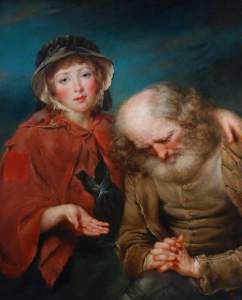
Russell, John; The Blind Beggar and His Granddaughter; The Bowes Museum;
John Russell. The Blind Beggar and His Granddaughter, oil on canvas, 18th century. The Bowes Museum UK.

Bring it. Bring the ordinary.

But if you can’t be ordinary or run the children’s games or be subservient or show how women dressed, that’s okay. For the love of god, someone, be desperate.

Be hungry, be angry, be resentful, be religious.

Whatever you do, don’t be afraid to speak your mind.

Of Chamber Pots and Train Seats

DSC_0361
Why yes: I was able to carry all my loot.

The Northeast Regional: Bane and delight of my existence, for while the night train at least allows you to sleep through the agony of an eight hour trip, and although the quiet car allows some solid time to for reading and writing, one’s seat mate can be unpredictable.

I am not a good seatmate. My legs are long, and I have a marked tendency to cry through several station stops (or states) when leaving someone I love. But the foolproof way to maintain seat independence is writing: reading over someone’s shoulder is rude enough that I feel little guilt in writing all the things I write about. On train 86, it was chamber pots.

DSC_0367
How fantastic will that look with blue?

Part of my southward trip was to the Market Fair at Fort Fred, where I was pleased to visit old and make new acquaintances in addition to shopping. Handkerchiefs: can you ever have enough? I think not, and was delighted to find one pretty much guaranteed to clash with any blue gown.

You can never have too much to read.

Thread is always useful, and I find it easier to purchase in the flesh, when I can get a better sense of gauge and color. I’d had a request for a period-appropriate notebook and a replacement pocket knife, and was delighted indeed to find one (I bought two) that will hurt less to lose.

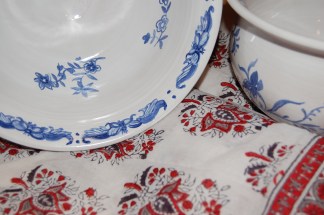
But, reader, best of all was the pottery. I possess enough self restraint to know I cannot venture near the mocha ware, for I might take leave of all common sense and purchase more than I can carry on the train, fit in my already full cupboard, or reasonably afford. Still, there was a custom punch bowl to see, kindly ordered for me some months ago, and, by the same potter’s hand? A chamber pot.

DSC_0363
Because I can, that’s why.

Not for me the lighthouse coffee pot (though of course I covet one). No, sir: the blue floral decorated chamber pot caught my eye, and have it I must. So I do.

I realize I have a bit of an obsession, and that one might consider this an unholy interest, but the utility of the device is not lost upon me, having had occasion to use one. Whilst staying in a 1787 house that remains unplumbed, I woke one Sunday at 2:00AM to pouring rain outside, and the urgent call of nature inside. Privies don’t faze me, but I lacked adequate rain protection and a fireproof light source. Happily, I had discovered a chamber pot in the house when I poked around it, and was able to find it by candlelight.

Two hip replacements make some activities more challenging than others, hence my tip: put it on a chair. Your floor will thank you.

Providence, After Dark

IMG_6651

Yes, I like to burn my candle at both ends: let’s get that out of the way up front, as I admit that yes, I am recovering from strep throat contracted a mere week before the evening program, and that immediately after said program, I hopped on the night train to Virginia for a quick vacation.

I walked to the train station, and was struck by the contrast between the closeness of the house lit only by [LED] candlelight and the openness of a city incandescently bright. I’ve walked Providence streets at night for decades, and never appreciated street lights so well until I knew the city didn’t have oil street lights until 1820.*

The LED candles aren’t as bright as real candles, but they’re safer and come remote-equipped.** In the end, I ordered a total four dozen, forgot I’d ordered four dozen, and requested only six dozen AA batteries (each candle takes two), so spent the late afternoon scrounging power sources. With this many candles, we were able to put eight in the Waterford crystal chandelier in the formal parlor, and watch the light play upon the ceiling, even if the room wasn’t fully illuminated.

IMG_6653

We kept the hallways and central stair lit for safety, and gave guests or groups of guests battery-powered candles to carry as they made their way through the house. (All sixty-plus spots on the two tour slots were fully booked.) Downstairs, each of the three docents from our study group interpreted a room: Mrs JF in the dining room, talking about dining and entertaining; Mrs MF in the formal parlor talking about sin, crime, and control; and Mrs AB in the informal parlor talking about novels, music, and family gatherings.

Upstairs, the Director of Education, Ms T, took over one bedroom where she talked about sex and I took another to talk about bedtime, bedding, bedbugs, vermin, chamber pots, and hygiene. Of all sixty-plus visitors, only one, a young man, asked about menstruation. Perhaps the rest were too overcome by the thought of Hannah Glasse’s bug bomb (ignite a pound of brimstone and a Indian pepper in a tightly closed room, exit quickly, and leave it for five to six hours) to ask more intimate questions.

IMG_6661

It was a popular program, and I can imagine doing it again. It does make me wonder about a What Cheer Night, and what that could be like; how far can we push the ways we use a historic house and its contents, when it’s only one day a year?

*It took until 1822 to get a sidewalk committee to concern itself with smoothing the rough patches and straightening the paths; we could use a reconstitution of that committee, thank you.

**Yes, I believe the site manager feels like Dumbledore every time she uses the remote, though she is not yet saying “Nox” as she wields it.