Back to Basics

Landscape with Rising Sun, December 1, 1828, 8:30 a.m. Artist: Joseph Michael Gandy (British, London 1771–1843 London) Date: 1828 Medium: Watercolor over graphite on white wove paper Dimensions: sheet: 4 3/16 x 6 3/4 in. (10.6 x 17.1 cm) Classification: Drawings Credit Line: Harry G. Sperling Fund, 2005 Accession Number: 2006.46
Landscape with Rising Sun, December 1, 1828, 8:30 a.m. Watercolor by Joseph Michael Gandy. Metropolitan Museum of Art, 2006.46

Despite the assertions of Mr Eliot, I find December to be the cruelest month. In each of the past five years, December has brought me drama if not disaster, usually on a grand scale. After the immediate crises passed, I tried to figure out what I could learn, really, from the things that happened.

Scandinavian tradition puts the start of Jul at the solstice, and here we are: at the moment when it’s traditional to stop the spinning world to consider where we are, where we want to be, and what we really want. (Hint: It’s not a toaster.)

I write a lot about authenticity, and after The Noble Train, I thought about how authenticity isn’t just in what we wear, or carry, or eat, or how a day is run: it’s also in who we are. The way some of us are made, we cannot be other than who we are. It’s akin to the real thing: you know when it’s right, and it matters.

Finding the real and the true isn’t easy– brass ladles, shawls, love, yourself– it takes time to develop a good eye, and honesty often hurts.
IMG_5534

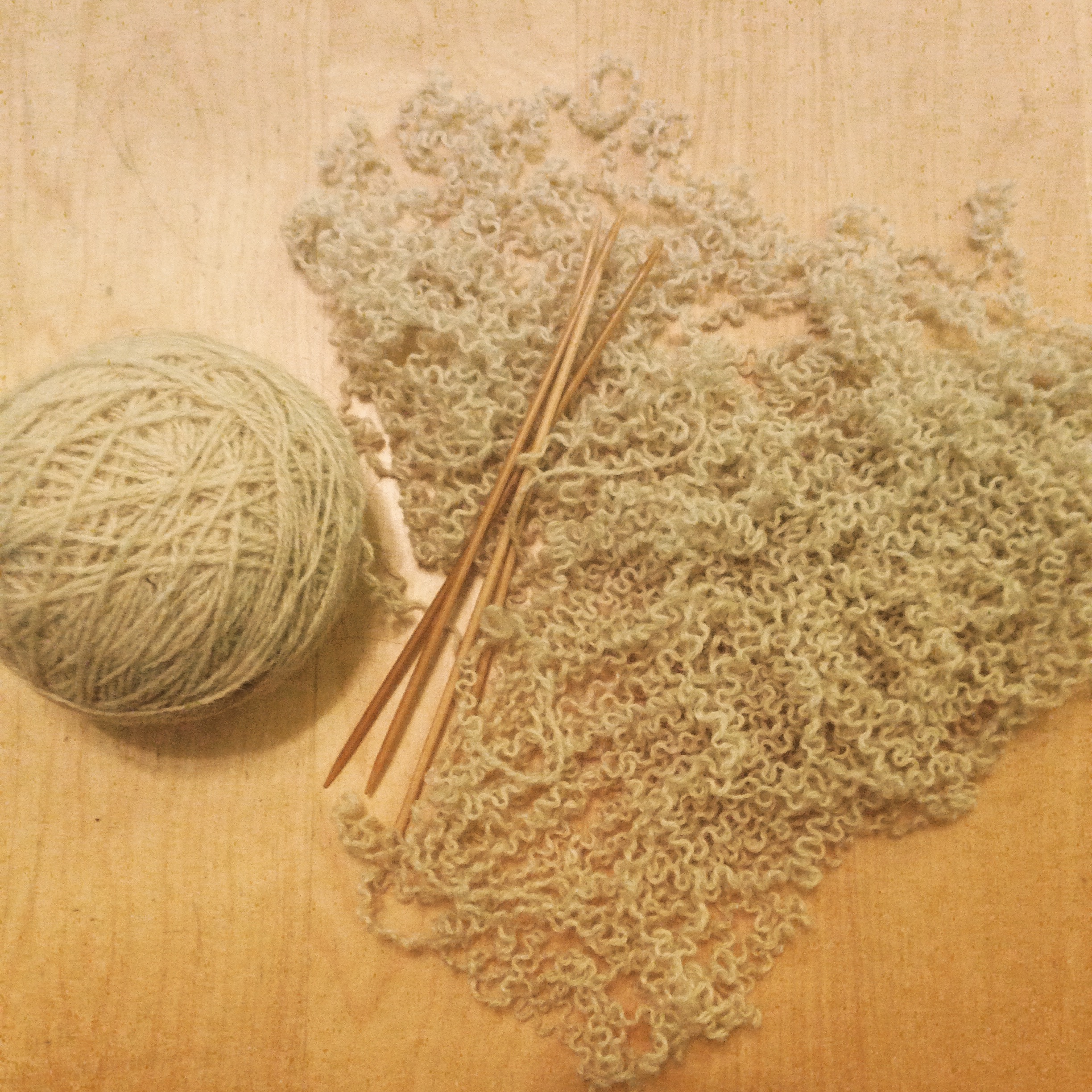
Taking apart the things you’ve made isn’t easy, but sometimes that’s the only way to get them right. Mr Hiwell learned that setting linings and making mittens. Sometimes the things you must take apart aren’t tangible, but are concepts, organizations, or beliefs. That work is much harder than undoing and redoing a sleeve seam or taking apart and recutting a box lid, or frogging a stocking.

If you’re a consistent reader, you know I won’t tell you what to wear, or carry, or eat. I’m much more interested in helping people figure out what questions to ask than I am in giving answers. It’s what we don’t know, and the assumptions we overturn as we learn more, that makes living history– and living– worthwhile to me.

IMG_5557

So while I don’t encourage you to reduce your actual house to stone walls alone, I do encourage you to question your house of assumptions, and the why of the things you do.

Mr Hiwell Chased by a Chihuahua, and Other Minor Disasters

Of course we can read maps. GPS has not spoilt us at all.

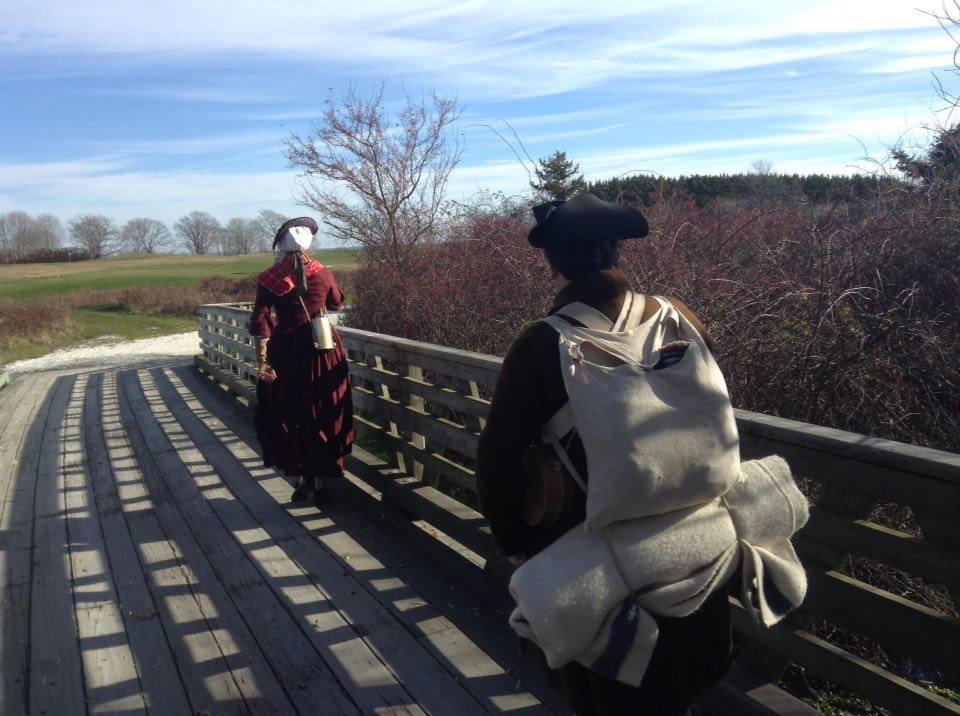
Bored over the Thanksgiving holiday weekend and possibly jealous of images we might have seen on social media, Mr HiWell, Low Spark, and I concocted a plan. Or perhaps I made a suggestion that seemed like a good idea at the time. Screen caps of message threads indicate that I probably was the root of the evil of getting up early Saturday morning to put on historical clothing and take a multi-mile walk.

File_006

We know it was at least seven miles, and may have been nine…we went off the trail in a couple of places. But the lads are going to Trenton, and need to get in some walking time, and now that it’s shotgun deer season, the number of places we can safely hike are fewer. There’s no blaze orange in broadcloth– yet.

And this wasn't the squeeziest photo op.
And this wasn’t the squeeziest photo op.

The walk began harmlessly enough, through corn fields and brush. We forded a stream the easy way (I suggested fording a la the 40th but the lads opted for the bridge.) The Sakonnet Greenway Trail maintained by the Aquidneck Land Trust is pretty mellow. Flat (unusual here), relatively free of traffic noises, and used by dogwalkers, it seemed safe. Then we met the golfers as the trail skirts the edge of the Newport National Golf Course. We were too nice and said yes, they could have photos with us. Of course, they had clubs and we didn’t.

File_002(2)
We could have ridden in style.

When we went off trail to loop up to East Main Road, we encountered many homeowners and many barking dogs. When we told one woman we were off to a Paul Revere and the Raiders tribute band concert, she noted that “the kicks get harder to come by.” Further on up the road, two boxers charged the fence that enclosed their yard, startling us– but the real danger came from the chihuahua that charged up the road after us, barking madly. The children’s rhyme about “the beggars have come to town” seemed all to relevant.

The Kitty Who Walked Alone

By the end of the walk, there were many references to Captain Sobel and Currrahee, though I thought more of Rudyard Kipling’s The Cat That Walked By Himself.

But when he has done that, and between times, and when the moon gets up and night comes, he is the Cat that walks by himself, and all places are alike to him. Then he goes out to the Wet Wild Woods or up the Wet Wild Trees or on the Wet Wild Roofs, waving his wild tail and walking by his wild lone.

Once More, with Feeling

Ajax and Cassandra, Oil on canvas, 1806. Johann Heinrich Wilhelm Tischbein [Public domain], via Wikimedia Commons. Großherzogliches Schloss Eutin

Mansplaining. It’s a thing. I’ve written about it before. (Dude, I’m pretty sure I know you are.) Better writers than I have tackled the topic in auspicious titles like The Atlantic.

When I write about specific experiences at Fort Ti, or Eastfield, or about “The Hobby” generally, that writing does not mean that I didn’t enjoy myself at events or sites*, or think they’re not doing a good job. It doesn’t mean I’m going to quit the hobby, or that I hate men. It means I’ve taken issue with specific patterns of behaviour that affect not just me but others in the hobby- and sometimes issues that don’t affect me directly, but are serious and need to be addressed

Woodcut illustration of Cassandra’s prophecy of the fall of Troy (at left) and her death (at right). Giovanni Boccaccio’s De mulieribus claris. Penn Libraries. Inc B-720
To address the comments here, I have to say that I understand Sharon’s point, and I fully expect officers to treat me as if I am invisible during military reenactments. I’m calling out after-hours socializing behaviour. Still doesn’t mean I didn’t have a good time, doesn’t mean that I don’t enjoy all the conversations I have, but I note the fiercely gender-binary nature of discussions and call them out. I’ll call out the talking over and interrupting, too. I get that at home from a 17-year-old. I get that at work from men I supervise– with the exception of those who served in the military, thank you very much.

I don’t find civilian reenacting a completely mansplaining-free zone, either. It’s better, sure, but this is a societal issue, not a camp- or hobby-specific issue.

And, to Drunktailor, yes, you’re about half-right. The older organizations, the Big Three, the classic units, have more deeply ingrained habits. But when I see younger men and newer organizations perpetuating behaviour patterns I’ve seen from the guys they say they don’t want to be like, I think it’s worth calling out. There is a generational shift, on that you and I agree. But one can become the thing one hates most, or at least adopt some of their patterns, if you don’t examine, and then break, the mold completely.

Further, I believe the young women in living history today will not tolerate nearly as much as I did, and do, in their personal or work lives. They’ve grown up fully in the time of Title IX. 

Organizational change is hard. Societal change is hard. It starts with individuals. Listen. Women being talked over have talent, knowledge, and skills that can help move living history forward both professionally and avocationally. They have research, sewing, organizational and management skills that can vastly improve visitor and reenactor experiences. 

Fail to listen at your peril. I’ve said it before: Adapt or die.

*And if you ever wonder whether or not I did enjoy an event or site, feel free to ask me about it– or anything else! kittycalash (at) gmail (dot) com. Thanks for playing!

Lysistrata on the Lake (and elsewhere)

Let me be clear: Fort Ti was amazing. It was everything I’d hoped for. Far away, made of stone, populated with people I like, with an event cleared of all the crap that makes me crazy.

File_000 copy

The issues that enrage me are both societal and hobby-specific.

While boys were boys and women were women this past weekend, I found myself tired out by biologically deterministic behaviour. For the love of Christ, you can listen to a woman, not talk over her or interrupt her even if:

a) she is not your boss or mother
and/or
b) you do not want or expect to sleep with her.

Gentlemen: we are human beings as smart as- if not smarter– than you. If we are smarter, society has taught us to manage that for you, so you won’t feel <ahem> small. I know that what men fear most is humiliation (the bravest ones will admit it) and what women fear most is violence (it’s true).

But a woman’s interest in history, or even military history, should be as joyous to you as your male friend’s interest.

So why the shouty?
Why the taking over of the conversation?
Why the relegation of women to a separate bench?
Why am I pointing this out?

Well… because even some of the best progressive reenactors have trouble getting past uber-traditional gender roles.

I get it, really, I do. I am accustomed to being a woman in a (hyper manly) man’s world.

I studied sculpture in college in the Dark Ages and I know from male-dominated fields. I ran a foundry in grad school, and a bunch of mostly-male work study students. I’m an owner’s rep for construction projects, and work with a lot of different contractors and construction workers.

But that doesn’t mean I have to like it or tolerate it, as any of my history, art, or construction associates will tell you. My younger counterparts have even less tolerance than I do, so I advise you to listen up, think about gender roles, gun shows, assault/predation and interpretation or consider Lysistrata the future you have earned.

It’s really simple.

You like living history?
We like living history.

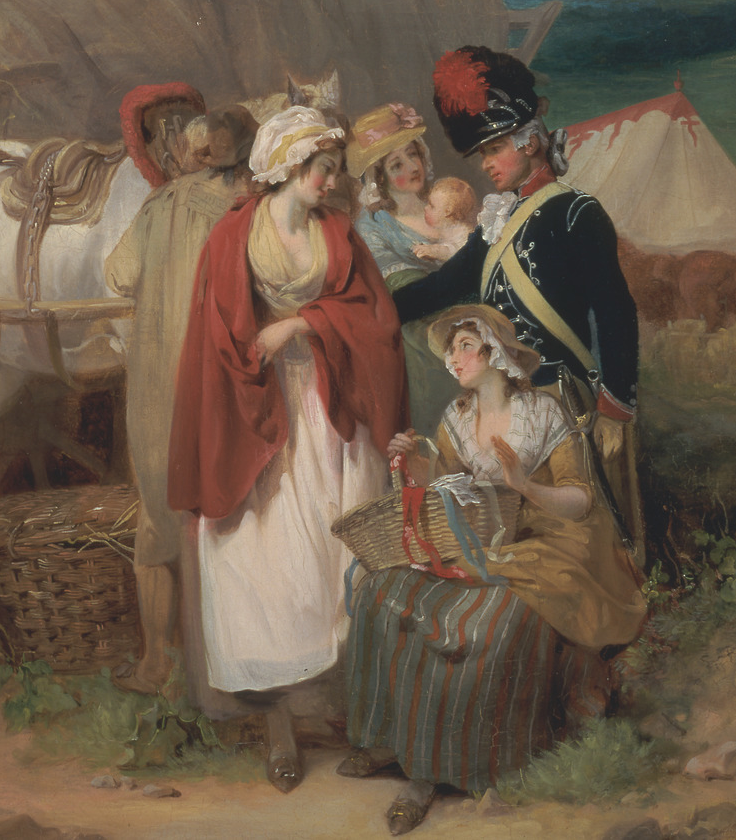
Francis Wheatley, 1747-1801, British, Soldier with Country Women Selling Ribbons, near a Military Camp, 1788, Oil on canvas, Yale Center for British Art, Paul Mellon Collection

Let’s play together better to more accurately represent the past without replicating crappy gender relations. If you start listening and stop interrupting, we’ll stop laughing at you.