Experiencing Eastfield Village

The Young Mr on site.

Mr Hiwell, the Young Mr and I ventured out to Nassau, New York this weekend to be part of Founders Day Celebration at Eastfield Village. The gents were part of the 1833 militia muster, while I traveled out intending to interpret tailoring with Mr JS, and to provide meals for the militia.

It’s an interesting assemblage of buildings, and we were pretty curious about what the site and the experience would be like. While OSV and Genesee are also assembled villages, they’re museums, with different missions and guidelines; they’re also larger, with electricity and flush toilets for visitors and volunteers alike. That means they’re lovely, but not nearly as immersive as the pitch-dark privy experience.

The back of the Benjamin Culver house, or, our dining room for dinner.
Wear all the patterns possible, please.

There was a lot to consider at Eastfield, but I’m tired from driving back and will stick to the simple things for now.

I was incredibly fortunate to have a bed—indeed, the entire 1787 Benjamin Culver house—to myself for sleeping. Friday night, after changing into period clothes, we went up to the Yellow Tavern to eat our supper (pasties brought from home, with hard cider for Mr JS and myself). The candle lit taproom was cozy, and I understand from Mr JS that the sleeping quarters upstairs were even cozier.

We cooked our meals in the Yellow Tavern kitchen, and ate sometimes in the taproom, and sometimes standing in the kitchen, except for dinner, which was served picnic style on the grass behind the Culver House. (Saturday supper was provided by Eastfield Village and prepared by Neil DiMarino with able help; that deserves a post all its own.)

Cozy is as cozy does.

Much of time was spent on women’s work, interpreting daily tasks to a stream of visitors travelling through the house from front door to back, and sometimes upstream. The scullery—for want of a better word—had a soapstone sink which drained through the wall, which made dish washing pretty plush, and provided entertainment for all who cared to witness it. No chickens were present, but from washing dishes at Coggeshall Farm, chickens would have enjoyed the ground beneath that window drain.
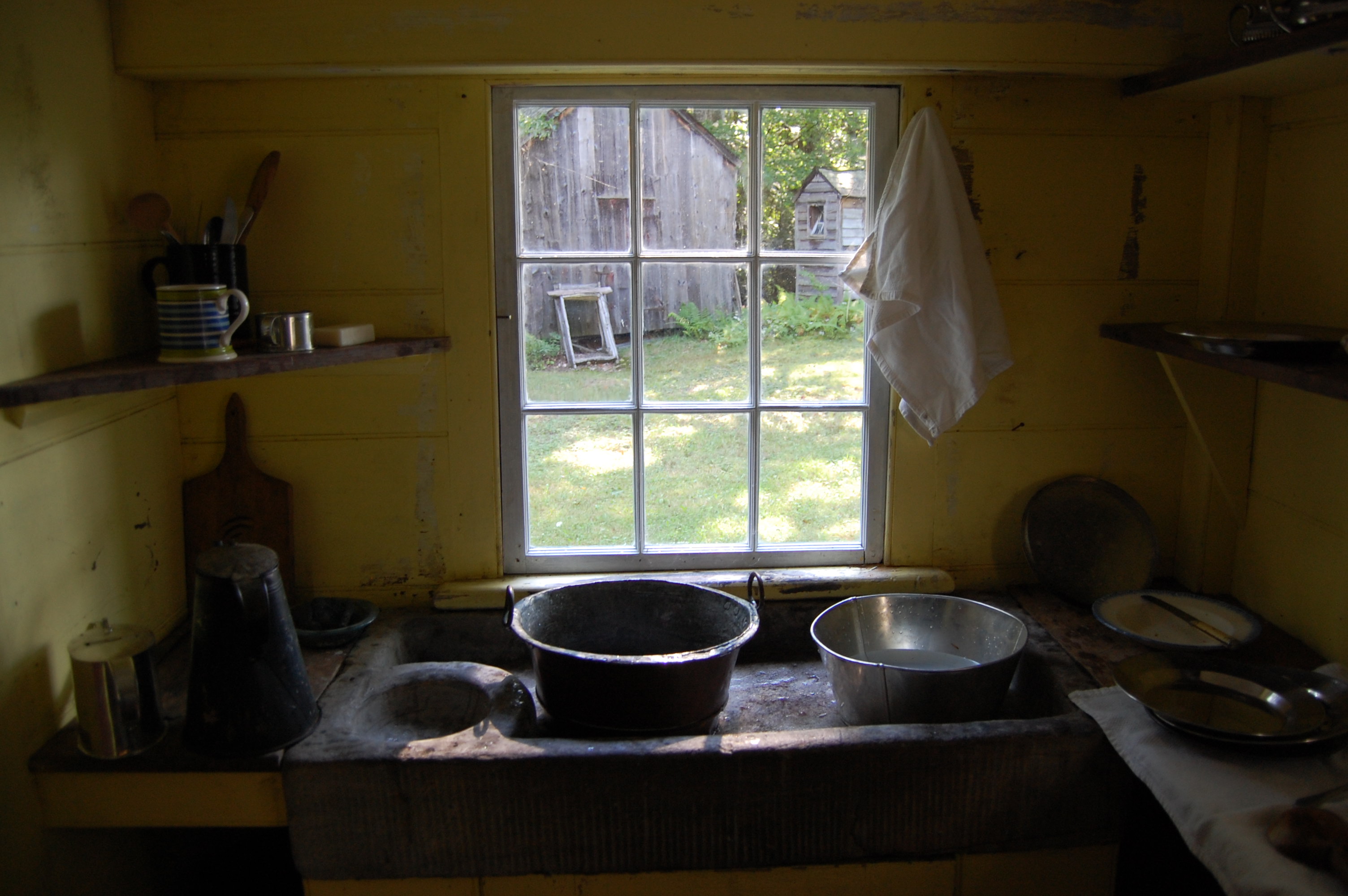
The view from the scullery: not bad, really.

There are always curious questions, from “Is this a house?” in a tone of wonderment, to “Where did you get the water?”

Gentle reader: these stumped me, briefly, until I was able to gather my wits enough to reply, “Yes, it’s a house, built in 1787,” and to assure the visitor that people had, in fact, managed to live in it. The water question was somewhat more perplexing.

I started with, “Well, I got this from the hose, but they would have had a well,” when the visitor stopped me. “No, I mean, how did you get it hot?”

The kettle had been over the fire in what would be the kitchen room where Mr JS and I were set up to sew, and the fire was still producing heat, albeit from coals. Then I realized she had not been among the clump of people watching me remove the kettle from the crane so that I could pour hot water into my basins. I pointed to the kettle, and said, “Over the fire.”

Fire hot.
Fire hot.

It’s hard: there’s so much we take from granted in our own daily 21st-century lives, let alone what we become accustomed to when we inhabit the past. Interpreting between the two worlds, things can be lost in translation.

I’m always curious about what I’ll learn when I travel to a different century, and I think what I learned, again, was that I find it hard to find a way to interpret women’s lives and work in the past that does not reinforce stereotypes of “life was hard” and “roles were constrained.” Enough! I tried explaining the greater freedom some women enjoyed in the early Federal era, in contrast to the pre-Revolution and post- Great Awakening eras, but that wasn’t entirely successful, and would you believe that story from a woman washing dishes?

What I may really have learned is that I’ve done enough time in the kitchen and the scullery; I’d rather be the tavern keeper than the cook or scullery maid. Women were in business, and while never on the scale of partnerships like Brown & Francis, women as merchants, tavern keepers, landlords, and, yes, tailoresses, are underrepresented. It’s easier to talk down the scale than it is to talk up the scale from the washbasin to the shop or tavern, so it’s time to leave the wash basins aside for a bit.

Done with dishes for now, thank you.

On & Off the Grid

It’s been a very busy time chez Calash, with many changes underway and to come. It’s hard to keep up with all the writing I’m doing everywhere, but eventually I’ll be back on topics of authenticity, standards, and whimsical Wednesdays.

This week, though, is all about checks. (Most weeks are, in some way, aren’t they?) Not paychecks, silly: linen checks.

We are headed out to Eastfield Village Friday afternoon where Mr Hiwell and the Young Mr will join in the 1833 militia muster, and Mr JS and I will occupy a house as a shop/tailoring business/punch-making and cooking establishment of one kind or another.

Mr Hiwell has been warned to expect a diet unlike his norm, and since his roundabout is white, we will quickly know if he is smuggling Oreos and barbeque sauce.
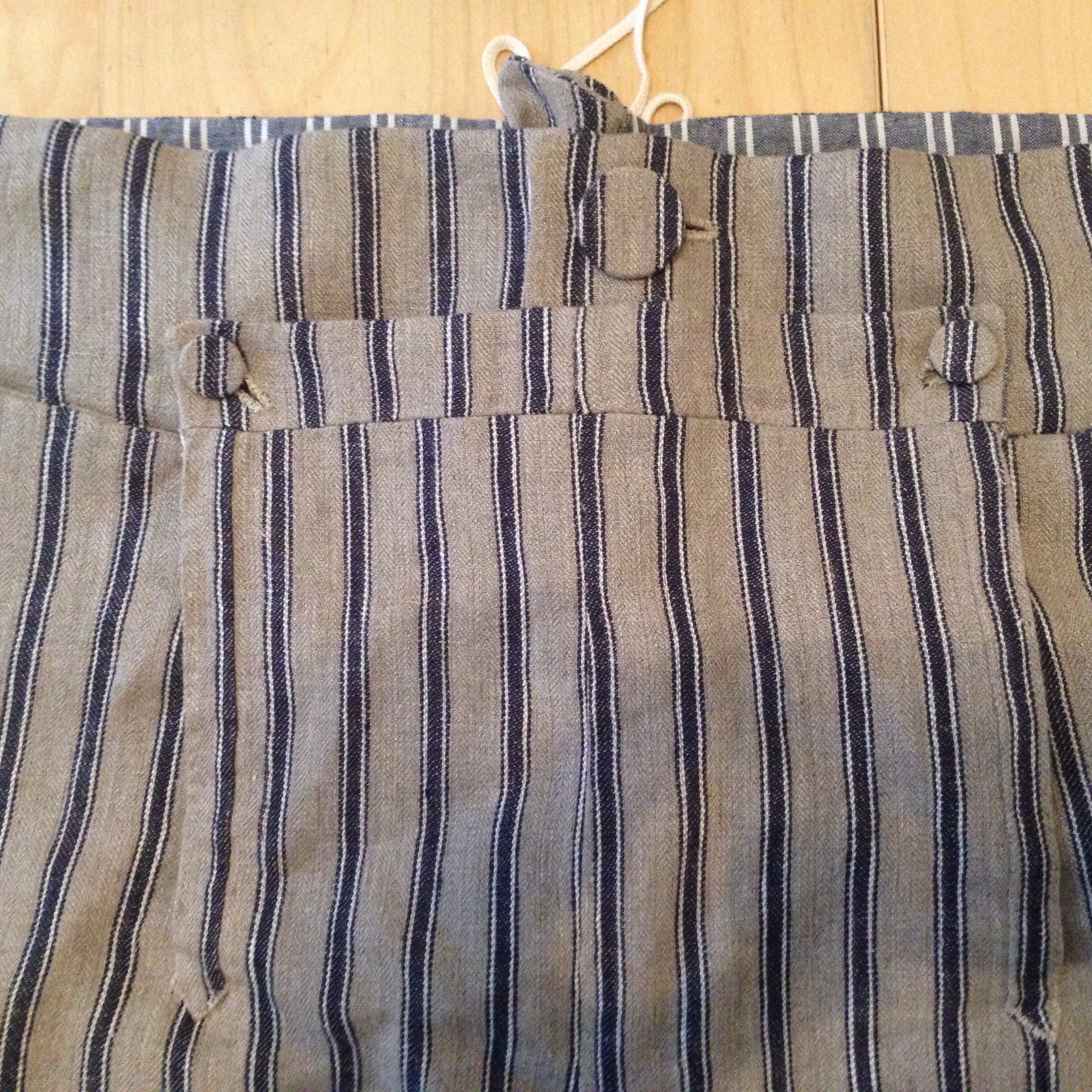
 For the Young Mr, I have been making trousers. Yes, I do like things to line up. I wasn’t even paying that much attention when I cut these, but apparently that was  was enough.

Yes, even the buttons.


Sigh. It’s a thing.

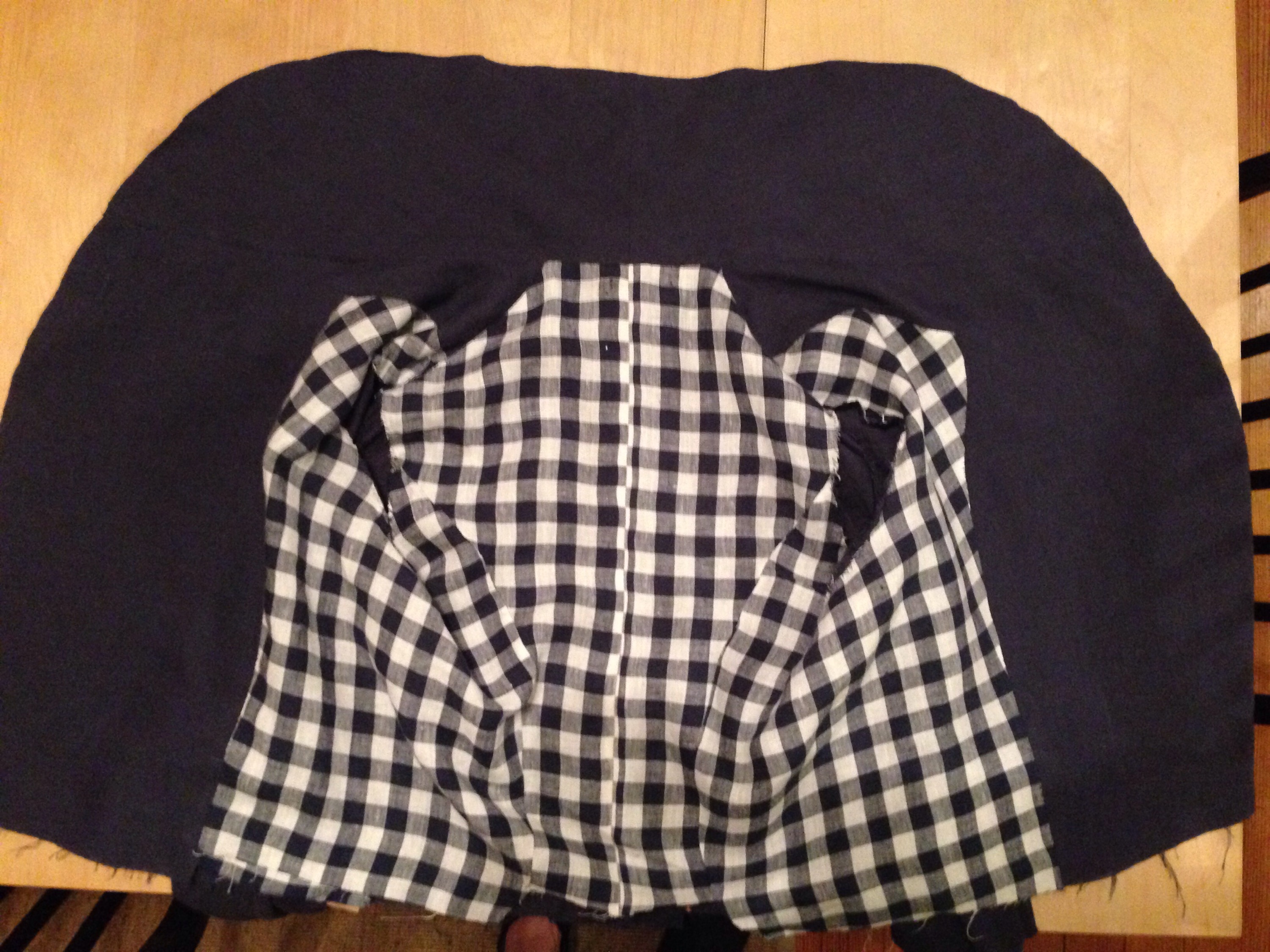
He’s also got a roundabout in the works, which I must focus on more closely to finish. This is patterned from an original in Henry Cooke’s collection, but… Mr. Cooke and I, on a very sticky Tuesday afternoon, did not have the Young Mr at hand to measure again. The original was too small: that we knew. What we did not know was that the boy had taken on a man’s shape– or, as a friend says, “he’s dude-shaped now!”–and the additions we made were not enough, except (barely) to the sleeves.


Oh, well. There was just enough to make it all work, and after some trials I realized it needed a lining. What kind of lining? A checked lining, of course!

It seems okay, but these collars are strange to  me.


Well, at least he will be clad.

Let you think  I’m sewing only for the lad, I am in fact working on a gown for myself. There’s a hopeful yard or so of another check’d  linen from the stickiest fabric store on 39th Street lurking, but I do not think that apron will happen this week. Perhaps John Brown’s housekeeper will finish it someday.

At least there are already gowns and aprons ready-made that can travel with me. Someday soon I’d like to finish my new stays… winter will come soon enough, and more sewing then.

The Myth of Perfection

Ain’t nothin’ perfect.

Jackie’s got good points, and although I think they are slightly tangential to where I thought I was going on Monday, let’s pick them up.

Completely 1819 to represent 1819? My standard reply to pretty much every question is: It depends. Who are you, where are you, what are you doing? Middle class or higher bride? You are so 1819 it’s scary, from your skin out, head to toe. Lower class? You’ve altered your best dress, if not made a new one, and refreshed your accessories.

Look, folks: part of our problem is that we forget that the people in the past had the same covetous, jealous hearts that we have. They had wants and yearnings, for each other, for new bonnets, for velocipedes and overcoats. They were just as interested in impressing each other as we are, even if they sublimated desire into poetic images of greater obscurity than James Brown ever used.

I thought about this notion of mixed up times for clothing as I stood on a landing at work yesterday. Skin out, here’s what I wore on 1 September 2015:

  • Black Natori sports bra, purchased in Boston on January 10, 2014 (I saw my surgeon so I remember.)
  • White cotton tank top, label gone, acquired ca. 2013, possibly from Target
  • Blue and white striped cotton 3/4 sleeve J. Crew blouse, 2006
  • Black Nike undershorts, 2010
  • Lucky brand jeans, August, 2015
  • Red suede belt with brass buckle, ca. 2004
  • Red suede Naya oxfords, late winter, 2014

The oldest thing was the belt, followed by the blouse. The most stylistically determinate item is probably the jeans, since waistline height and cut of the legs fix trouser/jeans style. So, what could this mean for us, when we dress for the past?

Let’s start with dressing for the American Revolutionary War period, 1775-1783. What you wear depends of course on who and where you are; here I am in New England, wishing I was middling sorts.

Detail, Mrs Richard Skinner, oil on canvas by John Singleton Copley, 1772. MFA Boston, 06.2428
Detail, Mrs Richard Skinner, oil on canvas by John Singleton Copley, 1772. MFA Boston, 06.242

If I wear an open-front stomacher gown in 1775, will I still feel comfortable in that in 1783, when the ladies of means around me have switched to closed-front gowns? Or will I feel like I’m wearing bell bottoms and a macrame vest to high school, while the cool girls are wearing pegged Guess jeans and Fair Isle sweaters? (Not what happened to me, but you follow my point). Think how much American fashion changed between 1975 and 1983, and while you will surely see pieces carried over– watches, headbands, socks, Tretorn sneakers– they will be primarily small pieces, accessories, and not main garments.

Lady Williams and Child, oil on canvas by Ralph Earl, 1783. Metropolitan Museum of Art, 06.179
Lady Williams and Child, oil on canvas by Ralph Earl, 1783. Metropolitan Museum of Art, 06.17

That’s really want I think we want to get at: Yes, people mixed up clothes, wore favorite things, wore things out. But then as now, they wanted to be stylish. The more care you put into imagining yourself in the past, really being that person, the more convincing you’ll be. You won’t be perfect, and authenticity is as unachievable as objective truth, but you will be closer to real, and yes, even the public will know.