Sounds like the start of a bad joke, doesn’t it? It could also begin, “A weaver, a blacksmith, and a curator walk into a diner,” but it doesn’t. Genesee was fabulous, and there will be words soon, but after 8 hours on the road, there are only photos for now.
Courtesy Burnley & Trowbridge
Supervision required
I desire a nankeen suit, dyed pink!
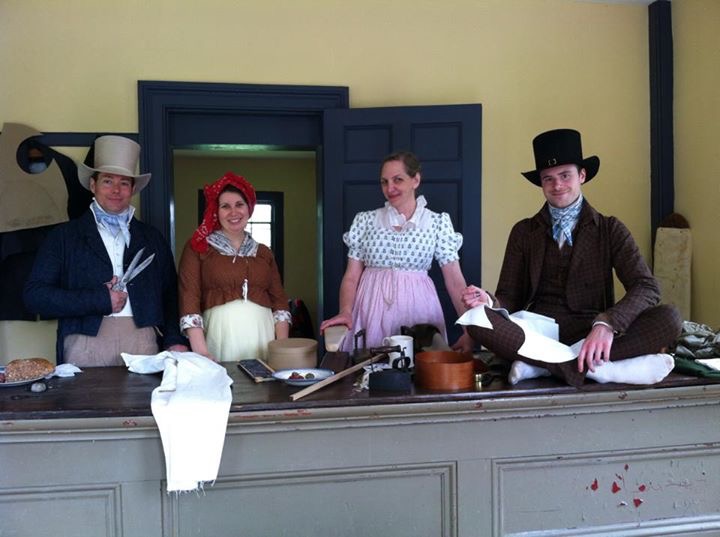
Two of the Tailors & the Tailoress on Sunday morning
Mercury is retrograde and the schedule is tight, even for me, as I made the plans I’ll put into action at the end of this week: a special event Thursday night at work, followed by mad packing and a drive pretty far into New York.
I did say sheer.
Yes: I am going to Genesee. It’s a long drive from here, so I’m happy to be picking up some friends in Albany (neither of whom live there) for company and some relief behind the wheel. Of course we’re taking our car: it’s the Quartermaster cart.
Yes, I am a little crazy, but it does make life interesting.*
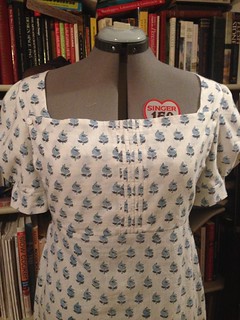
Finished –even hemmed– days before the event!
The gown is made from fairly sheer block-printed Indian cotton found on eBay. The pattern is based on one in Nancy Bradfield’s Costume in Detail with a bib front and tucks in the center back. To help with measurements, I also referred to the bib-front dress in the back of Bradfield’s book, as patterned on the fabulous 19th US site, as well as Janet Arnold.
The first bib-front gown I made ended up a little slanted: your mileage may vary, but I find patterning on opioids is not recommended (I sewed while recovering from hip replacement surgery). This one seems a little better, though the fabric came in for some commentary when I was working on this in a room full of light infantry “men.” We devolved from “chicken on flower” to “Seagull on a bush” in describing this buta-like shape. I only bled a small amount on the tucks, despite texting while sewing.
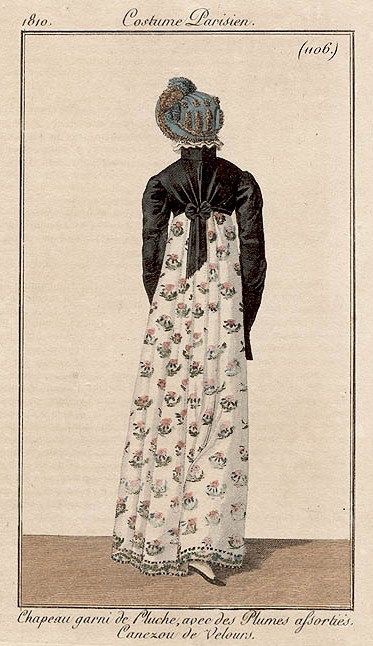
Canezou de Velours, 1810
Inspired by this 1810 fashion plate, I made a black velvet Spencer as well. That’s finished, save for the buttonholes, though there will be no texting while button holing.
Men’s waistcoats often have cotton or linen at the CB neck.
It got pretty matchy-matchy when I did the lining.
You will note that the plate describes a “Canezou de Velours.” Canezou was new to me, and while I don’t trustthe internet too much, here we are with Larousse:Vieux. Corsage de femme en lingerie.
Huh. It seems to be a lightweight-bust length garment for women.
Here’s the OED:
Oxford English Dictionary
canezoucanezouHist.
(ˈkanzu)
[Fr., of unknown origin.]
A woman’s blouse-like garment of muslin or cambric. Also attrib.
1827Lady’s Mag. Sept. 510/2 A canezou spencer of embroidered muslin. Ibid. 511/1 Muslin canezous over high dresses. 1893 G. Hill Hist. Engl. Dress II. 241 A cambric canezou..with sleeves full to the elbow. 1898Daily News 26 Sept. 6/4 When the Restoration came in 1815,..Fleur-de-lys appeared on everything… The canezou replaced the hideous spencer.
Ah, the hideous Spencer. I rather like them, myself.
*A very long time ago, I had a drawing teacher who said there is never an excuse for being bored. There is always something to do, to see, to observe. That was my first lesson in being present. Perhaps I take this statement a bit too literally.
Spencers. hand-colored etching published by S W Fores, 1796. British Museum, 1851,0901.782
Spencers were clearly the rage for well over a decade, turning up in satirical prints from at least 1796 (We’ll get to that satire soon). I was wrong when I questioned the Maine catalog record that called a man’s short coat a Spencer: there were Spencers for men.
Here, everyone is wearing a Spencer down to the monkey and the dogs. What I find particularly interesting is that the short Spencer jacket is worn over the men’s coats– this is an entirely new concept to me. Yet, here it is again, in the “Pupils of Nature” print.
Pupils of Nature.hand-colored etching published by S W Fores after Maria Caroline Temple, 1798. British Museum, 1867,0713.409
Were Spencers were the 18th and early 19th century equivalent of Members Only or Barracuta jackets? (You will know a red Barracuta–even if you think you don’t.) Perhaps. They do seem to be a splashy unisex fad in the late 1790s that gives way to women’s wear, but that’s a thesis in need of more research than Frivolous Friday demands or permits.





 Kirsten Hammerstrom
You must be logged in to post a comment.