La famille Anglaise à Paris.Plate 11 to ‘London und Paris’, x, 1802 [1803]. Explanatory text, pp. 90-5. Copy of No. 11 in ‘Le Suprême Bon Ton’ series, see BMSat 9957. An English John Bull stands stolidly full face with clasped hands, a grown daughter on his right arm, his wife on his left arm. With them are two tiny little girls and a grown-up son, also stolid. A Frenchman and a lady attitudinize elegantly on the left. 1802 Hand-coloured etching. British Museum 1856,0712.605
Mr JS and I have amused ourselves of late not just with thimble chatter, but with this satirical print of the English family in Paris.
I’m not nearly as funny as Mr JS, who pointed out that the bonneted girl on the far right is “I literally can’t even right now.” I think of her as Lisa Simpson, 1803. That’s the voice I hear reading the line texted to me: “I just want to pull this chemise dress over my head and die. Could someone with yellow fever cough on me?”
The father is Homeresque in his proportions, and nearly as befuddled. The artist is clearly mocking this poor family, contrasted with the graceful Parisians at left, but only the two youngest are aware, hiding in their cones of shame.
That deep coal-scuttle-like bonnet is mocked in other engravings; it is probably closer to the actual form of Julia Bowen’s cold scoop of 1799 than my approximation this fall. Julia would surely have known the shaming purposes of those grandiose and over-sized calashes: “Go sit in your calash and think about what you’ve done!” Mr JS quipped.
Appropriately enough, the silk I ordered to make my own calash of shame has arrived at the post office. Dark green taffeta envy lined with the bright magenta of embarrassment: clothes are so emotional.
I troll the interwebs in the fishing and not the under-the-bridge sense: there’s a lot to read out there. Still, I’ve kept one eye on the feather-and-flower kerfluffle that erupted in certain circles this week, but have been much more interested in documentation of one kind and another.
Miss Vernon is really my favorite image of feathers on hats, and I wish I could say that a) I have replicated this fabulous creation or b) that I have seen such a thing, but alas! I have not.
Still, scouring sundry repositories for tayloring manuals (more on that another time), I found this delightful broadside. We can’t use 1782 to document 1780, and no means of using any of these items is mentioned or implied. Still, there they are, those inflammatory terms: Feathers, Flowers.
1782 Broadside. Early American Imprints, Series 1, no. 45771 (filmed)
Winslow Homer, Snap the Whip. oil on canvas, 1872. Metropolitan Museum of Art, Gift of Christian A. Zabriskie, 1950, 50.41
Have you ever wondered what your friends would have been like to play with as kids? Mr S likes to, but he does have long hours on the commuter trains to fill, and I think by now he’s counted all the Bigfoot shelters along the route twice.
Sometimes we imagine one of our friends as the dirty, shirtless boy who plays hard until dark, until he realized he’s actually cut you with the stick sword, and you have to go home to get the blood cleaned up.
Another one might really be into building, but likes the process more than the result. Expect frank critiques, and lots of small parts, which ends in satisfaction and cookies. Sadly, when you come back, the creation is disassembled into neatly sorted constituent parts.
There’s the one who you partner with on a science fair project: you do the three-fold display with little samples of something, captioned. Too bad that when you win second prize and ask to take the display you designed and created home, you get hit under the eye with a lunch box for your trouble.
The Children of Nathan Starr. Oil on canvas by Ambrose Andrews, 1835. Metropolitan Museum of Art, 1987.404
Some friends are a little wilier: I don’t know how you get talked into licking something weird, but it can happen when you’re under ten. It’s not poisonous, but it is nasty. Sorry about that. Have some milk.
The bookish types aren’t all that safe either! Suddenly, on a windy day, you’re falling downstairs because Mary Poppins was far too convincing, and now Dad’s umbrella is ruined. Two strikes, and now your friend hears her mom calling her home? Pro tip: don’t play Wuthering Heights, Mill on the Floss, or Tess of the d’Urbervilles. Bonus note, and just trust me here: just leave the Brontes to Orson Welles.
Girl Skipping Rope. Tempera on board by Ben Shahn, 1943. MFA Boston, 1971.702
Don’t get me wrong: I enjoyed all the games and stories we made up and played when I was kid with all kinds of friends, and I enjoy everything my friends and I do today. But sometimes I see the glint in a friend’s eye, and I know we are in for something I might wish my mom wouldn’t let me do.
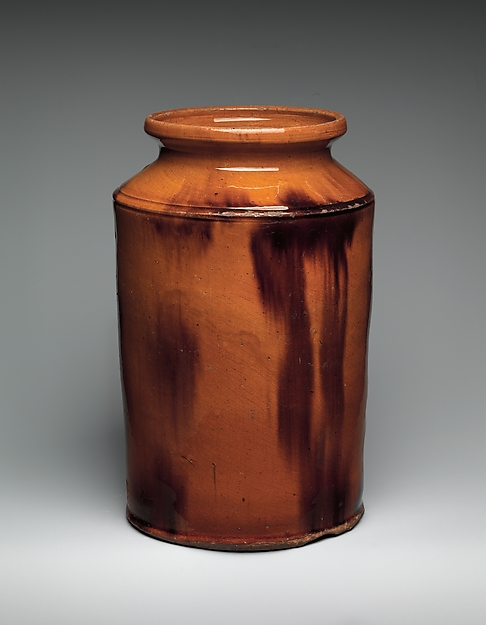
Jar. Paul Cushman, 1805-1833. Stoneware. 20032.475
Or, how do you keep your pickles?
At work, we have found that the road to history is paved with unexpected documents. As often happens, while looking for something completely different, m’colleague and I found two documents that might help illuminate the question of food preservation and storage in the 18th century.
Probate inventories: I read all the way through and had one of those d’oh! moments. Why? Because at the end, there’s all the kitchen stuff. Andirons, warming pans, roasting pans, kettles, firkins, kneading trays, piggins, barrels, casks, bottles. This is the stuff of cooking and keeping food.
There are clues in the receipts (recipes): Amelia Simmons gives a hint in the final instructions “To pickle or make Mangoes of Melons.”
“put all these proportionably into the melons, filling them up with mustard-seeds; then lay them in an earthen pot with the slit upwards, and take one part of mustard and two parts or vinegar, enough to cover them, pouring it upon them scalding hot and keep them close stopped.”
To pickle Barberries ends thusly:
“let it stand to cool and settle, then pour it clear into the glasses; in a little of the pickle, boil a little fennel; when cold, put a little bit at the top of the pot or glass, and cover it close with a bladder or leather.”
Jar, Thomas Commeraw.1797-1819. Stoneware. 18.95.13
To pickle cucumbers:
“put them into jars, stive them down close, and when cold, tie on a bladder and leather.”
To keep Green Peas till Christmas:
“have your bottles ready, fill them, cover the them with mutton suet fat when it is a little soft; fill the necks almost to the top, cork them, tie a bladder and a leather over them and set them in a dry cool place.”
If we tease these apart, we come up with some basics: preservation is done with pickling and “putting up” foodstuffs in pots, jars, bottles, and glasses. These are sealed with bladders, which are tied on; there is a sense in the first receipt that “close stopped” might imply corkage, but the repetition of bladders in the following receipts suggests otherwise for most of these; the entry for Emptins does state “will keep well cork’d in a bottle five or six weeks.”
Covered jar, Connecticut. Earthenware, 1800-1830. 18.27.1a, b
The other key? You’ve probably come across food packages that require storage in a “cool dry place,” and as we have cupboards in our kitchens, or perhaps in our pantries, early cooks also had pantries or butteries (say it but-trees). How’d they do it?
Jar,. Earthenware, 1800-1900. 18.95.11
The 18th century house was not centrally heated. 18th century Providence residents recorded temperatures of 48 and 58 degrees indoors in the winter, in rooms with fireplaces. An unheated room or cellar would be cool, too; here in the Ocean State, maintaining dry conditions could be the bigger challenge.
What did those jars and pots look like? As you can see in this post, the Met has a few– fortunately, these appealed to collectors and wound up in museums. Closer to home for the original question, the Missouri History Museum has a collection with a number of jars. A cursory look showed dates in the 1830-1860 range, but the shares are consistent with those seen at the Met.
I’m not a food historian, and I don’t pretend to be, but as I think about answering a question, these are the steps I take. Recipes, collections, and then more looking. I just hadn’t remembered that probate inventories would list everything, so one might get a sense of a household’s contents and thus its eating and storage habits.

![La famille Anglaise à Paris.Plate 11 to 'London und Paris', x, 1802 [1803]. Explanatory text, pp. 90-5. Copy of No. 11 in 'Le Suprême Bon Ton' series, see BMSat 9957. An English John Bull stands stolidly full face with clasped hands, a grown daughter on his right arm, his wife on his left arm. With them are two tiny little girls and a grown-up son, also stolid. A Frenchman and a lady attitudinize elegantly on the left. 1802 Hand-coloured etching. British Museum 1856,0712.605](https://kirstenhammerstrom.com/wp-content/uploads/2023/03/a38fc-bontonno11.jpg?w=640)


 Kirsten Hammerstrom
You must be logged in to post a comment.