We Need to Talk

If you’re reading this, you probably spend enough time on the interwebs to have picked up news about, oh, Bill Cosby and various Roman Catholic priests, and to know that sexual harassment and assault is both prevalent and under-reported in America. I don’t want to argue either of those topics, but I want to set the context for you, because sexual harassment, assault, and predation happen everywhere, even in reenacting circles; it certainly happens in cosplay: see here and here.

To be clear: I’ve only had issues with the public, not fellow reenactors, and the issues with the public involve non-sexual touching and drunken stupidity which I can avoid by never being alone in kit–which means I skip some events (Tower Park, I’m looking at you).

Most of us think of reenacting and reenactments as safe places and spaces: we do not expect to encounter predators at the museum or historic site, and I want to emphasize that, as far as I know, the visitors are not the ones being preyed upon. It’s mostly younger reenactors, and it’s rare, but it happens. And I think there are several pieces to the “why” of this.

Sometimes people are completely different away from their homes and families. Whatever secret obsessions they have may be indulged when they’re engaged in fantasy play far away from their homes. These guys (and they are usually guys) are pretty rare, and they are identifiable. The best defense against them is to monitor the vulnerable; young people who have a safety net around them are much less attractive. Once this kind of predator is identified, they have to be confronted.

Men will sometimes act more aggressively masculine (macho) in the presence of other men. There’s a defensiveness that comes to fore when women want to play in that sphere, and men will sexually harass or even assault women in an attempt to maintain dominance over what they perceive as their turf. Think of the firehouse sexual harassment cases, or what we’ve heard about at the military academies or even in some art school departments.This may be what’s behind a couple of the other stories I’ve heard.

Here’s the EEOC’s definition of sexual harassment:

It is unlawful to harass a person (an applicant or employee) because of that person’s sex. Harassment can include “sexual harassment” or unwelcome sexual advances, requests for sexual favors, and other verbal or physical harassment of a sexual nature.

  • Harassment does not have to be of a sexual nature, however, and can include offensive remarks about a person’s sex. For example, it is illegal to harass a woman by making offensive comments about women in general.
  • Both victim and the harasser can be either a woman or a man, and the victim and harasser can be the same sex.
  • Although the law doesn’t prohibit simple teasing, offhand comments, or isolated incidents that are not very serious, harassment is illegal when it is so frequent or severe that it creates a hostile or offensive work environment or when it results in an adverse employment decision (such as the victim being fired or demoted).
  • The harasser can be the victim’s supervisor, a supervisor in another area, a co-worker, or someone who is not an employee of the employer, such as a client or customer.
  • Although the law doesn’t prohibit simple teasing, offhand comments, or isolated incidents that are not very serious, harassment is illegal when it is so frequent or severe that it creates a hostile or offensive work environment.

And in case you’re thinking, “Well, these folks are volunteers! That’s different,” in Illinois, at least, it is not. An Illinois ruling found that a volunteer can be considered an employee, and is therefore covered under Title VII.

How do we stop this? If the best defense is a good offense, what do we do?

  • Name the behaviour. Call the harasser out on his behaviour, state it to him, be specific.
  • Insist that women are equal to men, even in this masculine and militarized context.
  • Make clear the behavior is the issue. Say what you have to say, and repeat it if he persists. (If you are being harassed by a woman, kindly switch the pronouns; yes, it can happen. The incidents I have in mind involve male harassers.)
  • Listen to the people who tell you they have been harassed or assaulted. Don’t judge them.
  • Report harassment to your unit commander, or another trusted person, in case it’s your commander harassing you. Report harassment to a board member or your unit, umbrella organization or museum/site.

Want more information on sexual harassment? Here’s a fact sheet for you.

To be clear: not every guy is guilty. Not every unit has a problem. There’s more good than bad. But I’m hearing about incidents large and small, and it behooves us to be certain we are behaving appropriately and legally.  That said, I’m not a lawyer, I’m a blogger, so see the disclaimer.


DISCLAIMER:

The information and materials on this site have been provided for general informational purposes only, are not comprehensive, not complete and are not legal advice. The information contained in the site is general information about sexual harassment and should not be construed as legal advice to be applied to any specific factual situation. None of the information is intended to constitute, nor does it constitute, legal advice. For information about your legal rights you should consult an attorney.
Smells Like Money: Must be Auction Season

There’s nothing like a little frivolity to lighten your day when you’ve been pondering some really serious and stomach-churning topics. Hail, then, the arrival of the Sotheby’s catalog and the momentary dropping of all material culture pretenses.

This time, it’s Private Collections.  You say Private Collections, I say Disturbing and Hyper-Overpriced Gift Shop. But what does Snarky Duck say?

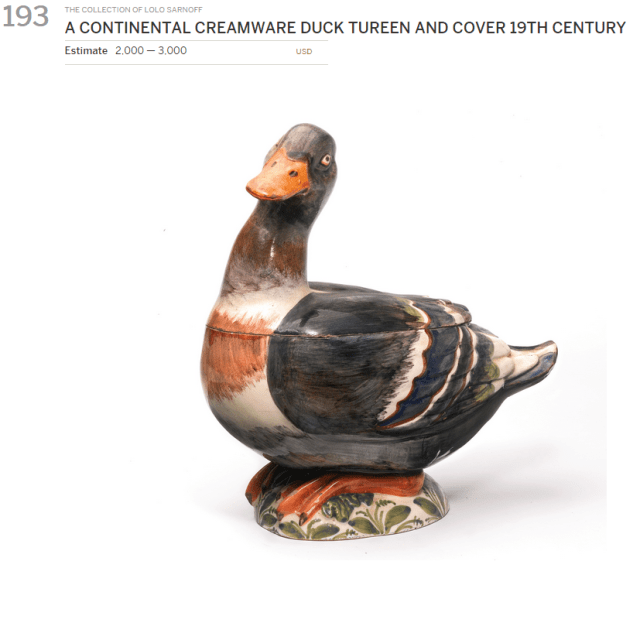
A Continental creamware duck tureen and cover.  Duck ways, no more hot soup, please.
A Continental creamware duck tureen and cover. Duck says, No soup for you.

Poor Strangled Parrot: I don’t think he can say much.

A Holitsch parrot-form jug and cover ca. 1760.

And these guys, described as playful dogs, look more like dyspeptic pugs to me.

A pair of Hochst fayence figures of seated pugs ca 1770.

It is amazing what people will make and buy (which delights me), and I’m certain that things I own would astonish and appall someone with different taste. But animal effigies always intrigue me, and (aside from Snarky Duck, our 19th century friend) figures like these could have graced the mantels and tables of the finest homes of the 19th century. It would have been a crowded and raucous world.

Here’s the whole catalog, should you care for some ormolu chairs or Aubusson drapes (which I did not know existed until today).

Bellevue in the Rain

Marble House, Newport, R.I. Bain News Service, Glass plate negative, 1910-1915. Library of Congress. LC-B2- 3547-5 [P&P]

Bellevue Avenue: in Newport, that’s a fancy street. I don’t spend much time on fancy streets anywhere I go, but I had a meeting at a museum on Bellevue so there I was, curving out onto the point on a wet, grey day that made everything look like a WPA photograph.

Newport, R.I.: Ochre Point, Cliff Walk. Library of Congress, LOT 9192. It can feel like Rebecca.

Bellevue runs down the eastern side of Aquidneck Island; the houses look out onto the water of Easton Bay, or across the street at each other, in the rare cases where they’re even close to facing.

It was a kind of mysterious trip; the rain curtained the street, hiding facades better than fences, and even listening to the kind of music I like, I could have slipped into an afternoon of pre-code films on TCM.

CALLBOX IN MRS. BERWIND'S BATHROOM - The Elms, Bellevue Avenue, Newport, Newport County, RI. Library of Congress, HABS RI,3-NEWP,60--29
CALLBOX IN MRS. BERWIND’S BATHROOM – The Elms, Bellevue Avenue, Newport, Newport County, RI. Library of Congress, HABS RI,3-NEWP,60–29

There was a for sale sign on one property (Sotheby’s Realty, of course), and for an instant, I imagined walking into the house and owning it, starting a life completely different from the one I live, with different people and places.

Isn’t that what we do, or try to do, when we dress in these funny clothes and inhabit these historic places? We’re trying to slip the bonds that tie us to the mundane, quit the quotidian, and live a different life and time.

I wouldn’t want to live in the Elms or Marble House, but moments of imagining, and truly inhabiting, a different world are what make living history so appealing for interpreters and visitors alike.

Feeling Materialistic

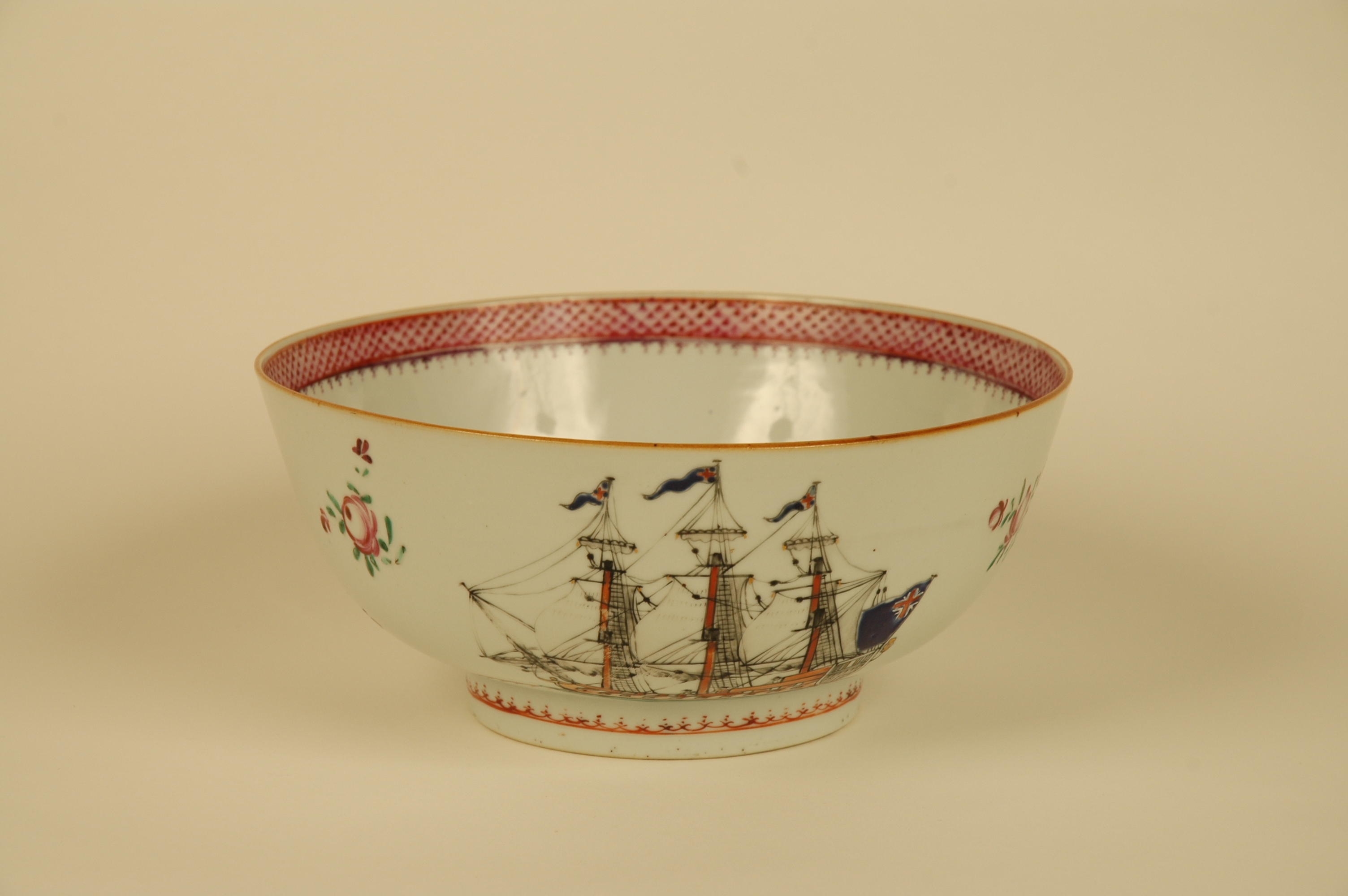
Chinese Export Porcelain bowl for the American market, 1790-1810. RIHS collection

I went to Newport yesterday for a History Space program on material culture. I don’t know why I  was nervous, really, because I love stuff. I try not to accumulate too much stuff in my own life, and to be a careful curator, but really: beautiful objects make me really happy, and I love talking about “the thingness of things.”

Living history is fun for me for a lot of reasons, some esoteric and personal. I spent a lot of time in school thinking about images of America, and what they meant (it was the age of semiotics and Derrida) so creating living history personae and clothes and based on images and research is a way of making art of history, or else dressing up in funny clothes and enjoying loud noises.

Historical research is most fun when it asks questions– the journey is as good as the destination–and there are good questions to ask the things you carry with you or use in living history. (They’re probably good to ask if you’re in a mood to downsize at home, too.)

  • What is it?
  • When was it made?
  • Who made it?
  • What is it made of? Where did the materials come from?
  • Where did you get it? When did you get it?
  • How does it work, what does it do?
  • What does it mean to you?

If you can answer those questions, you’ll be a lot closer to knowing the why of what you have.

It’s the stories we tell about our objects that give them meaning: sometimes it’s who made or used a thing, sometimes the story has a meaning that you can’t tell from the object itself.

Think of this: I crossed the Pell bridge last night to come home, the road climbing into a storm cloud, the car lashed with rain and wind on a road surface daguerrotype-reflective and hard to read. The buffeting gusts on the car reminded me of the carpenter who didn’t like crossing the bridge to work in Portsmouth. Still, he told a story about crossing the bridge in storm on a motorcycle, with a girl riding behind him. The wind would rise, you’d both get scared, and she’d squeeze closer. He shivered inside his t-shirt as he told the story, with a tiny smile, and you knew he’d gone to Newport in that weather, on that bike, with that girl, on purpose.

You’d never get that story just from a jacket, a helmet, or a bike, but somewhere, there’s a object tied to that story.