A Valentine’s Puzzle Purse

Puzzle Purse Valentine. RIHS Graphics Collection Lot 42

Here’s a nifty little thing you can make: A puzzle purse. This is from the collections of the Rhode Island Historical Society, but the form seems to have been fairly common; I know I’ve seen other fancifully-folded letters.

Because I’ll be spending Valentine’s Day in 1820, I thought I’d try to replicate this token. News on how it turned out later… I don’t feel clever enough to write my own verse, but here is the Rhode Island example transcribed.

My love is true to none but you
My heart expires for your sake
And if you don’t me pity show
My true and tender heart will brake

Here a question you will find
A sweet question you will find
Sweet is the question mark it well
Heart upon heart and so farewell

My Dearest dear and Blest Devine
I’ve pictured here your Heart and mine
But Cupid with his fatal dart
Has deeply wounded my poor heart

There between us sat a Cross
Which makes me to Lament my loss
But I am in hope when the Cross is hone
That both our hearts will be in one

My heart is fix’t no more to Range
I like my Choice to well to Change
Oh that my Heart to yours could meet
Then all my joys would be compleast
If you take this in disdain
Pray send it back from
Whence it Came L M
Frivolous Furry Friday

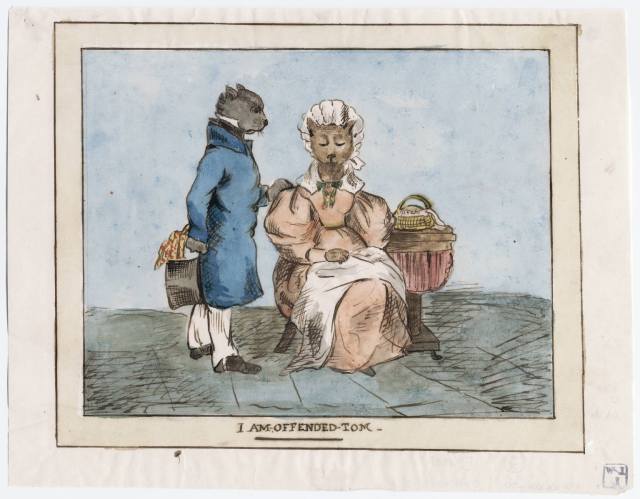
I am offended Tom. Watercolor, 1830s. Lewis Walpole Library, Drawings Un58 no. 29 Box D108

I don’t know the backstory here, but the summary is satisfying: A standing cat attired in men’s 19th century fashion rests his paw on the shoulder of a sitting cat attired in women’s 19th century fashion. The latter declares “I am offended Tom” while engaged with a sewing project.

Really, the lolcat is a historic tradition, and it’s research I’m doing when I wander over there on lunch break, honest. So, let’s research this up:

Judging by the lady’s sleeves, we’re probably looking at ca. 1830 for a date- circa gives you so much leeway–but the details of collar and cap are quite nice. Tom has a nice blue coat, straps on his trousers, and a spotted neck or handkerchief in his paw; I think we’re seeing a black waistcoat lapel under the large blue coat collar. The pedestal work table is a nice touch, and not extremely common in collections today.

Whatever has happened between these two (I don’t need to tell you about a tom cat’s reputation), the watercolor does a nice job of depicting a fairly common domestic scene in which only the trappings change. Those anthropomorphic emotions have played out, and will play out, in many a parlor, drawing room, chamber, living room and studio.

Let us hope we all avoid domestic stresses this weekend, except when truly warranted.

Many thanks to Sew 18th Century for the image link!

Winter Amusement

Winter Amusement: A View in Hyde Park from the Sluice at the East End.Aquatint, printed in color and colored by hand, 1787.Print made by James Tookey. YCBA  B1985.36.609
Winter Amusement: A View in Hyde Park from the Sluice at the East End.Aquatint, printed in color and colored by hand, 1787.Print made by James Tookey. YCBA B1985.36.609

I count myself among the people sick of winter in New England, but the piles of snow and wretched driving have prompted some comments from the Young Mr, including “Well, it would be worse in the 18th century, right?”

16314413949_fca9e1de44_zHaving recently walked on a combination of cleared, partially cleared, and uncleared walks, I’m not so sure…but I was in modern boots, and not my leather-soled repro shoes, which I prefer not to expose to the variety of modern snow-melting chemicals, though they can be cleaned.

Still: the partially cleared and unsalted walk was easier to walk on than you might imagine, and I suspect that the 18th century tasks of clearing steps and paths to make room to walk or drive carts, wagons and carriages was probably reasonably effective– though the melting must have been more annoying and messy when mud season arrived.

In all this cold and snow, how did people keep warm and stay fashionable? For gents, of course, greatcoats were an option, and cloaks or mantles for women, both in the last quarter of the 18th century and into the 19th. I found documentation for women’s Spencers and greatcoats in the first decade of the 19th century, but what about earlier?

detail,  Winter Amusement, 1787
detail, Winter Amusement, 1787

While I cannot (yet) place the coat at right in New England, you know I covet one.

Tail pleats with back buttons, a possible shoulder cape? I love the menswear styling of this coat, and the drab-and-black color combination of coat, gown and accessories. I don’t have much call for 1787 clothing in my life (actually none whatsoever) but by the time I’ve patterned and made this coat (after many other things to finish), perhaps I will also have created a reason.

Winter frolics, New Year’s Eve party, 1788? Anything is possible, and time is better spent imagining fun than complaining about snow.

New England Spencers

You may recall how tortured I was (sort of) about making a Spencer for What Cheer Day, concerned that Spencers could not be documented to Rhode Island, let alone New England. I had the same worry about the Not-Quite-Good-Enough Coat.

JDK_8210_1

Things will come to those who wait, and what came this week was the long-awaited Proceedings of the Dublin Seminar for 2010, Dressing New England. In it I found an article by Alden O’Brien, Federal New England Fashion in the Diary of Sylvia Lewis.

Sylvia Lewis [Tyler], Diary (1801-1831), MSS 2899 in the Americana Collection of the NSDAR provides the basis for O’Brien’s article and my joy. It begins routinely enough with my favorite stuff– spinning!– and carries on to knitting: stockings, mittens, gloves, a hat or two, and even “comforters,” or scarves. Shag, or thrummed, knitting is mentioned, so at least those of us interpreting the world of 1801 and later can be war.

The real excitement comes on the third page: in the winter of 1803-1804, Sylvia Lewis cuts and sews a greatcoat. Then, in 1806, she makes a green Spencer, and in 1808, a black one.

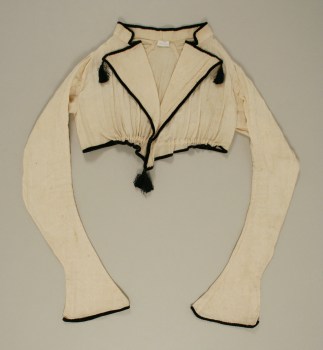
Spencer ca. 1800 French. silk. Purchase, Irene Lewisohn Trust Gift, 1991 1991.239.2
Spencer ca. 1800
French. silk. Purchase, Irene Lewisohn Trust Gift, 1991
1991.239.2

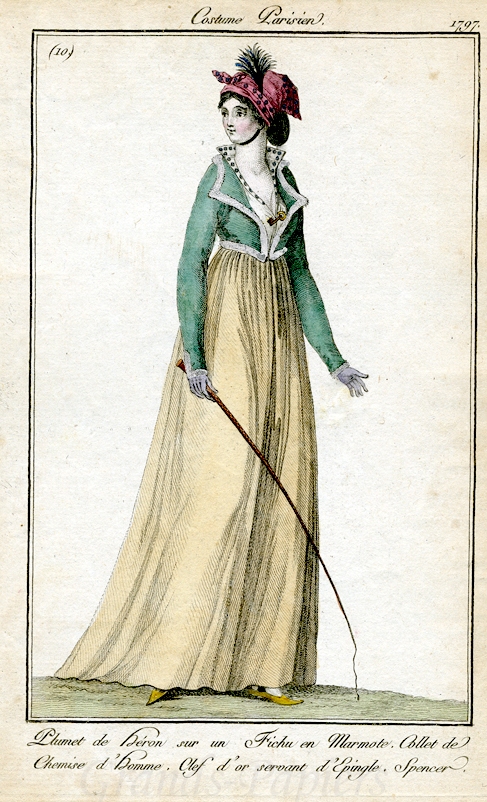
1806 is still later than I wore my Spencer. They’re shown in fashion plates of the 1790s, and here’s a pattern, too: so they’re clearly worn in Europe earlier than 1806. The similarity between the French silk spencer at the Met and fashion plates gives me confidence that they are being made and worn in the 1790s and early years of the 19th century; Spencers are also mentioned in tailoring manuals of this period.

1797, with a similar shape to the Met's French silk spencer.
1797, with a similar shape to the Met’s French silk spencer.

They’re placed in New England with written documentation, but how early are they here? And what did they look like? I know of one in a private collection which I am slavering to see, based on the description of the wool. The MFA has a few that seem to be local to Lexington, and there is one in Maine with a catalog record that shines with passive aggressive crankiness, and delights when compared to another in the same catalog. And no, I’m pretty confident that gentlemen did not wear spencers, or tailed spencers, at any time.

But there’s really good stuff in Sylvia Lewis’s diary for anyone who wants to know more about clothing production, use, and costs in early Federal New England. Even if your Library doesn’t have it, your Librarian can get a copy of the article for you through ILL or you can buy the entire proceedings here.