
Send in the History Clowns

Once upon a time, I called reenactors and costumed interpreters History Clowns. The pilgrims at Plimoth Plantation 25 years ago scared me, and I did not like to visit living history museums.
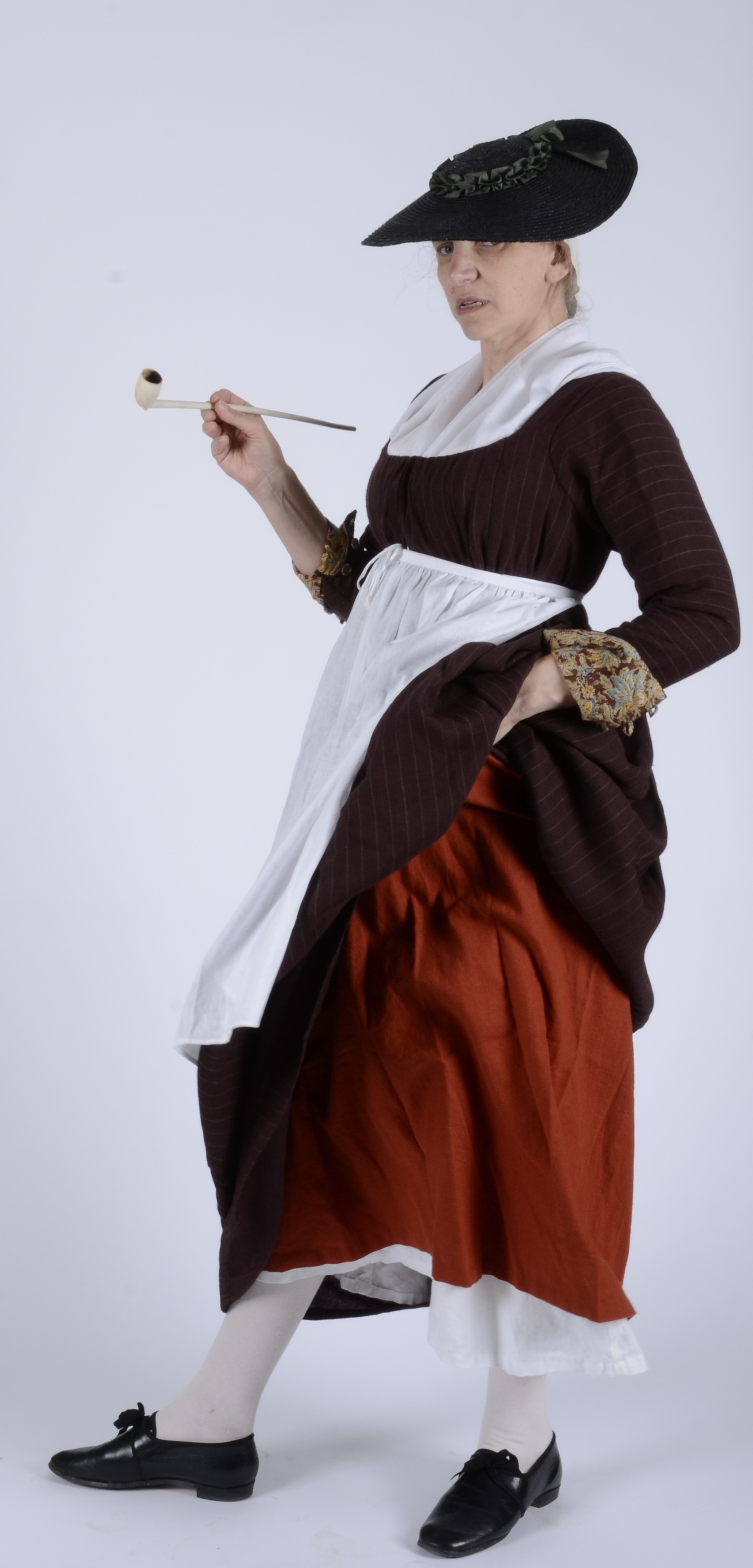
petticoat
History Clown

Now, I’m one those costumed clowns.

What changed? For one thing, I did. But more importantly, living history and reenacting changed. It got better. It became more accurate, more inclusive, more specific. (Even Plimoth admitted at a Dublin Seminar that their costuming had evolved.)

When I see the fights that erupt online (there was a skirmish on Facebook last night—Peale’s march will not die), I think about the History Clowns. I think about the evolution that has taken place, and I think about the skirmishes I get into in trying to plan living history events at my own institution.

Most of these fights are not about accuracy—that FB fracas wasn’t—but do we know what they are about? We try to push back with our insistence that accuracy matters, but that’s not the argument our opponents are trying to have with us. They don’t give two rats about the cut of your breeches or the cord on your canteen or what you think of their rubber-soled shoes.

They want to be recognized. They want to be appreciated. They want to matter.

It reminds me a lot of when I first came to the place I work; I was one of three new, younger people hired within a short span of time to work on exhibits and an expansion project that never happened. As we looked at the organization, we saw things that didn’t seem right to us. But often, we met a lot of resistance to new ideas: “We’ve done that already.” “We tried that and it didn’t work.” “This is fine the way it is.” “We’ve always done it that way.”

I think those translate thusly: If you do it, you might make my attempt look bad.

If you succeed where I failed, I will look bad.

I don’t want to change.

I’m afraid to try something new.

What about my efforts? Won’t they be rewarded anymore?

I think that’s what people are saying to us sometimes, even when the words they say are, “These haversacks are fine, they’re really durable. It doesn’t matter if the fabric isn’t really right,” or “Market wallets? No, that was just a Henry Cooke fad.”*

43919175The fight is probably not as much about accuracy and authenticity as it is about feelings. That said, I think it behooves people on both sides of this line (and it is often generational) to be equally mindful of each other’s feelings. While we can respect the work that people before us have done, they should respect the work we are doing now, as new resources come to light, and new thinking is applied to history and interpretation.

Just as we cannot live in the past of historic house museums, we cannot live in the past in reenacting/living history. And while I respect the tenure of some unchanging regiments and the work they’ve done before, it comes down to this:

Accuracy matters. Adapt or die.


*I think my eyeballs fell out when I heard that one, from a guy who prides himself on his extremely accurate topographic battlefield models.


Drapers, Sutlers and Other Sources

Shopping with swatches: it’s what I do.

The biggest difference between sewers is location: I have access to resources here that people in the Midwest don’t, but friends in New York have the garment district, which is just a little too far for me.  For a lot of my projects, I’m buying from the reputable sources we all know about: Burnley & Trowbridge and Wm Booth Draper. They’re supplying people who want accurate fabrics, they do their research, and the goods are well described. But how to choose among the offerings? And where else can you go?

Wools
The creme de la creme are Kochan and Philips wools. I have some bottle green I haven’t cut yet, which I got from Roy Najecki because he’s local, he’s got the stuff, and he has other stuff my household uses (like cartridge box clasps and quarter-inch mohair braid).

Wm Booth and B&T’s wools are also good, and you can get samples. What you buy will be dictated by what you are making. Broadcloth for suits and cloaks, stuff (worsteds) for gowns and waistcoats. Buy the best you can afford: this is an investment. Divide the cost of the fabric by the number of times you’ll wear a garment, and look at the per-wear cost, the way you might look at a suit for work. (I have no regrets about that Saratoga coat, which has now been worn on at least 5 separate occasions, making the per-wear cost $25 after 18 months, and I know it will be worn again.)

Once you’ve felt and seen good-quality, period-correct wools, shopping locally is easier. Take a swatch with you and compare to what’s in the stores and you’re likely to find yourself shopping online. You’ll want 100% wool, and that’s expensive pretty much everywhere. Here in Rhode Island, I do have access to mill stores and remnant tables that make a difference in my costs and allow me to be a little more frivolous in my sewing. Sewfisticated in Framingham and Somerville and Lorraine Fabrics in Pawtucket both have remnant tables with reasonably priced goods with pretty accurate fibre labels. They’ve been the source for many a garment, but have no online sales. I don’t recommend JoAnn’s wools: they’re not as tightly woven and they’re over-priced. Wm Booth and Burnley and Trowbridge are a better value.

Silks
Here again, it’s unfortunate, but my local sources come into play. Artee, Sewfisticated and Lorraine all have both discounted taffetas and tantalizing remnant tables, but Wm Booth and Burnley & Trowbridge have fabrics the local shops do not carry. I don’t have a local source for what Booth calls “persian,” but taffeta can be found– though color choices can be limited.

The trick with silks is slub. Much of what is sold today is silk dupioni. It is not universally bad for all historical applications, as by the 19th century, silks were being sold in several grades. If it’s right for your impression (i.e. not upper class), and you can find a pretty fine dupioni, you can use it. But the really slubby (bumpy) stuff should remain in this century.

Crisp taffetas from the bridal department can be your friend, though home decorating can also yield good results. Some higher-end home dec departments do stock wool, linen and silk fabrics, as the best designers and manufacturers use them. You’ll pay for it, but again: it’s an investment you’ll enjoy over time. Online, there’s Hyena Silks, too, which has supplied some friends. But my silks are pretty much locally bought, at $9/yard.

Cottons
Here’s the biggest trouble spot for a lot of people. The mantra is that today’s quilting cottons are nothing like the cottons of the past, and while that is true in part, it is not the whole, or nuanced, truth. Quilting cottons are stiff and crisp, and generally do not drape as well as apparel fabrics. But what’s more correct is to say that the range and hand of cottons available today in historically correct or acceptable prints do not come close enough to the cottons of the past. Still, you can find good analogues for late 18th and early 19th century cottons (1750-1825) if you’re careful.

Aside from Wm Booth and Burnley & Trowbridge, I buy from Reproductionfabrics.com. She has been a good source for Indian print cottons. Time Travel Textiles no longer has a functioning web store, but the articles are still there, and useful.
Regency Revisited sells via phone and Facebook now, and has an interesting range of prints, though I have not bought from them…yet…as I am trying hard to sew down the strategic fabric reserve.

But again, I buy locally from the bargain loft at the mill store where I can feel the goods. It’s worth ordering some swatches from Burnley & Trowbridge just to get a sense of the hand of different goods. That, along with printed resources, can serve you well in an actual store (presuming they still exist near you).

Linens
Again, much of my trade is with the main two sutlers, but I buy linen in quantity from Fabrics-store.com. It’s not the best of the best (see the main two) but it gets the basic job done.

For really nice and perfectly correct linen, in every sense, Justin Squizzero’s hand-woven linens are the way to go. I’ll get a hand-woven neckerchief one of these days– actually, I want one for February– but have yet to make the leap to buying hand woven linen shirts and shifts.

Fabric Selection Resources: Printed & Online

Jackie asked about fabrics: how do you choose?

I’m going to start with prints, cottons, linens and silks; the second part will cover wools and sutlers.

There’s no substitute for feeling up the real thing, or samples, and while I do not have the book, I’m told by a very reliable source that it is worth buying Swatches from Wm Booth or from Hallie. I also order Burnley & Trowbridges swatch sets, which are often  more extensive than what’s on their website. Those samples help me gauge fabrics online– comparing the actual square with a thumbnail online is helpful.

Barbara Johnson: a typical page
Barbara Johnson: a typical page, this from 1803

Where else can you look for guidance? One of the best books that spans a wide range of living history time periods is the Barbara Johnson book of swatches. Owned and published by the Victoria and Albert Museum, A Lady of Fashion is out of print, but the pages have been scanned and are available online. The print version is better– it’s big!– but you can download the images and get a better sense of the scale of the samples.

What is particularly useful is that Barbara Johnson dated the samples, and wrote down how they were used. You can’t get better than that!

Susan Greene’s Wearable Prints is neither small nor cheap, but it is extensive, covering 1760 to 1860. This is a very hand book to have to help sort out typical looks for different time periods, and the likely range of colors.

Textile Sample Book, 1771. Metropolitan Museum of Art. 156.4 T31

Other museums have digitized sample books: the Met, for example, has multiple images of woven fabrics from a 1771 sample book online.

What you need to remember here is fibre: those homespuns at JoAnn will not behave the way linens behave, even if they look the same. Hand and drape are everything, and cotton, or cotton-poly will not do want linen does. Buy the linen, it’ll look, feel, and wear better.

There are many more sample books, but you have to be careful: some are dated only “19th century.” Great. That’s where Susan Greene and Barbara Johnson can help you sort out which *part* of the 19th century you’re looking at.

Swatch book, 1763-1764. Victoria and Albert Museum, T.373-1972

For silks, you can see a very specific and detailed range of silks in Selling Silks, which reproduces another sample book at the Victoria and Albert. Not all samples are 1763-1764; you will need to read the descriptions, but this can be helpful in figuring out how to use fabrics. I have come into some red silk damask that I can make into a gown; it’s vintage silk from France, probably pre-World War II. The pattern is large, replicating a 1740s fabric, but when I make up my gown, I think it can be 1760s, but not a lot later.

Part of looking and buying is understanding how textiles might be bought, saved, made up, reused and repurposed over time.


Peale’s Progress, or, High on History

No, we didn’t go, and I have regrets. Six weeks before the event, I thought I was working on January 3rd, and by the time the schedule changed, it was too late. Instead, you can read about Drunktailor’s experience.

Reenactors portraying Philadelphia Associators take part in the real time tour of the Battle of Princeton, Princeton, NJ, January 3, 2015. Beverly Schaefer, Times of Trenton
Reenactors portraying Philadelphia Associators. Beverly Schaefer, Times of Trenton

The background is interesting, similar to the kind of events and projects we’ve been talking about here in RI: site- and time-specific events that combine commemoration, history, and experimental archaeology, or an emotional and social archaeology, if you will.

From event co-organizer Dave Niescior, quoted in the Rutgers-Camden News Now: “The goal is to gain a better understanding of the hardships endured by individuals who lived and made a critical moment in history.It is one thing to write ‘the troops marched overnight to Princeton,’ it is yet another to understand what that physically and mentally meant to the men who had to put one foot in front of the other all night long.” Co-organizer Matt White told NJ.com, “We’re trying to stage a number of vignettes to give people a sense of what was going on in the Continental Army in this period between late December and early January of 1776 and 1777.”

that’s cold. From Daily Reenactor

These and other collected images help convey a sense of the event,  which–as far as I can tell– did provide participants with the kind of transcendent experience I know I enjoy and hope to find at events.

This is the kind of event that I think proves a belabored (and elsewhere belittled) point: accuracy matters. It is just about ALL that matters.

On a now-defunct phone, I had an old video of the Young Mr with a now-deceased reenactor of whom I was quite fond, despite our wildly divergent politics. In it, Mr D shows his Charleville to the Young Mr on the front porch of an 18th century home and asks, “Do you know what this is?” The Young Mr shakes his head, and Mr D answers, “It’s a time machine.”

Although I remain committed to reducing the degree to which living history is musket-centric, there’s truth in that statement: Mr D had an original, period Charleville and a fairly well-cut uniform, considering his generous figure. Using, showing, and interpreting actual period pieces and well-made, correct replicas is the single best way to connect the present, and the public, to the past. Accuracy matters because it’s the literal key to the past: you have to cut the pattern right.

Accurate impressions rendered in a place of shared value will transport you to the past, and give you insights you did not expect. That is the point of these exercises: insight and understanding. It’s how to get high on history.