Mansplained in the Museum+

+ Edited to correct typos and to add this link to Sheldon Cohen on Divorce in Providence County, 1749-1809.

I’ve been at a conference the latter half of this week, peering inside the workings of Cambridge and Boston cultural institutions, and most enjoyably, hearing about authenticity and disruption at the Bostonian Society: let’s get this party started!

Except: there I was in the elegantly and intelligently* done “Seat of Power” exhibition in the Council Chamber, pulling the label out from the chair seat to read about a Boston woman shopkeeper in the 18th century when a man had to explain it to me, with a special “feminist” bent that was supposed to, somehow, make this disruption of my visit okay.

I had been telling a young woman next to me, also part of the conference, that I wasn’t sure if this woman was the Boston woman who had been widowed three times and accumulated a great deal of wealth despite the interference of her husbands, and despite the property laws of the time.

The man, not part of the conference, needed to tell me that of course the woman had owned nothing herself, that being the regrettable law of the time, but in balance it was okay, because men were required to care for, and pay for the keep of, their wives and children.

Reader, this is where I made my mistake: I engaged.

“Not always,” I said. “There are certainly examples of divorce and bigamy, and women unable to get their bigamist husbands to pay heir children’s keep.”

“Oh, those were the exceptions. Men were even imprisoned and beaten for not neglecting their families.”

“Except when they advertised that they would not be a responsible for their wife’s debts, and forswore them; we see that in newspapers of the time. So it’s not universal.”

Do you hear the warning klaxon here? Because I surely missed it.

“I’m a history teacher, and I know. You cannot use the extreme exceptions of 1% of the population to justify your absolutist argument. You can’t make statements like that.”

Well, obviously I can: any of us can be as wrong as we care to be, whenever and wherever we like, if our skins are thick enough.

I replied that I thought I was trying to qualify his statement, and nothing more: that he had taken the absolutist position and I was interested in sticking up for the “predominately” and “mostly by not always” corners of history.

It devolved from there until I finally thanked him, told him he’d surely shown me the error of my ways, and I appreciated his comments.

He reemphasized his point that our forefathers had been wrong; I said they’d been right by their lights and in their time, and that it was important to remember that.

His rejoinder was that it was wrong, of course, and women should have rights, etc. etc.

Gentlemen: let me tell you now that this approach will not endear you to the ladies. These are bad pick up lines.

So there it was, mansplained in the museum, by a feminist history teacher.

It’s enough to make me stop talking to people. And best of all: I think he was a reenactor I’ve met before, unable to recognize me because I am a woman, and not a soldier. Also, no bonnet.

May your day be amused by this anecdote, even as I puzzle over it. References to divorce articles later– I am in a cafe before another session.

*thanks to T. S. Eliot for binding these words together in my mind for ever

Pushing Interpretation Forward

Dare I say progressing?

servant mannequin in 18th century room
That’s no ghost, that’s my kid

In the past decade, museums, particularly historic house museums, have been challenged to refresh and reinvent their interpretations and presentations. The most notable challenge has come from the Anarchist Guide to Historic House Museums (AGHHM), and the Historic House Trust of New York’s executive director, Franklin Vagnone.

I re-read a number of Vagnone and Deborah Ryan’s papers recently (including this one), thinking not just about What Cheer Day in a historic house, but about reenacting, living history, and costumed interpretation.

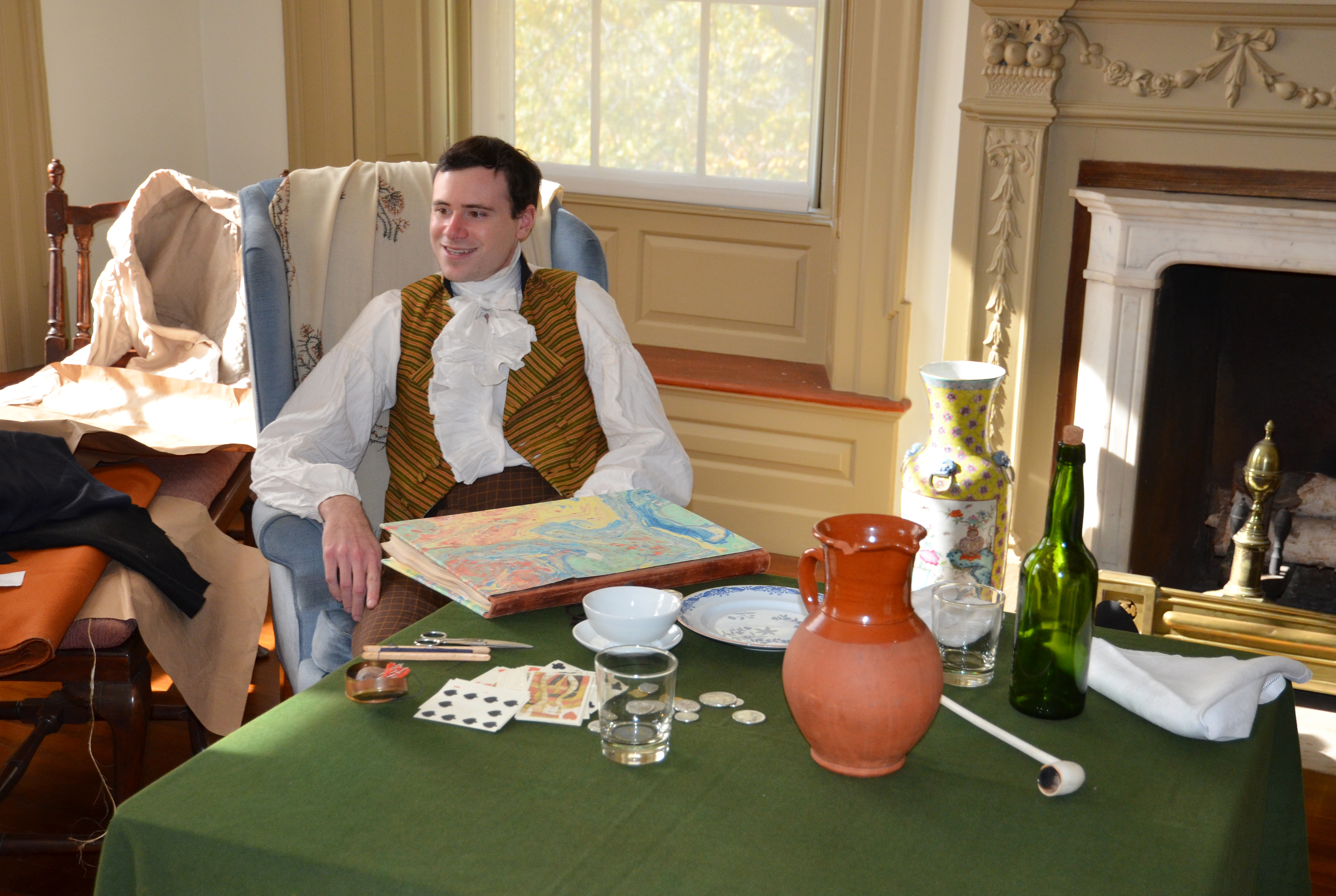
To make a historic house museum (HHM) seem more inhabited and real takes a lot of stuff: clothes, dishes, shoes, stockings, toys— all the stuff that surrounds us now, but correct for the time of the HHM, and arranged in a plausible manner, not like a sitcom set, where chairs before a fireplace face the visitor and not the hearth.

Man with cards, glasses and pipe in 18th century room
Stuff makes a house

To a degree, this is set-dressing, but set-dressing for a still-life, or real life, if the habitation will be by costumed interpreters. It has to be accurate to be authentic, whether it’s a HHM or a living history event that is striving to create a moment, or series of moments, in time– immersive moments.

We cannot step into the past unless we believe the representation we’re seeing, and that’s true no matter where we are: that’s why fabric matters, sewing techniques matter, tent pins and kettles and canteens matter. The world is made up of tiny details that we do actually notice without even knowing it: we see more than we realize, faster than we think. We’ll trip on the different, and stop.

A variety of coats can tell a variety of stories

But what we want to do, as interpreters, is to have the visitor catch the right difference: not the one about which canteen and why, but the larger interpretive point. In one hypothetical example, wooden canteens are a way to talk about defense contracting and supplying the American army, just as over-dyed captured coats are a way to talk about the American Revolution as an international, and not just a civil, war.

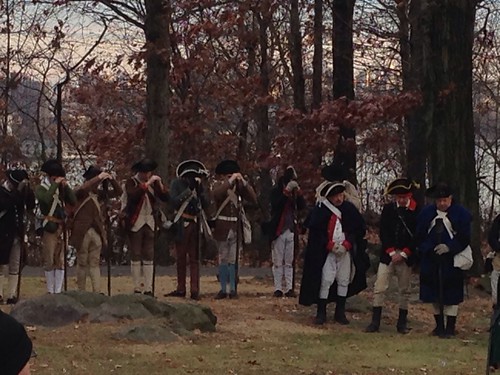
An encampment is, in a way, a neighborhood of HHMs turned inside out, with each regiment a separate family within the larger neighborhood. Each regiment tells a story about itself and its history, and is a lens through which visitors see the larger story.

14999323655_5d9dcf2259_o

That’s why accuracy matters: you don’t want to debunk Ye Olde Colonial craft in camp, or cotton-poly polonaises (poly-naises?) worn by purported women on the ration: you want to focus on the larger interpretive point. When not everyone plays by the same rules, it is better to focus on your own accuracy and authenticity and to ignore Ye Olde Annoyances.

Tell the larger story, the story of your own regiment’s people: that’s your interpretive goal.

A Matter of Interpretation

On the way to Southbridge, Mr S and I were discussing the last “big” event for the year, and whether or not we wanted to go. It’s an annual event grounded in ceremony, and somewhat repetitive.

The landing of the British forces in the Jerseys on the 20th of November 1776 under the command of the Rt. Honl. Lieut. Genl. Earl Cornwallis. Watercolor, attributed to Thomas Davies. NYPL

Mr S would like to go if he had the proper wool coat– it will be easy enough to make, once he gets a kit– but which he does not now have. I find it’s usually a day alone wishing I was across the river in a museum or fabric shop. In the end, it’s a long drive to a day spent in the cold and wind followed by a dash home in the dark, with Sunday spent catching up on chores and cleaning muskets, and now with an added measure of homework stress.

I have painted this as a grimmer day than it usually is, but considering that it’s been 7 months since we had any non-medical time off from work, squeezing this into a busy and stressful schedule is not as appealing as it once was. In part, I think it is because there is a lost opportunity in the interpretation, which is surely limited by the size and nature of the site, and by the loss of the historic fabric of the area.

Nestled in a densely settled and very urban area, the park site has a block house, hut, and fortification as well as a museum. Sutlers and others set up in the museum for the day, including some demonstrations of women’s work…like spinning. Spending the day inside spinning is not for me: not only can I not spin, I cannot imagine fleeing the British with a spinning wheel, which is an annoying contraption to move even with assistance, plenty of time, and a Subaru.

The Young Mr hides

But more than my impatience with Ye Olde Colonial Spinning Wheel at too many military camps this past year, I think what stops me from wanting to go is the repetitive formality of the interpretation, with the the march to the monument and the post-prandial “battle” for the blockhouse, with the Americans sometimes winning, despite the fact that the fall of this site marked the beginning of Washington’s retreat to Pennsylvania, and despite the fact that three days earlier, when the companion fort across the river fell to the British and Hessian troops, nearly 3,000 Americans were taken prisoner in 1776, and of those, only 800 survived. In what way is this ritualistic commemorative event remotely authentic? And if the only way people get the actual history and importance of the event is through the event narration or museum exhibit, hasn’t the reenactment or living history portion then failed?

Ritualistic, commemorative.

The more I think about interpretation and presentation, the more Ye Olde Colonial things annoy me and the more important I think it is to be accurate and correct.

Forcing a passage of the Hudson River, 9 October 1776. oil on canvas by Thomas Mitchell from an original by Dominic Serres the Elder. Royal Museums Greenwich

That does not mean that I expect a naval engagement (though a girl can dream) or a cross-Hudson rowing affair, but I do think it could be interesting to see troops at a fort packing up and evacuating the site, with the confusion that could result. But it’s not my circus, and not my monkeys, and in any event, I shall probably stay home to make sure that homework and housework alike are done in this current century.

One Coat Two Coat Red Coat Green Coat

I cannot manage to find the button I need to sew onto my real-world everyday winter coat, but I’m pondering and plotting how much broadcloth a Redingote (Redingcoat or Redingcote) would require, and internally debating the merits of red versus green.

Greatcoats have their attractions, and while Mr S would undoubtedly enjoy the warmth of a greatcoat, with a February 14 program in the offing, I am pondering a greatcoat of my own.

I can rationalize [almost] anything, but a Redingcote is a stretch even for me, despite that February program (indoors). I suppose the real appeal of one of these coats, aside from the pleasure of handling delicious green or red wool, is the challenge of making one. I have even found a front view to aid in the patterning.

1813 Hat of velvet and broadcloth coat

What stops me? Some unfinished projects, and a certain feeling of unease about buying quantities of expensive wool. I have two yards of dark green broadcloth, but I’m pretty certain that I will need three to make even the shorter red coat. Without making a firm resolution, I had determined that I wanted to sew down my stash–and I suppose the answer is to sew it down, or put it on Etsy. Or to buy the wool, make the coat, and wear it in the winter. It would be a spur to winter program ideas, after all.

Now, if only I could find the missing button from my winter coat…