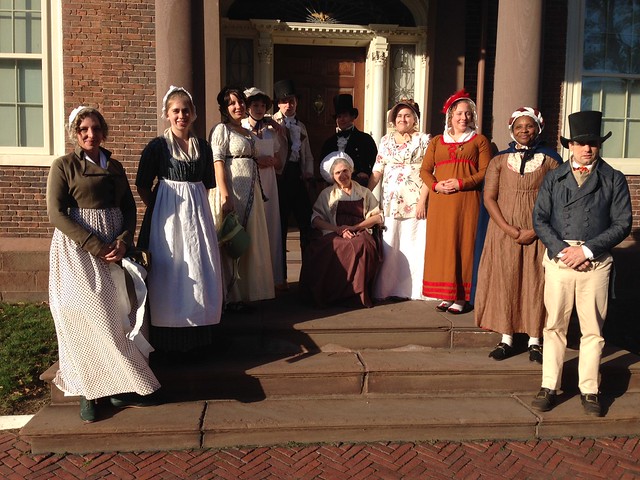
Authenticity Measur’d in Moments

Chopping wood: it takes  a lot to cook and to keep warm in 1799
Chopping wood: it takes a lot to cook and to keep warm in 1799

In the post-What Cheer Day aftermath, when I was very tired and two houses were very messed up, I started thinking about why I bothered with living history. What exactly is this thing, and why I do it? Those questions made me think about the very best moments I have had in this business of re-creating the past in cloth and smoke and time.

In no particular order:

1. Going up to the field at Coggeshall Farm to call the boys down to dinner after spending all day in the kitchen. I was desperate to get out, and finally knew first hand how limited women’s lives could be in the 18th century, especially non-elite women.

2. Running upstairs at the John Brown House with Eliza, giggling over a joke to be played on Mr Mason. I don’t know what Mr C thought of it but I felt twelve years old, silly, carefree and light. John Brown’s housekeeper surely never felt that way, but a naughty maid might have, and for an instant I knew what it was to have no responsibilities.
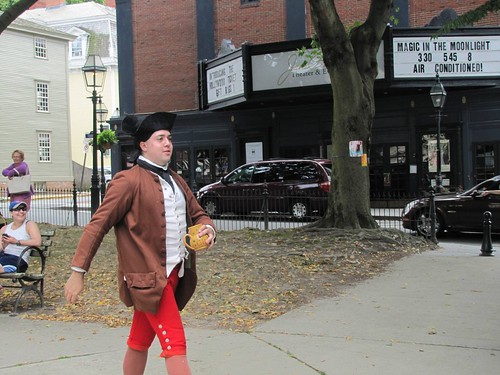
We didn’t even notice the background at the time

3. Chasing the Young Mr, a wayward apprentice, across the street; mobbing Mr Howard’s house; and arguing with the Stamp Inspector, all during the Stamp Act Protest in Newport It was not until I looked at the photos that I realized we really had been in front of a theatre, and that there were actual cars! A friend confirms that he, too, forgot about the cars, to the point of nearly being hit whilst running to Mr Howard’s house.

4. Assembling with a group of friends to take tea with Mrs Silsbee in Salem, sorting ourselves into a group on the sidewalk and venturing out, only to meet Mrs Silsbee on the street. That is the most Jane Austen/Mrs Gaskell I have ever felt. The wretched cobblestones do not count, as they were from the 20th century, but walking out on the wharf, and meeting a friend who brought an umbrella as the rain began was also very Austen-esque.

Perhaps more Gaskell than Austen, here

None of these are military events, and the majority of them happened this year, in past three months. I think this may be because we have been to fewer military events, and I expect the concentration is due, in part, to finally getting better at this practice. They are also site-specific, and trending toward first-person interpretation.

Coats
Those coats.

For reasons explained better by the NPS and in the excellent study of NPS-Reenactor relationships, no battle reenactment can ever capture the truth of the war it attempts to recreate, and that is true even when the battle takes place on the same site, at the same time of year, and even when soldiers are dressed in as-close-as-possible replicas of the uniforms worn at that battle, on that field, on that date, 236 years earlier, and no one has brought a spinning wheel or tent chandelier to camp.

I respect the notions of moveable monuments and performances as commemoration. I like military history, I like war memorials: there is not a competition between civilian and military reenactments. But military events have not yet had the power to transcend experience for me.

My best guess as to why military events are not transformative for me is that, to this point, the business remains too much like camping in funny clothes. As I experiment more with 18th century methods of cooking appropriate rations, and as I strip away the gear we carry into the field, the military events are better (as at Bennington). But I already know how limited women’s perspectives could be (see item 1), and while Bennington was instructive in how ridiculously different the experiences of men and women could be, the military events remain more instructive experiences for the men.

18th century camp
Domesticity in the Field

Why? Because the specificity of site plays out at those events in the battle, and not in the camp. The point at Bennington and at Saratoga and at Stony Point was to use the site as it had been used. The men experienced the landscape in ways as close as possible to what soldiers and militia had actually seen. And women stayed in camp and got smoke in their eyes, cut up vegetables, or washed clothes, which is pretty much what happens at any outdoor event where we can have a fire and, with differences in technology, is pretty much what I do when I get home from work every day.

All that leaves me wondering what to make of military events, and what I want to do in the coming year. No matter how much of this is “for the public,” it still has to be rewarding for the practitioner.
What Cheer Day Review

There will be more, and better, images

Let’s begin with the easy part: pretty pictures of a pretty house. (It’s too easy, right?  More on that later this week.)

There are only a few for now– while our photographer took over 800 images, before he can process and sort them, we have to put the house back together first!

October 25 was a Saturday in 1800, the last Saturday before the first public schools opened in Providence on October 27. Mr Sweet, the tailor’s apprentice, had too much current-day public school homework to join us.

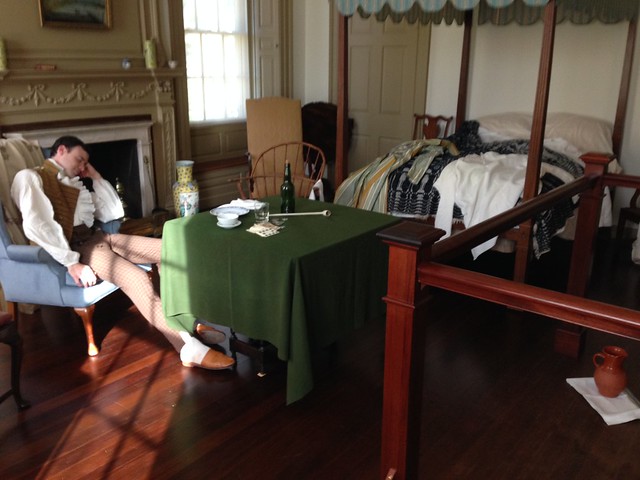
Mr Mason begins his day

It was as well, perhaps, that Mr Sweet did not see the client in his natural environment. His tailor, Mr Taber, arrived with many samples and plates for Mr Mason’s perusal, and the room was in quite a state by the day’s end. I do not know why Mr Mason could not take the short walk to Cheapside, but his custom is so good that the tailor made an exception and came to call.

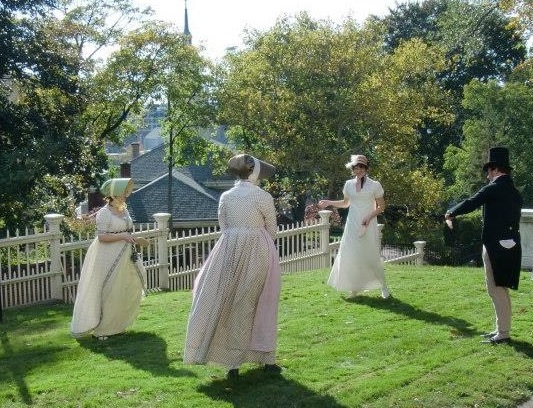
Lawn games

Late in the afternoon, we played battledore and shuttlecock; I was surprised and pleased to see the images and how much like Diana Sperling’s drawings they looked. It was a pleasure to see that we were doing something right, though a cold scoop bonnet was no help in seeing the shuttlecock.

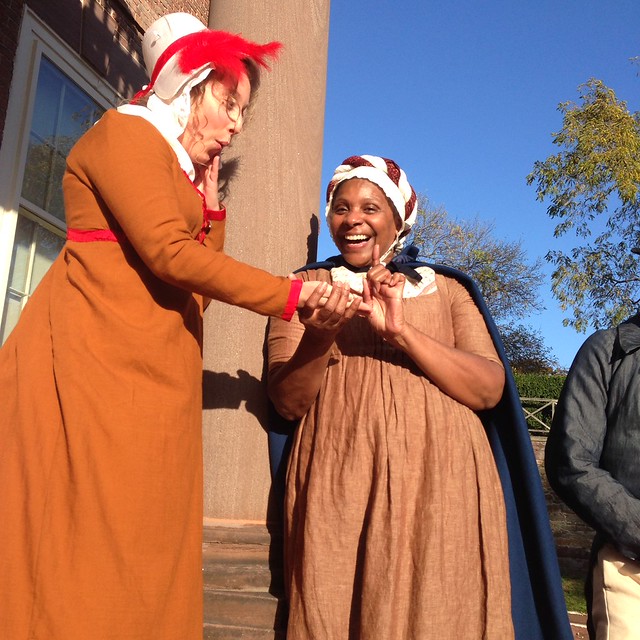
Nancy Smith hears her fortune from Goody Morris

The fortune teller came, much to the consternation of Mrs Brown and her sister. I believe it was the housekeeper who thought she could get away with inviting her friend to the house; in any case, it was foretold that Kitty should have comfort in her life, which was a great relief to someone who had been wearing straight-lasted and very flat shoes for some twelve hours.

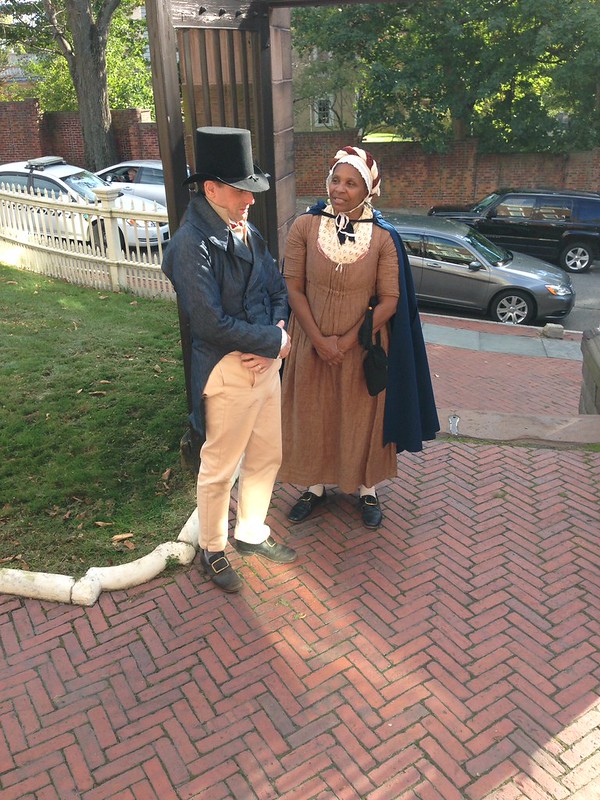
Mr Young and Goody Morris

Of late there has been a man hanging about the house; he enjoyed Goody Morris’s conversation as well, though late in the afternoon he caused quite a disturbance with a delivery of wine. We think he had been imbibing from our order, and his behaviour caused our new maid, Eliza, much distress. Mrs Brown was not well pleased at the commotion in her house.

What Cheer Day 2014

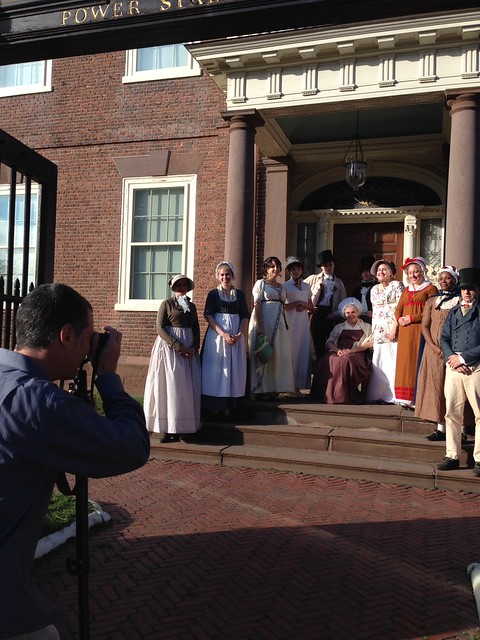
Still, by the end of the day, we were well satisfied with our work, and posed for the passing limner.

Miss Juniper Fox

Miss Juniper Fox. [London] : Pub. by MDarly 39 Strand, Mar. 2, 1777. Lewis Walpole Library , 777.03.02.01.
Miss Juniper Fox. [London] : Pub. by MDarly 39 Strand, Mar. 2, 1777.
Lewis Walpole Library , 777.03.02.01.

If you’re not wearing an inverted rooster held down by two foxes on your head, you’re not living 1777.

I have no idea what, beyond extreme hairstyles, this print is satirizing. It’s not the Wedding of Mrs Fox (as interesting a read as that is), and it’s really 100 years too late to be about Quakers.

The thing about those foxes is that at first glance on my phone, I thought they were the muscular lycanthropic squirrels of historic house wallpaper, but what two squirrels would be doing with a rooster– supporting him in illness? holding him hostage for an acorn ransom?– was beyond me.

At least as roosters, this headdress makes a bit more (morbid) sense, but it’s still a satirical engraving that makes less sense to us in 2014 than it did in 1777.

What Cheer! Wednesday

The cast at the end of the day

Where are you going this weekend? I’m going to Providence in 1800, along with my family and friends.

The mantua maker is coming, and writes a very pretty letter about the new fashions she has found for the young ladies.

Mr Herreshoff and Miss Brown hope soon to be married

Mrs Brown will be in, and receiving guests, and we hear that Mr Herreshoff will come to call as well. While he may decry the state of the roads, we expect him to have news of business conditions in New York, and his prospects for the future.

Miss Alice– Mrs Mason, now– will be at home with her sister, Miss Brown, and Mr Mason is living here now as well. I do not know how I shall keep their room in order, since he is hardly outside of it!

There are other visitors I expect as well; there is a man (I cannot call him a gentleman) who has been doing jobs for us, though he does not live here at the house. He seems extraordinarily interested in the house, and will not stay away. Whatever can be his interest? There may also be a tailor and his apprentice– though the apprentice tends to daydreaming, and looks above his station, studying Latin at all hours. I think he will not be long in his apprenticeship if he will not pay attention.

If you have not visited us before, you can find directions here.