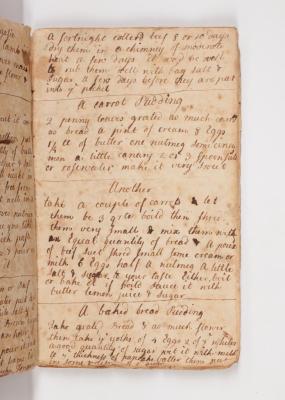
Thanks to the American Antiquarian Society and a grant from the Pine Tree Foundation, you can now access digitized versions of the AAS’s manuscript recipe/receipt/cookery books. Pretty cool, right? Because I know you want to experiment with every variation possible of carrot pudding. (Mr S got a stomachache just now and doesn’t know why…)
I first read about this in a twitter link to the MassLive article, and I’d like to point out up front that you go to the AAS GIGI portal and search in the box for Pine Tree Foundation. That’s the quickest way to access the books. I also searched for cookery or recipe and ended up in some interesting places with carrot pudding recipes.
One of the AAS staff members has been trying out the various recipes, and blogging about them here. There appear to be manuscript books as early as the late 17th or early 18th century, which is very cool (and still about puddings!).
We’ll be there: will you? I’m looking forward to trying out a new Paul Sandby-inspired persona, and figure my filthy “Bridget” gown is just about right for a street vendor.
It promises to be an interesting day with much to see.
Camp cooking can get old. Stew, sigh. Bread, sigh. Cheese, sigh. Apples, sigh.
Don’t get me wrong: all of the above are delicious today. Historically, New England troops are all about cheese and cider, and have much to say about the quality of beef, but menu can be repetitive and lacking in challenge.
Ever since I had boiled flour pudding at Coggeshall Farm, I’ve wanted to make it since I so much enjoyed the texture.
1777 May 24
Dined upon flowr puding & Venison Steak.
Flowr puding? I love that guy! But there it is, documented, even if eaten by the officers and not the private soldiers. It’s common enough that I think it likely almost everyone knew how to make it. The trick would have been getting hold of eggs and milk, which is easy enough for me, if not for the soldiers of 1777. Fortunately, as we drove down Cottrell Road headed for home, a flock of Plymouth Rock chickens crossed the road in front of us: there were the eggs, at least in our time.
Not your chaplain’s pudding.
The method I had tried at home worked: I beat three eggs and four spoons of milk in my tall redware mug, and added the liquid slowly to the flour and salt mixture. The whole mixture went into a cloth bag, which I tied with a string and boiled in the smallest kettle, not want to risk any damage to the beef stew. I’ll test the works at home on my nearest kin and willing victims before I loose it upon a regiment and hungry guests.
Although the pudding was a strange shape, it cooked up quickly in about 45 minutes, had a firm texture and a satisfactory enough flavor. I would have liked it to rise a bit more, which is an argument either for beating the eggs with a fork in the confined cylinder of the cup, or risking the splash of the whisk in a bowl, or, finally, for a smaller whisk.
Still, not too bad for expanding the camp cooking repertoire of Things That Can be Boiled and Eaten.
An excellent time was had by all at Bennington, but a busy week lies ahead and Miss Calash craves your patience as she must report early to construction workers, furniture researchers, granting agencies and numerous other disasters and joys too varied to recount here.
Regular posting will resume later this week with reflections upon Puddings Boil’d in Camp, Mustering While Chewing, Letters Carried To and Fro, and other Trivialities.
* To the tune of “Miss Otis Regrets,” by Cole Porter.




 Kirsten Hammerstrom
You must be logged in to post a comment.