Can’t Type: Sewing!

What has kept me so busy I can’t blog? Mostly preparing for the millinery shop in Salem, which I am really looking forward to!
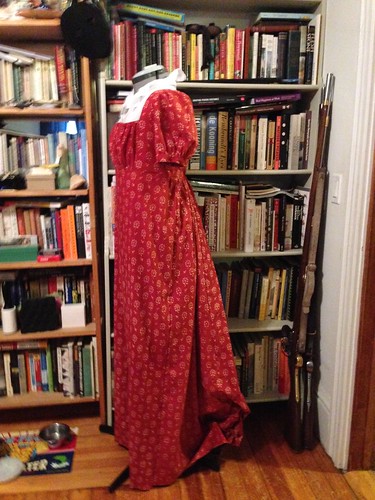
Cassandra attempts a Regency Wedgie

In just about a week, I managed a gown, now needing only a hem.  This based on the roller-printed serpentine stripe gown at Genessee Country Village and Museum, documented nicely at the 19th US site.

This was an easy gown to build up from a shoulder and back piece, once I did the math to scale it up to my size, and with the generous help of Sew 18th Century, who gave me the sleeve pattern I started from. This isn’t a drawstring sleeve, so the gown is not an exact copy of the GCV&M gown. I’m OK with that, since–as far as I can tell– it fits. It may be a little large, but that’s what an apron or sash is for. No, I don’t know when I’ll get the apron made.
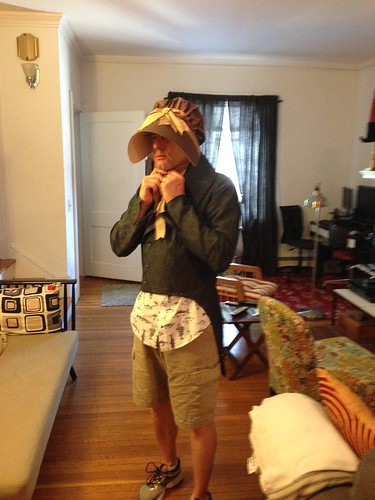
Mr S saves time by modeling *both* coat and new bonnet

There should also be a coat, and many bonnets.

Mr S’s coat seems to be working, and is now faced on the right side, leaving the left, the sleeves, and just a few buttons. He was excited about helping with button manufactory until he realized that the largest tool required was patience. But what are facings and buttons and buttons holes, among friends?
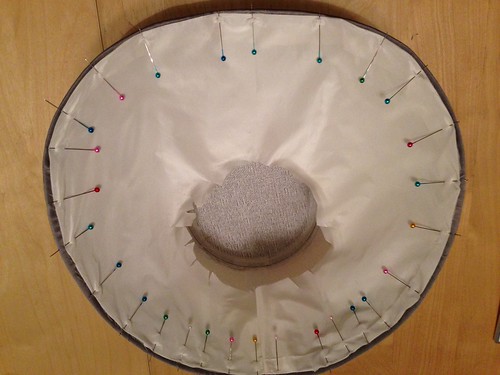
Bonnet Number I Forget

Another bonnet is in the works- can you ever have too many? I think not. It is in the prickly phase, while I work this evening on taking apart a waistcoat that must be altered for the Young Mister for this weekend at Stony Point. Bouncing between 1779 New York and 1812 Salem, when one is also considering 1765 and preparing for 1800 can make telling time a little challenging!

An Insomniac Dreams of Pudding

Thomas Rowlandson, 1756–1827, British, Gypsies Cooking on an Open Fire, undated, Watercolor and with pen and brown ink and pen and gray ink on medium, slightly textured, cream wove paper, Yale Center for British Art, Paul Mellon Collection

Once again, I’m sleeping 18th-century-style, but without of the luxury of sleeping late. What wakes you in the middle of the night? Whatever woke me, I finally fell back asleep after 4:00 thinking of what to make for Stony Point.

This will be a cold camp, with very limited cooking, which presents a stiff challenge for the caffeine-dependent, as I must confess I am. (There are gentlemen in the expected party who are also not quite themselves until they’ve had their coffee, too, and they know who they are.)

I’m up against it, this time, given how I will be spending the week leading up to Stony Point (very busy) and that Friday (giving a talk in Newport, instead of baking). As a devoted fan of breakfast, I usually spend the Fridays before a weekend event baking and assembling the provisions for the weekend; this time, however, I will be crossing and re-crossing a bridge.

As I considered prepping a pork-apple-and onion pie Thursday night for Mr S to bake on Friday morning, and the logistics and food safety concerns associated with transporting and eating meat, it finally came to me: Indian pudding. Simpler, easier, filling: all the remains to be done is to talk the Young Mr into eating it, though when presented with no other option, he may acquiesce, at last, to reality.

Breaking Up By Letter

Mr S, always slightly suspicious

Mr S and I joined other members of the 10th Mass and National Park Service staff and volunteers at the North Bridge in Concord, Mass last Saturday for the postponed reading of the Declaration of Independence. It was one of those perfect New England summer days, breezy blue skies and dry wind smelling of grass and flowers: days like that I finally get the Transcendentalists.*

Some of those present in modern and historic clothes alike had never heard or read the Declaration all the way through; it is one of my favorite documents, and not just because I was in a 5th grade play about the document. Questions of slavery and principles aside, the Declaration is a great poem of a break-up letter. It makes poetry of the list of King George III’s crimes and reminds us of the core principles that undergird our government and that began with the Magna Carta, limiting the power of the king.

Governments are instituted among Men, deriving their just powers from the consent of the governed

Leaning against a tree near the North Bridge, you could close your eyes to the shorts and kayaks and baseball caps and listen to a document being read as it would have been 238 years ago, and imagine what it was like to hear this for the first time (at least until the airplane passed overheard).

I have a complicated relationship with patriotism, which makes me a curious candidate for this living history business. But that moment in Concord reminded me of the enthusiasm I had for history as a child, and the passion I had for what educators now call narrative play, and what some of us now grown up call reenacting, and others call historical re/creation.

There is something we can learn, as participants, and that the public can learn, as we go about this business of re-investigating the past, through making clothing and reading and cooking and re-learning historic processes and crafts. We may not always learn what we expect to about the past or about our selves, but if some in the audience enjoyed the smell of grass in the wind, and heard the true poetry of Jefferson’s text, maybe that’s enough to be getting on with. Because for all the questions about how a musket works, the real point of all of these events isn’t the musketry, it’s the history.**

*They clearly did not wake up to the “what the hell’s that smell?” game tidal canals like to start on summer mornings.

** Sorry, lads, but I think it’s true: wars are about words backed by muskets or other weapons.

Six Toiles, a Coat and a Bonnet

14557116394_73c2d5ea9f_zYes, six toiles.
That’s how many it took to get a coat pattern to fit Mr S the way I thought it should. I finally built the pattern around a sleeve and arm scye that I knew worked and suited the period. From there, I built out the back, altering the center back seam curve to suit Mr S’s figure. Arm scyes are still hard for me to figure out, although sleeves are often my favorite part of a garment. I like how flat pieces become three dimensional in a sleeve, and I enjoy setting sleeves– go figure.

Thanks to the three-day holiday weekend and sitting out a parade to pad stitch, I have a coat body.

I’m not thrilled about the size of the lapels, though I have found extant examples and fashion plates showing lapels this size, and sleeves, too. While I’ve pinned up the sleeves in the back, thinking there’s too much fabric there, I can also see from the images that the subject’s posture was not the best– and that was the moment when I realized that I really did want a mannequin for menswear as the subjects are hard to catch at any age, and variable in posture and wiggliness. They also object to being pinned accidentally.

But there is at least a coat body on the way to being done, so I took a break and made a bonnet, which is really the point here <ahem> milliner’s, not tailor’s, shop, after all.

IMG_1738

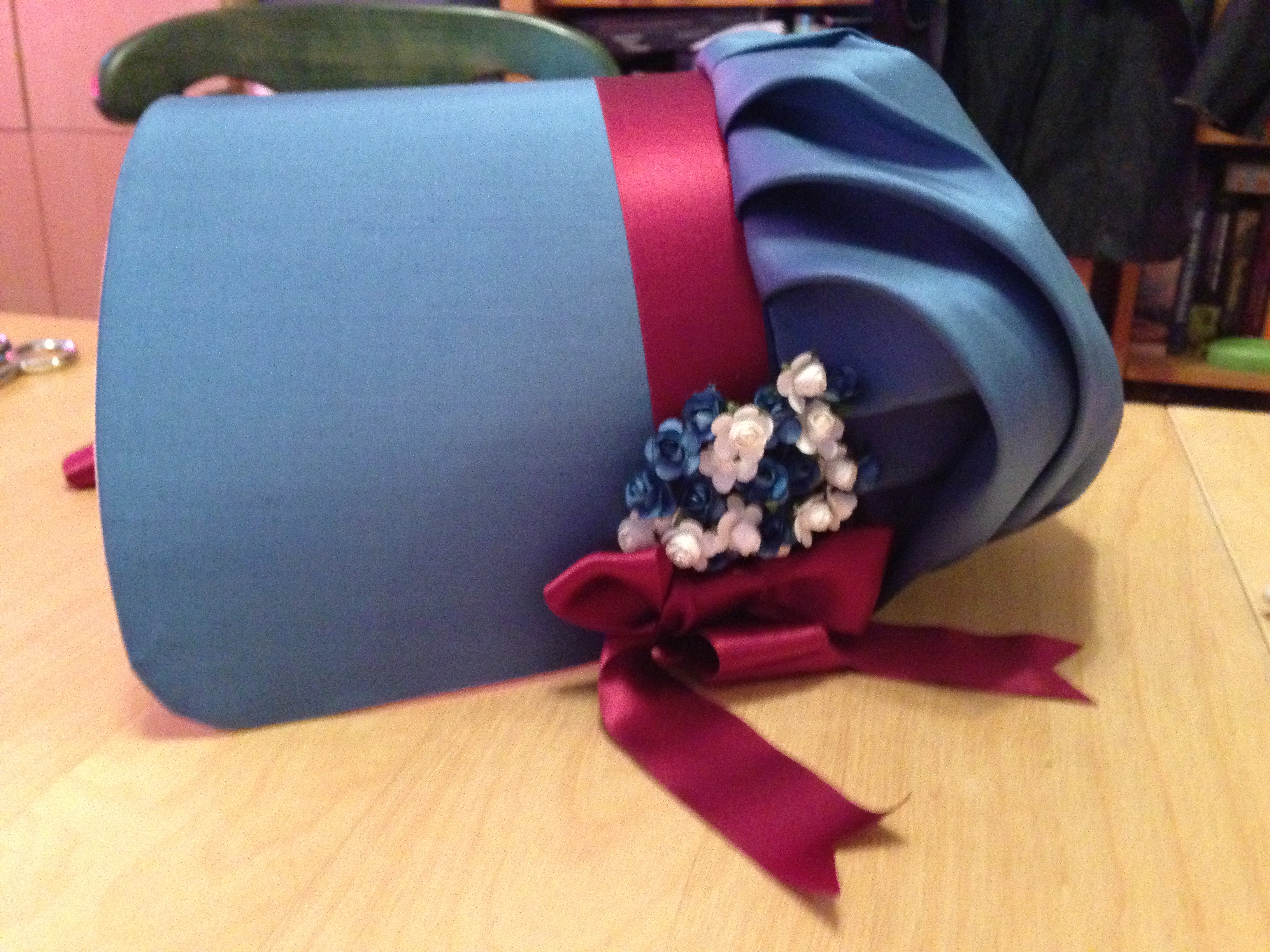
Pasteboard brim, blue silk taffeta lined with white silk taffeta (they had new things at the fabric store, very exciting!), trimmed with silk ribbon from Wm Booth and paper flowers from the V&A.

Now, more bonnets, two waistcoats, a gown, an exhibition, a lecture, and Stony Point are all that stand between me and the milliners’ shop in Salem…