Plate 11, Twenty-four Subjects Illustrating the Costume of Paris
Like most humans, I have whimsical tastes and occasional outbreaks of covetousness. Today, while looking for images of milliners, I found this book for sale online, and while I cannot dream of owning it, I am delighted by this image, and by the others shown on the bookseller’s site. The British Museum has a copy, but only a few images online; Yale has a copy at the Center for British Art, but no images online.
John James Chalon, (more images here) who made this engraving, also made the classic image of the milliner’s shop, and that was where my search began.
La Marchande des Modes
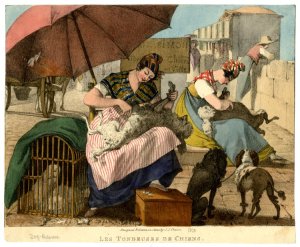
Searching a little more only improved the results… Dog groomers! I have got to get hold of this book.
Les Tondeuse de Chiens
While these engravings satisfy my delight with the absurd, more seriously, they provide some insights into daily life in the 1820s. It’s not the United States, but it’s a helpful place to start, because despite the humour in these, there isn’t a layer of satire that has to be peeled off before we can begin to understand the image.
Full-on satires, like those of Hogarth, Rowlandson and Gilray, can be hard for us to interpret: we’re so far away, we no longer get the joke, so the joke is now on us if we take what is shown for exact truth. The prints in “Twenty-four subjects exhibiting the costume of Paris” have a gentler humour.
I don’t think I’m ready to portray a 19th century dog groomer, but I am stunned that I never considered how long they’ve been around. How many other everyday occupations do we overlook when we think of the past?
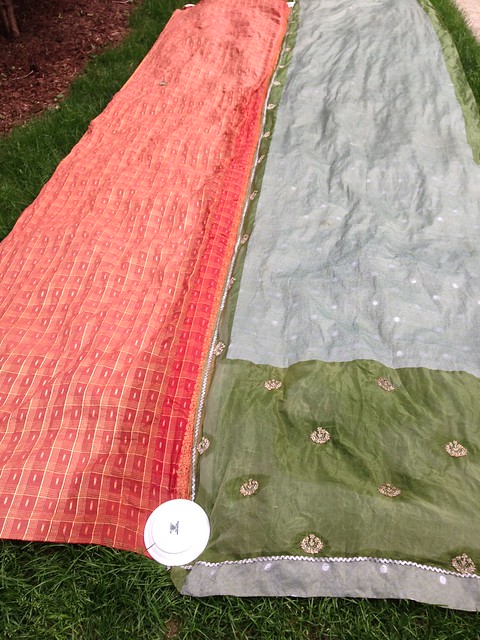
Like any good Rhode Island trader, I am pleased to announce the acquisition of some India silks. To be fair, I have not burn tested these, so while they were sold as pure and not ‘art’ silk, one never knows till one puts fabric to flame.
As reported elsewhere, these did have an odor (as most vintage and used textiles do) but a bath in vodka and cold water solved that. They seemed color fast, and brighter after washed. It’s really nice when what you read on the interwebs is true, isn’t it? Thanks to the Laced Angel blog entry, Mr S and I found ourselves at the liquor store asking for the cheapest vodka they had. It came in a plastic bottle, and we were compelled to explain we were going to be cleaning with it. The manager seemed pleased to get the tip, since his wife has a collection of her aunt’s doilies and things in their garage… I think Mr S was glad to drag me away, but he does get more human contact than I do, these days.
Samuel Ames, May 19, 1796
Besides just loving the fabrics and the potential for gowns and waistcoats, trading on Etsy with women in India pleases me logistically and historically. I retain a Huckle Cat fascination and delight with mail services, and am just astonished that a woman in New Delhi can wrap these up and put them into the India mail service and a week later they’ve made it to Rhode Island. How many trucks and airplanes does that take? And in the 18th and early 19th centuries, how many carts and ships and wagons?
By May 1796, the partnership of Brown & Francis was probably faltering (they dissolved that August, probably due to John Francis’ ill health), but Samuel James might well have boughtthe goods he advertised at wholesale from Brown & Francis. There were other importers, of course, in other Rhode Island ports, as Lopez & Dexter in Newport, advertising goods in 1809. Five cases of India silks! Four cases of fancy Prints!
It’s astonishing, the quantity of goods brought from the East, as astonishing in its way as the quantity of goods we bring from the East today. The range of colors, prints, and textures must have been incredible! For all the white muslin gowns of the Early Federal/Regency period that remain in collections, there must also have been numerous patterned gowns, shawls, and Spencers, and fancy ribbon trims, not to mention fancy silk waistcoats made up from the silks. I think we underestimate the rich texture of the past at multiple class levels– these ranges of goods hint at how colorful and acquisitive our ancestors were.
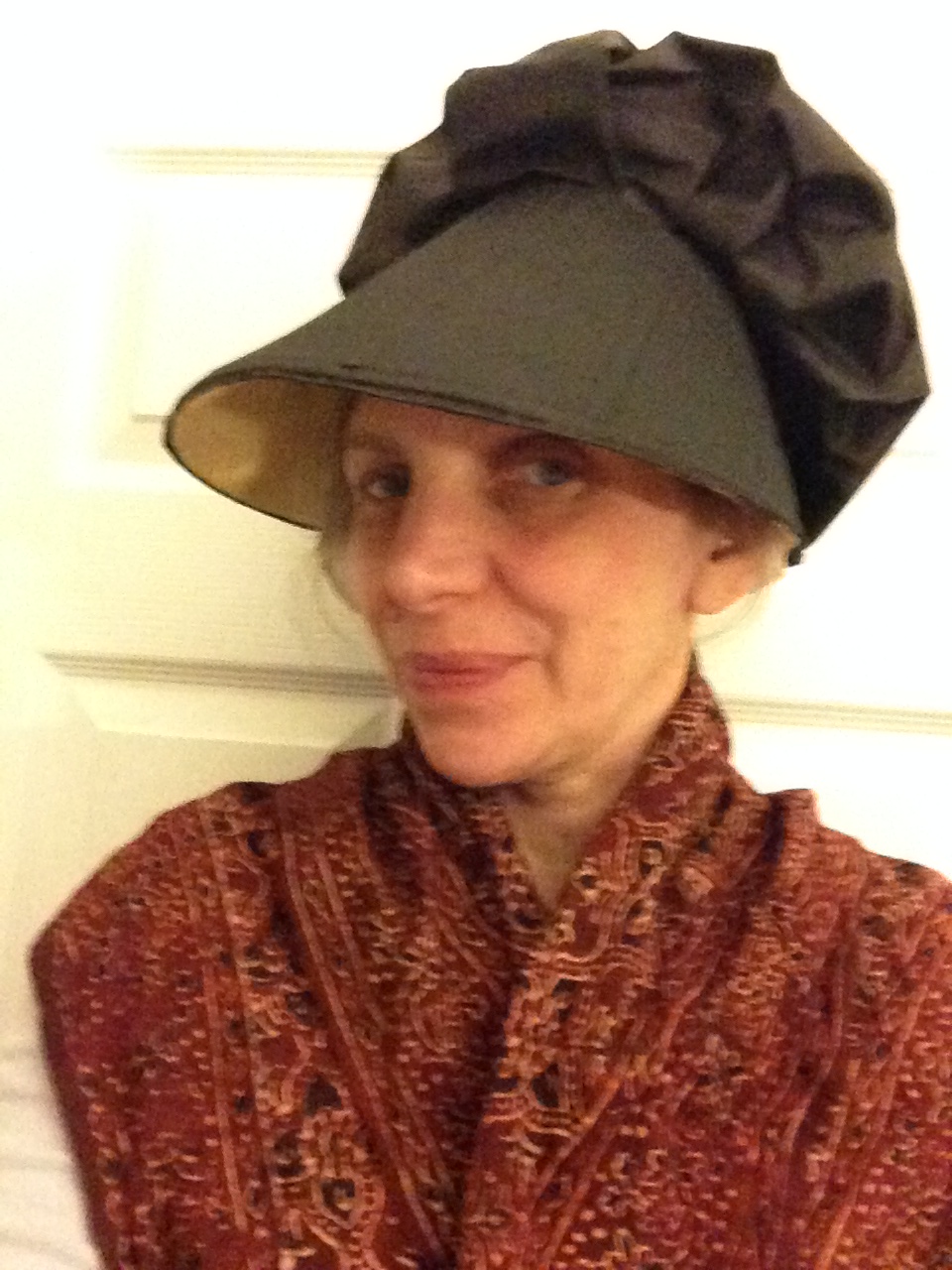
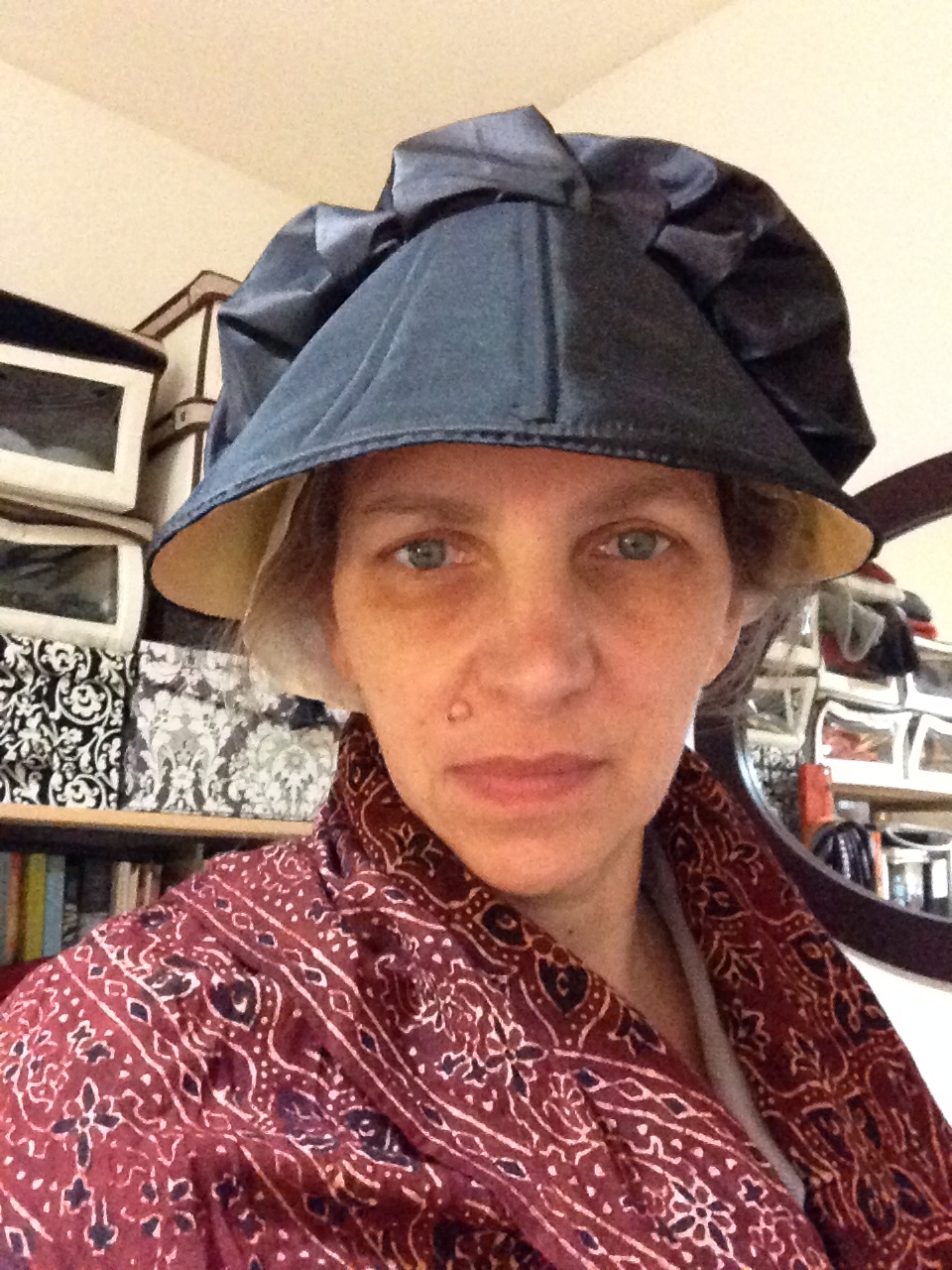
As promised, my interpretation of the ribbed bonnet in the 1789 engraving. There are a few problems with this beyond the model. (Which is not to say that I don’t like this bonnet– I do!)
I used the Kannik’s Korner bonnet pattern (view F, I think) as the basis for this because I already had a brim, lining, and caul cut and in a drawer. Given my current medicated state, using something pre-cut seemed advisable. That means I didn’t play with the brim to create the line of the Williamsburg bonnet, or the curve of the brim in the “Fortune Teller” engraving.
Detail, The Marquis of Grandby
Is this style acceptable for the period I typically interpret (1775-1783)? Well… there are other examples of the lampshade-style bonnet, as in the Edward Penny painting of the Marquis of Granby. This painting is dated “after 1765” so there’s some room for interpretation there…too much room. But if that’s 1765-1770, and the “Fortune Teller” is 1789, I think we have comfortably covered the 1775-1783 time frame, even if it is a bit like a queen-sized blanket on a twin bed.
Front view: more lamp-shade like.
As you can see, the bonnet does have some lamp-shade-like tendencies on my head, which I consider a benefit. I like the way the ribs are visible, even if I remain unconvinced by the caning. I think it’s a little too wide, and lacks resiliency, though to be honest, I have only felt baleen at the New Bedford Whaling Museum, where there is a large sample on the second floor.
To compensate for the disappointing cane in the brim, I slipped a piece of millinery wire into the pocket underneath the cane. The layers in the brim are:
black taffeta
horsehair canvas
linen buckram
yellow taffeta
The channels are all hand-sewn, and then the cane was slipped in. I stitched the black taffeta caul to the first three layers, and then lapped the yellow taffeta over the raw edges and stitched it down to finish the brim/caul seam.
No, I didn’t take any in-process pictures…probably because this took considerable snake-eyed concentration last weekend.
Usually, I line the cauls of my bonnets, but through shear laziness or distraction, I opted not to this time, and I think I’ll leave it this way for a while. You will also note that I have not trimmed this: I have some black silk ribbon coming, and I may try that. I don’t have enough black taffeta left to cut self-fabric ties, and there do seem to be some plain examples. A plainer, lamp-shade-like bonnet may be just the ticket for Bridget.
What would I do differently? Next time I would definitely play with the brim shape using a paper template. I’d like a lower, curvier, brim. Once I had the shape worked out in paper, I would use that as a template to cut the taffeta and horsehair or light buckram layers.
The Edenton Tea Party
I’d also try zip ties. I know: not period correct! But short of risking federal prosecution resulting from a trip to New Bedford with some shears, I’m not sure that anything other than plastic will have the resiliency and spring that baleen has, and that made these bonnets so special. I thought of them while making this bonnet, but I think Mr S used them all at work in the past two months. A Facebook friend has been thinking of zip ties, though, and has a hankering for one of these bonnets. I can’t say that I blame her– and honestly, I think I might join her.
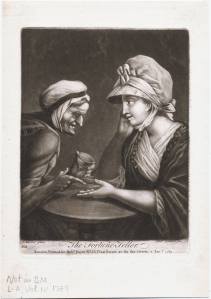
The Fortune Teller, 1789. Lewis Walpole Librray. 789.1.2.1
I like hats; I think it’s been made clear here before that I have a bit of a bonnet problem. As it stands, I have something in the neighborhood of a dozen bonnets, and really need to get my Etsy store up and running…
But as in life as in the Richard Scarry story, there’s always room for one more, and more to learn, so my collection hasn’t stopped me. I blame my Grandmother Elsa, who owned a dress shop, collected shoes, and had a particular face for trying on hats.
Black silk bonnet, 1770*1780. Colonial Williamsburg 1993*335
I’ve been thinking about bonnets because I lately came across some engravings showing what might be called baleen bonnets. At left above, a bonnet that is clearly reminiscent of the bonnet in the Colonial Williamsburg collection on the right. The CW bonnet (1993-335) has seven baleen bones, and a baleen rib around the bonnet brim.
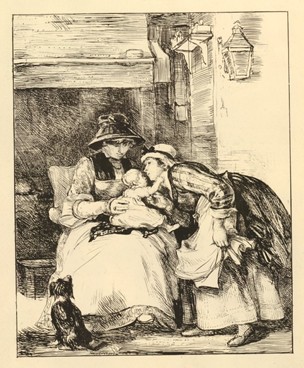
It is strikingly similar to the bonnet in the 1789 engraving, down to the decoration. In “Kissing the Baby,” a lithograph in the collection of the British Museum, the older woman appears to be wearing a ribbed black bonnet in the style my friend calls “lampshade,” and that others call “bucket.”
Kissing the Child. Lithograph by David Wilkie, 1800-1841. British Museum, 1852,1211.134
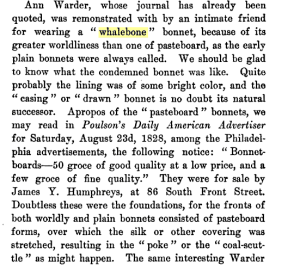
There are more bucket or lamp-shade-like bonnets depicted in engravings and paintings, and it is possible that flamboyant style was the one that got Ann Warder in trouble in 1788. I remembered this passage on page 223 of Amelia Mott Gummere’s book, The Quaker, A Study in Costume,:
Whalebone bonnet? Interesting… so, having an interest but no whalebone, I send the Young Mr to the basement for the remaining stock of caning I’d used for stays, and came up with a plan to replicate a “whalebone” bonnet, which I will describe and show you next time!








 Kirsten Hammerstrom
You must be logged in to post a comment.