You can join the fun this year by providing mail for the HMS Acasta‘s mail bag at the Jane Austen Festival. Maybe you can’t go, but why shouldn’t your letter?*
Read more here about the suggestions for types of letters, and the characters to whom you may write. It’s on my list of neat things to try to get done.
*Hot tip: Jo Baker, author of Longbourn, will be there. Creative writing, author talks and dressing in high-waisted gowns? Why am I not going? (Because I have too much to do in July!)
Pocket ca. 1784, American cotton, wool Brooklyn Museum Costume Collection at The Metropolitan Museum of Art, Gift of the Brooklyn Museum, 2009; Bequest of Marie Bernice Bitzer, by exchange, 1996 MMA 2009.300.2241
Sharon Burnston, on the Historic New England site, points out that “Pockets thus represent the kind of dilemma that objects of material culture can present to scholars. Much is known about how and when these items were made, but evidence of how they were used remains fragmentary and tantalizing.”
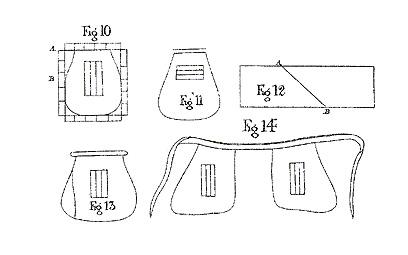
As we can see from this diagram from the Workwoman’s Guide, pockets could take many shapes, and the extant evidence bears this out. There are oblong pockets, and more rectangular pockets, rounder pockets, longer and shorter and wider pockets. One suited one’s self, and cut one’s pattern to one’s cloth.
A pair of silver buttons A pair of buckles A pen knife Thimble Coins A silver spoon A pair of scissors Keys Needlecase Biscuit Nutmeg and grater Smelling bottle An orange or an apple A pocketbook Comb Snuff box Jewellery Needlebook Pocketbook Paper Pen or pencil
When Pamela runs away, she takes with her, in her pocket, two handkerchiefs, two caps and five or six shillings.
Of all the listed things, what might Bridget have carried? Some of the things she carried would be needed, but others would be wanted.
Pocket, 1770-1780 Rhode Island Linen, cotton and silk RIHS 1985.1.9
In any case, I thought it time to upgrade my pockets, since I have given so much attention to the rest of Bridget’s clothing. I have also been talking with a colleague about a pocket game activity, similar to the process I’ve used in thinking about Bridget: what is in your pocket? If I’m going to try that out in public, then I’d like not to be embarrassed about my pockets.
The first pocket I made was based completely on one in the RIHS Collection, and it annoyed the daylights out of me as it had exactly the same loop on top and twisted around under my petticoats, making the opening hard to find. I also realized that it was too small to be really correct for a woman’s pocket: those tend to be larger. Sew 18th Century has a really nice article on pockets here.
Pocket, 1789 American linen Gift of Miss Blanche Vedder-Wood, 1940 MMA Costume Institute C.I.40.159.4
So I made a larger pocket based on this one at the Met, and made of a grey and cream striped linen with the slit bound in red calico. It’s dated to 1789, and technically that’s too late for my uses.
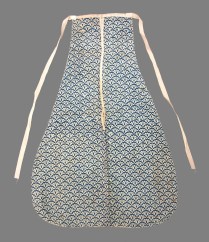
Pocket England, 1720-1730 Cotton; Linen Winterthur Museum Collection 1960.0248
Well, it has survived this long, and Wm Booth has that lovely shell print cotton, so what’s a sister to do? Pockets don’t take much fabric, so making a matched pair of printed pockets seems the thing to do.
Now the question is, what should be in those pockets?

 Gentle Readers, would you be writers?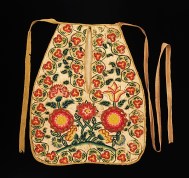


 Kirsten Hammerstrom
You must be logged in to post a comment.