Not in Defense of ‘Turn’

John André’s self-portrait, 1780. George Dudley Seymour Papers, Manuscripts and Archives, Sterling Memorial Library, Yale University

Like all the other history-obsessed Rev War reenactors with basic cable, Mr S and I have been watching ‘Turn’ on AMC, and like some other reenactors, I’ve been lurking on the fringes of the Facebook feeds trashing the show, but hoping a contrarian view would be possible, just to keep things interesting.

So we watched last night with the best intentions: I would not think about shoulder seams, drawstring-neck shifts, circular caps, obvious mascara, white linen shirts on farmers, shirts with neck bands but not collars, a lilac silk cloak on a farmers’ wife, the amazing amount of light candles throw, beards on smugglers who look like they escaped from a spaghetti western… Mr S has learned to live with this and I have learned to keep quieter. He learns best visually, so he really had hopes for this show. I think we all did, even given what we know Hollywood does to historical realities.

Mr S keeps asking, “Where’s the war? Where are the soldiers?”

I keep asking, “Why is Tallmadge allowed to be on his own for so long, and what the heck is wrong with his uniform facings? And he’s a dragoon, where the heck is his horse?”

The low shoulder seams on Woodhull’s leather(?) jacket still make me nuts, though I think Anna serving in the tavern in a pristine white apron over a cranberry silk button-front gown really took the cake last night, costume-wise.

The dialogue howler I enjoyed the most (i.e. caused the final outburst) was Major Andre and his “player” girlfriend who is so not pumping him for information (horrid pun intentionally retained).

If you were the suave Major, you would respond with complete candor to the charming (mascara-eyelashed, obvious foundation-wearing, look out for the lip-gloss) woman’s question: “You will tell me where you’re going on your next secret mission, won’t you?” “Why, sweetie, yes, and let me use my time machine to bring you the Enigma machine and a smallpox vaccination.”

I expect and grudgingly tolerate:

  • Bad costuming
  • Odd set dressing (highly suspicious table in the church-stable; suspect it would be happier in Amistad)
  • The incredible candlepower of candles
  • Non-18th century speech rhythms
  • Changes to actual events for increased drama

But patently absurd, asinine dialogue on top of all that goes beyond my patience.

I should give it up: Two Advil PM at 8 and I’ll no longer spend an hour every Sunday night performing mental alterations on TV costumes. (Those shoulder seams really annoy me, and could someone try pressing the facings?)

But no; next week, Fort Lee should fall and chances are good Mr S will lead the screen-shouting…

Frivolous Friday: Whitaker Auction Waistcoat

It’s so nice to have enabling friends. If it’s not one tipping me off to a sale on fabric at Williamsburg (over now, keep calm) it’s another tipping me off to costume auctions.

My most recent tip-off came from Mr Cooke, about the Whitaker auction coming up April 25 and 26 in New Hope, PA. There are some very nice things from the collections of the Met and LACMA coming up in that sale. It’s hard to understand deaccessions from the outside, so I won’t comment on that part of the sales.

Unmade waistcoat ca. 1790. RIHS 1990.36.15

I was particularly taken with this waistcoat.

The lapel embroidery and button details remind me very much of an uncut dimity waistcoat in the collection of the Rhode Island Historical Society.

Whitaker’s got copyright notices on their images, so I won’t post them here, but I can assure you, the visit will be worth your while. But my tip to you is this: forget those estimates– from what I’ve seen lately, they’re all too low by a factor of 10.

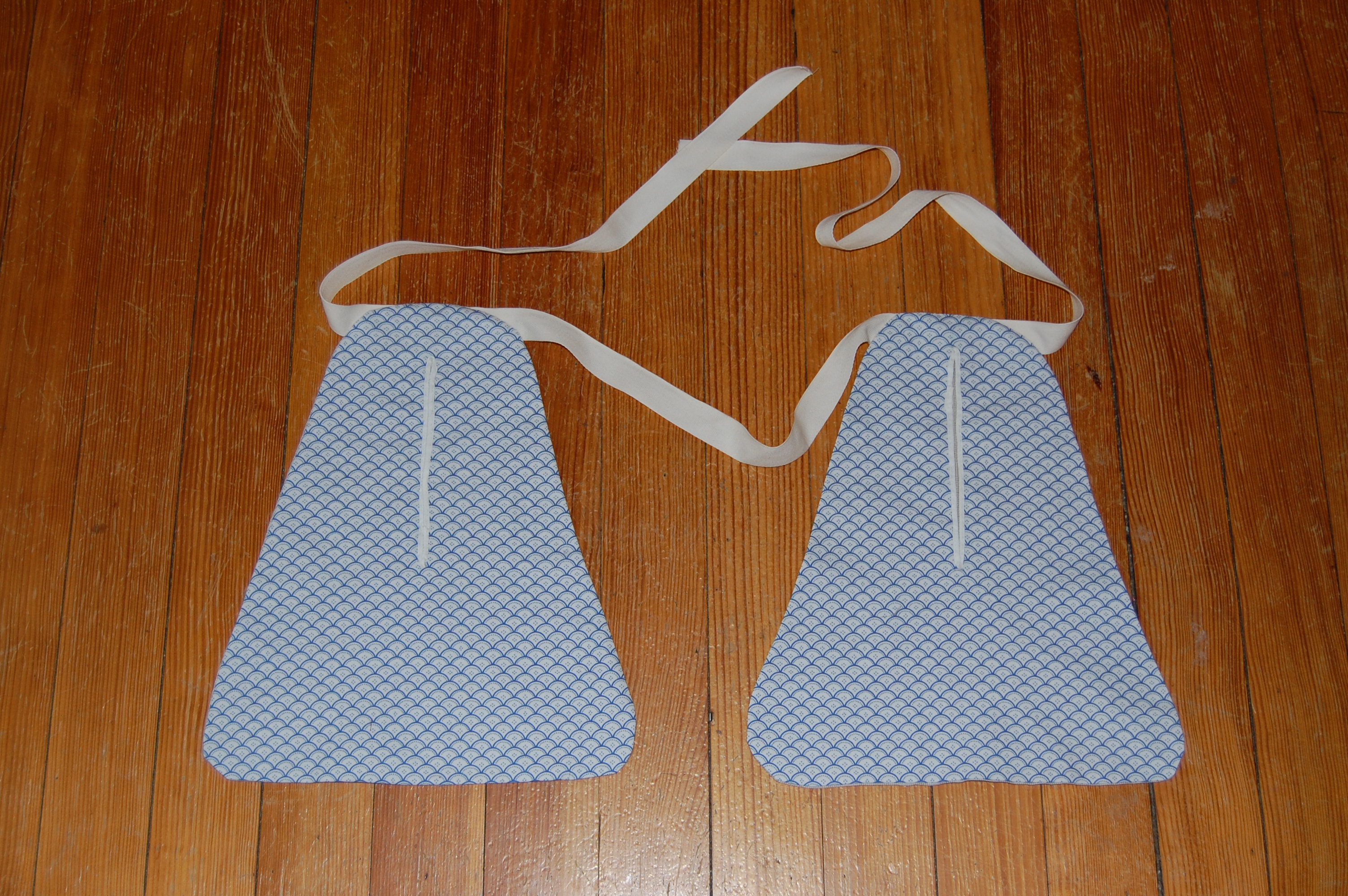
Pockets 2.0

Pockets the First
Pockets the First

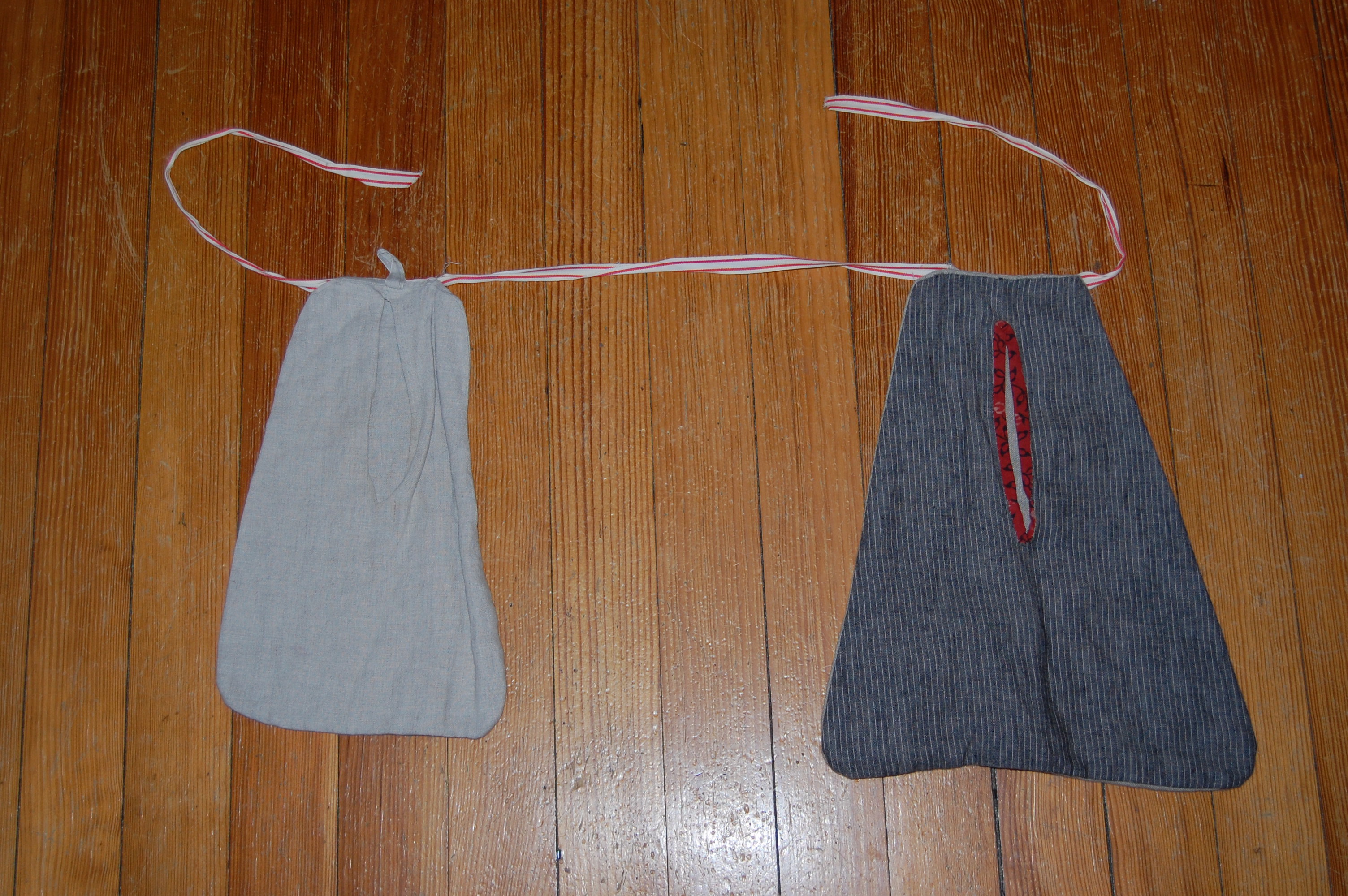
At left, Pockets 1.0 or perhaps beta. The far left pocket, when worn alone, was definitely beta. Then came the striped pocket, and then sewing them both to the tape. That helped– and I use the small pocket for things like wallet, phone, car keys and Band-aids, and the larger pocket for interpretive things. I try to follow the Under the Redcoat kind of model: one pocket is modern, one is historical; that way I don’t pull the car keys out along with the knitting, or am at least less likely to.

Too much stuff.
Too much stuff.

Here’s the stuff I carry in my purse today, actually a backpack-purse, downsized from a messenger bag. That’s a lot of stuff. But if you compare the list to the list of what might have been in an 18th century pocket, you’ll find a lot of similarities.

There’s a pen and a pencil, wallet and checkbook, granola bar, chewing gum, change purse, keys, more keys, and phone. All of those are just modern analogues for paper money, coins, orange or apple, candy, book and notebook, since the phone can fill in for so many things– notebook, money, keys, pen, book…

DSC_0174

The historical assortment is much more attractive, in part because I don’t use these things every day, and they don’t get tangled up and worn in a bag. Mitts, kerchief, hankie, my husband’s pay, knife, thimble, spoon, and knitting (I may never get a pair of stockings knit): these are all accurate to carry, though the knitting needles will have to change before that’s taken out in public.

DSC_0173

All that, or some combination of like things, will go into one pocket, and the modern mess into the other. I fear these new pockets are, for now, too nice for Bridget. I may just stick with my old, mis-matched ones for now.

Use it Up, Wear it Out, Make it Do

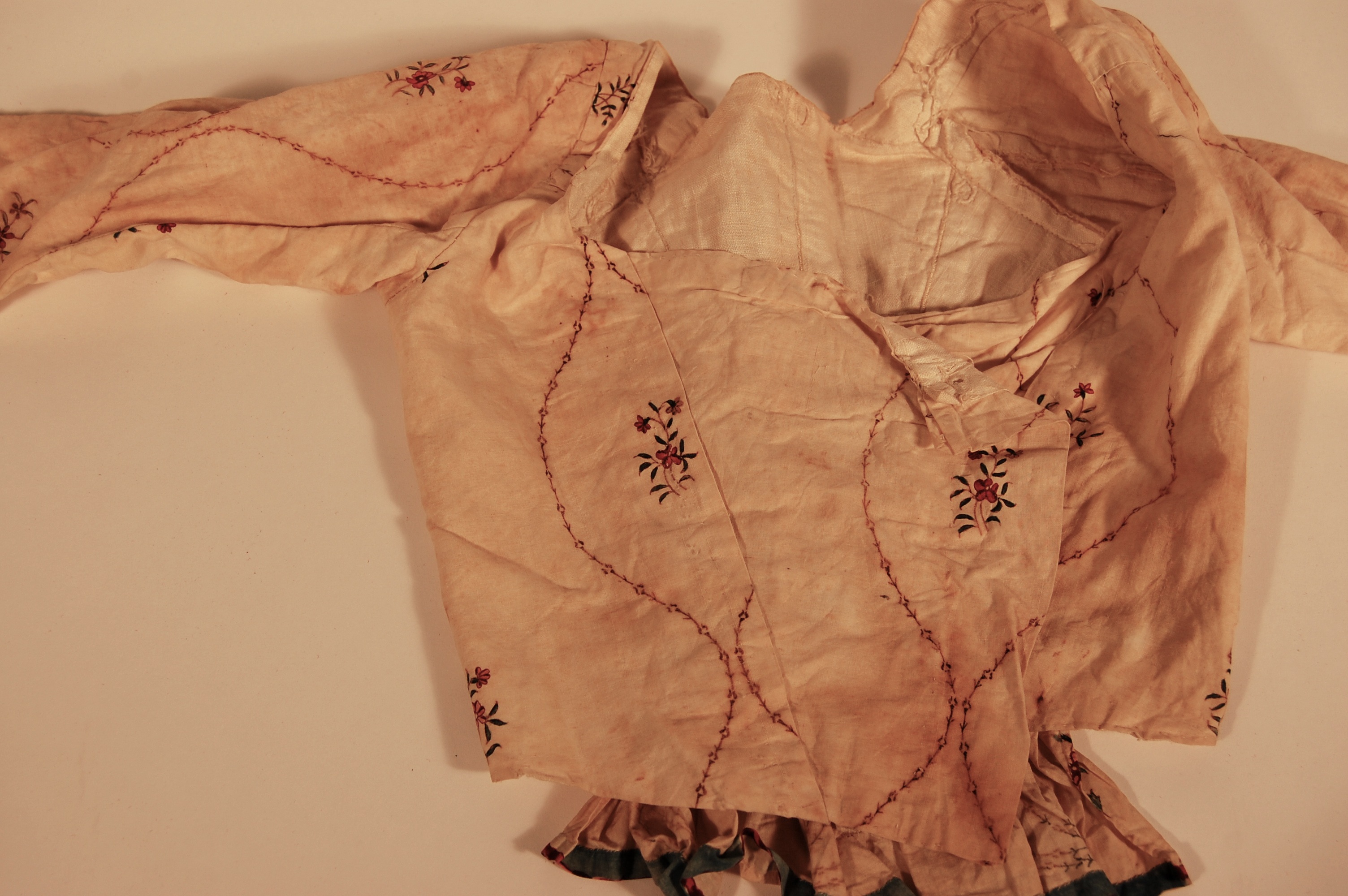
Bodice, painted Indian cotton, 1780-1795 RIHS 1990.36.27
Bodice, painted Indian cotton, 1780-1795
RIHS 1990.36.27

I’ve fallen behind again, as I spent considerable early morning time this past week working on a short presentation for a program in Worcester this past weekend. If you are among the people who do not wake at 4:00 AM panicking about the organization of your thoughts, or whom, exactly, might have worn a heavily-remade bodice, you are lucky indeed.

But I managed to present without falling all over myself, putting out someone’s eye, or causing mayhem and self-embarassment, so, phew! (I do this so much less often than I used to that my anticipatory anxiety is always high.)

Above you can see one of the items I talked about: a re-worked bodice from the collection of the Rhode Island Historical Society.

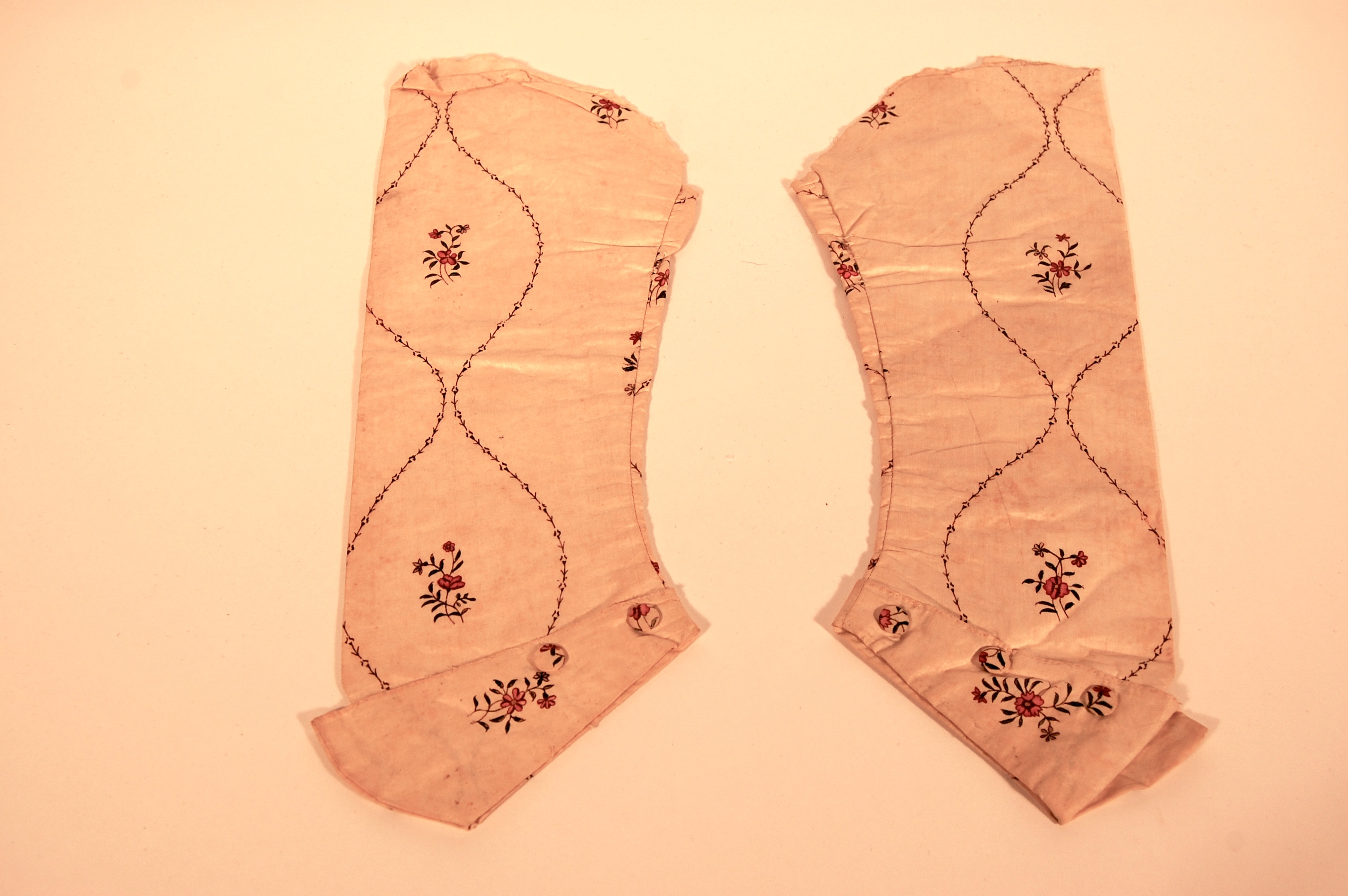
Sleeves, removed from bodice 1990.36.27. RIHS 1990.36.25A-B
Sleeves, removed from bodice 1990.36.27.
RIHS 1990.36.25A-B

I think, once upon a time, that bodice was part of a pieced-back closed-front gown with a matching petticoat.

And then I think someone decided (quite rightly) that the style was too passé for 1795, and altered the gown significantly.

Not only is there evidence of new sleeves being fitted into the gown’s armscyes, we have the sleeves-that-used-to-be. And my dear! No one is wearing sleeves like that this season!

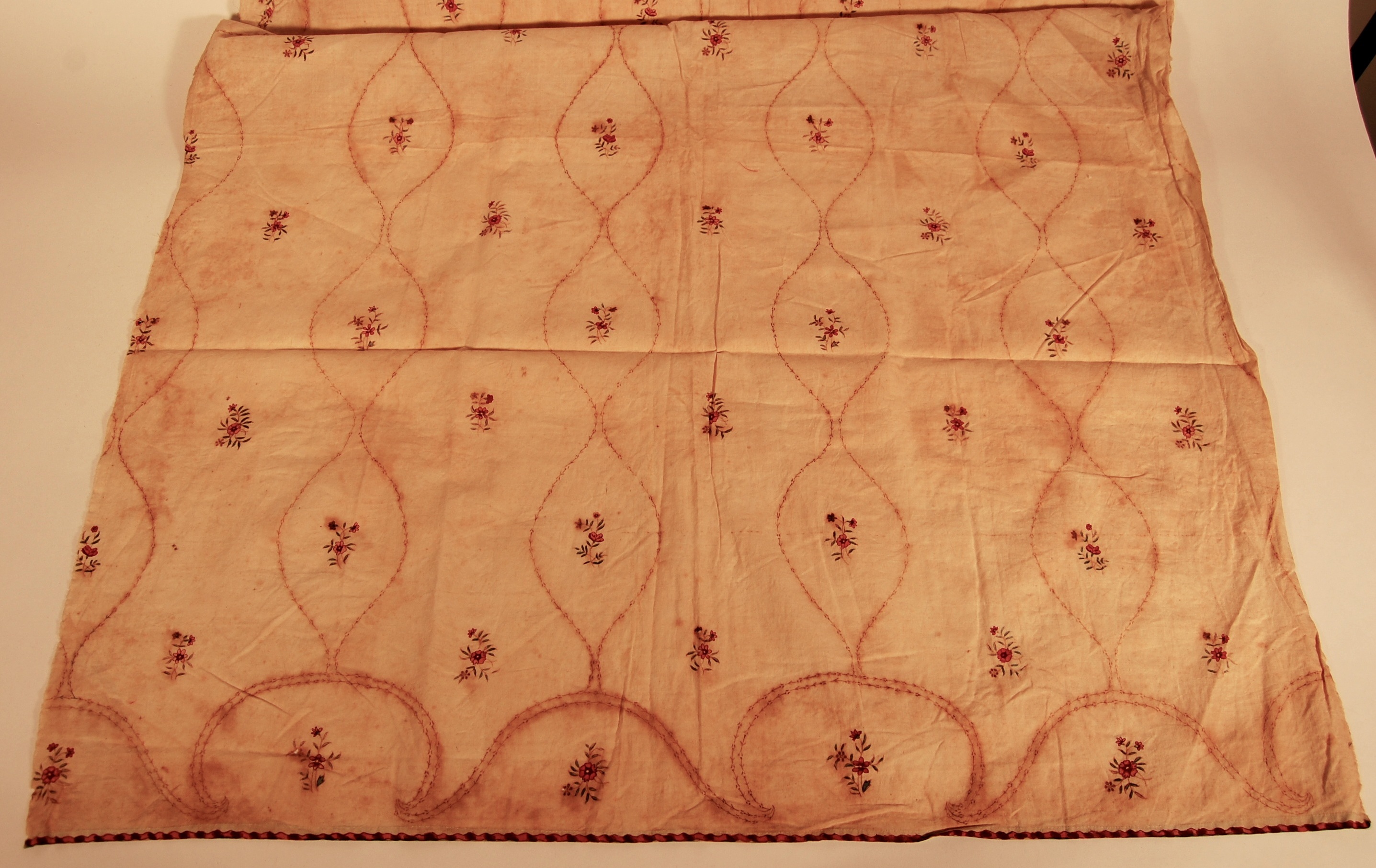
I find these garments in limbo really fascinating. Was that bodice finished and worn with a matching petticoat? (Yes, there’s a panel of that left, too; what a lovely hem!)

Skirt panel, painted Indian cotton. RIHS 1990.36.33
Skirt panel, painted Indian cotton.
RIHS 1990.36.33

Who wore the gown? Was the woman who wore it originally the same woman who wore it altered? I can only guess at this point, and may never find the smoking diary or mantua-maker’s bill. The alterations are not as finely done as the original gown, so I think there are two hands at work here– whose were those hands? There’s always more to think about and learn.

In case you’re wondering, thanks to the Met, we can see what the gown probably looked like in its first incarnation, and then what the alterations were meant to achieve. (Link to the gown on the left; link to the gown on the right.)