The Ladies Magazine, v/ 4, plate 53, Wednesday July 1, 1812. Casey Fashion Plate Collection, LA Public Library
I don’t know which I like best: the green and white bonnet, the green silk Spencer, or the suspicious and candid glance of the woman on the left. Perhaps its the date: mere weeks before the purported milliner’s store this coming August. Have I already purchased green silk and white cotton organza? Of course I have. Never let a fashion plate or an event keep you from a new and slightly mad project to make something new.
This weekend, we’ll be at the Brigade of the American Revolution’s School of Instruction, taking anxiety to the Hudson Highlands as I give a presentation on interpretation. Sure, it’s part of my day job to interpret objects and documents and even, sometimes, to do costumed interpretation, but experience has never prevented me from worrying. It has allowed me to focus my worries more productively and specifically. One of the things we’ll be trying, or attempting to try, are vignettes based on the shirt-stealing and selling ring of 1782.
Soldiers Steal a Shirt and dispose of same (~July 13-14, 1782)*
Cast: Two soldiers, officer who catches them
Props: shirts
Court-Martial July 15, 1782: Paul Poindexter and Titus Tuttle, for theft of a shirt
Cast: Two soldiers, accusing officer, three officers of the court
Props: Shirt; table and seats, orderly book (optional)
Discovered buying a shirt (~July 21-22, 1782)*
Cast: Bridget, soldier selling shirt, officer who catches them
Props: Shirt(s), money
Court-Martial July 23, 1782: Bridget tried for buying a ‘publick shirt’
Cast: Bridget, accusing officer, three officers of the court
Props: Shirt & money; table and seats, orderly book (optional)
Insolence to Officers of the 10th Mass (~July 23-24, 1782)*
Cast: Bridget, officers (two preferable, one adequate)
Props: None required, large stick probably handy
Court-Martial July 25, 1782: Bridget tried for insolence
Cast: Bridget, accusing officer, three officers of the court
Props: Table and seats, orderly book (optional)
Expelled from camp, July 25, 1782*
Cast: Bridget, drummer, officer(s), jeering onlookers; Francis skulking at the edge
Props: Drum, Bridget’s chattel
* Events are extrapolated from the Orderly Book as things that must have happened to cause the events that followed.
We’ll see…in the meantime, I’m finishing up a shirt for the Young Mr, so that his small clothes will no longer be too-small clothes, and so we have extra shirts for this black market ring.
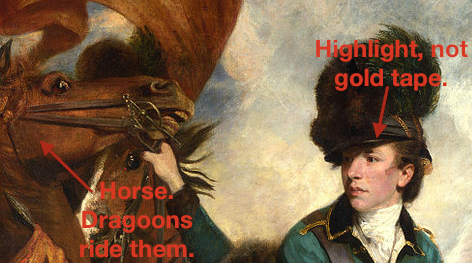
Portrait of Sir Banastre Tarleton (1754-1833) by Joshua Reynolds, 1782. National Gallery (UK) See update below!
By 9:00 on Sunday, I was asleep and missed “Turn,” which Mr S wasn’t even watching because, as he declared, “It’s just a bad show.” On Monday evening, I made it through the opening of the show and gave up for good. But those minutes made me think of the Banastre Tarleton portrait by Sir Joshua Reynolds, and the suggestion on Twitter that “Turn” had no historical consultant.
It occurred to me, as I stared at the rather curious headgear worn by Captain Tallmadge (I think it’s stretch lycra over a “Roman” gladiator costume helmet glued to a baseball cap visor and edge-taped with gold foil) that perhaps the people doing the costumes simply lacked visual literacy. This could explain the refugees from Fort Lee who looked like they stepped out of an Emma Lazarus poem, and it could explain the very unfortunate helmet.
Let us look at Banastre Tarleton, hunky bad boy of the British dragoons: he came to mind on Monday night, and what visual relief he is.
Note the light edge of the visor: this is a highlight. The leading edge of a polished surface will shine, and helmets, even of leather, will be reflective. Over time, the edges will polished by wear if not on purpose. I cannot speak to the helmet habits of the horse-mounted, but I know from paintings, and that edge is a highlight.
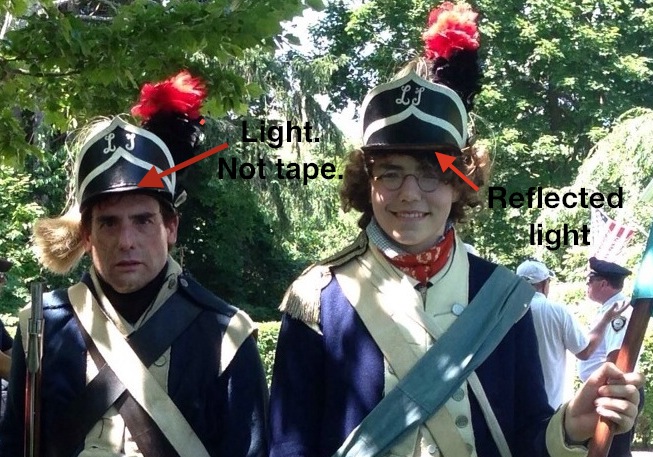
The Boys last July. Look, shiny, not-taped visor edges.
Reynolds painted what he saw, and just as the Young Mr’s cheekbones are reflecting light off the underside of his visor and Mr S’s helmet edge is shining in the direct light, so too is Colonel Tarleton’s helmet edge shining.
(Yes, there are both mounted and unmounted dragoons within a unit; but I just can’t help feeling that an officer would be mounted more often than he has appeared to be thus far.)
ETA: Heather has graciously pointed out a very nice blog on Turn, which is doing a far more even-handed and informed job of watching and commenting on the show. Thank you, Heather!
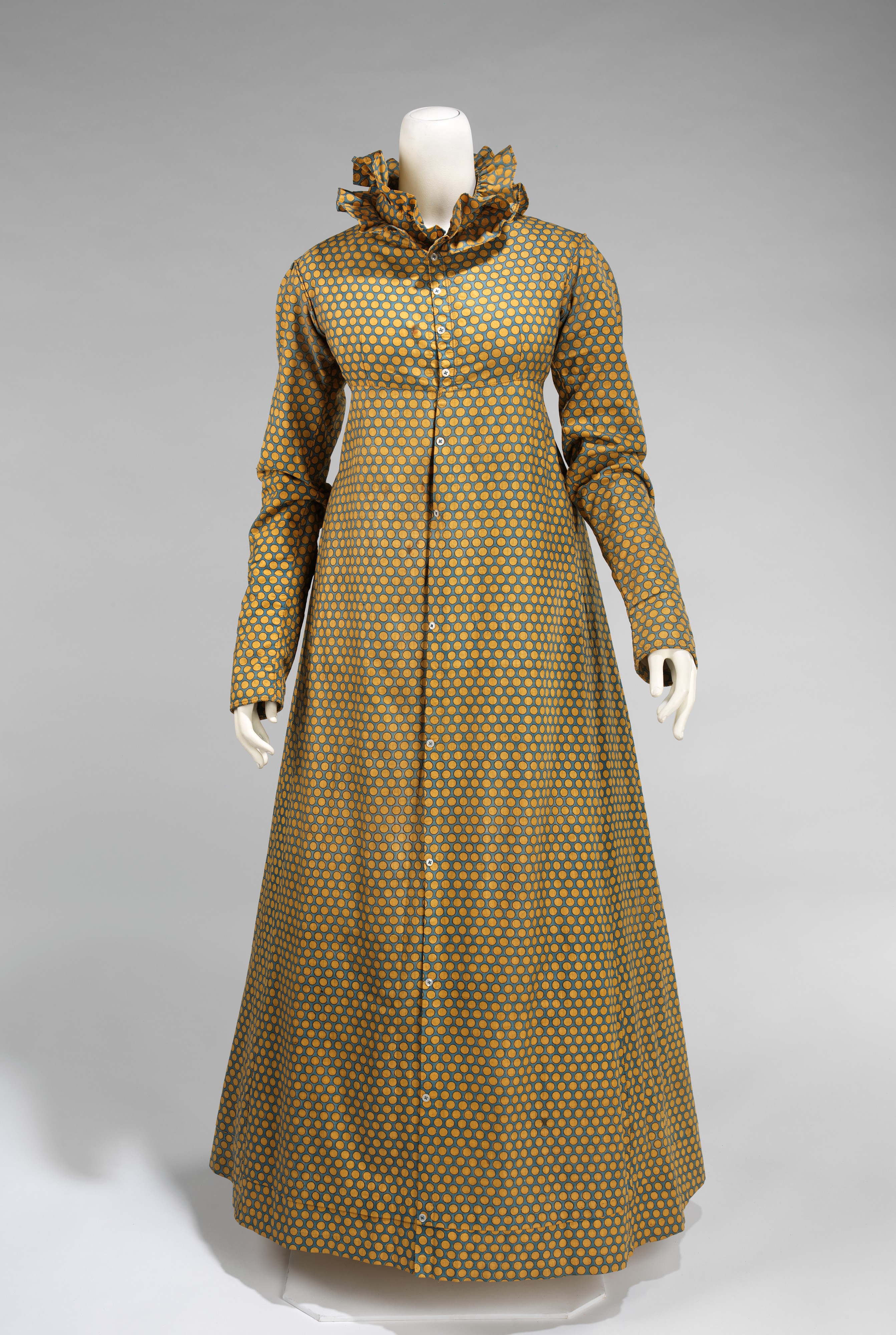
Dress Date: ca. 1815 Culture: American Medium: cotton Dimensions: Length at CB: 54 in. (137.2 cm) Credit Line: Brooklyn Museum Costume Collection at The Metropolitan Museum of Art, Gift of the Brooklyn Museum, 2009; Gift of Florence Inniss, 1970 Accession Number: 2009.300.943
In typical museum fashion, whilst looking for something else, I found something I didn’t know I wanted.
I’ve been asked to portray an 1812 milliner in Salem this coming August (which feels like next year but will soon be Ohmygoodness that’s TOMORROW) so I’ve been getting a start on images of bonnets and hats and gowns and things because you know I’ll have to have something new. Have to. And there at the Met was this garment, unassuming and bronze-looking in the thumbnail of catalog hits and ever so much more so when you get up close.
I recommend getting quite close to really appreciate the print. I’m pretty sure I’ve seen something similar in the quilting cottons, Amy Butler or Kaffe Fasset, and of course I’m tempted. Wouldn’t you be? How often do you get to mix historic costumes and Op-Art?



 Kirsten Hammerstrom
You must be logged in to post a comment.