
The V&A’s extensive article includes many hints about what might be in woman’s pockets.
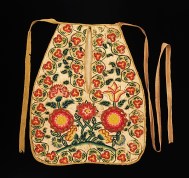
ca. 1784, American
cotton, wool
Brooklyn Museum Costume Collection at The Metropolitan Museum of Art,
Gift of the Brooklyn Museum, 2009; Bequest of Marie Bernice Bitzer, by exchange, 1996
MMA 2009.300.2241
Sharon Burnston, on the Historic New England site, points out that “Pockets thus represent the kind of dilemma that objects of material culture can present to scholars. Much is known about how and when these items were made, but evidence of how they were used remains fragmentary and tantalizing.”
Fragmentary and tantalizing indeed!
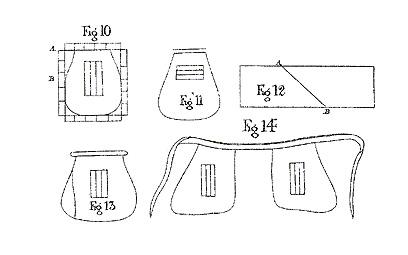
As we can see from this diagram from the Workwoman’s Guide, pockets could take many shapes, and the extant evidence bears this out. There are oblong pockets, and more rectangular pockets, rounder pockets, longer and shorter and wider pockets. One suited one’s self, and cut one’s pattern to one’s cloth.
The identification of pockets with self, with intimacy and privacy, is explored in Women’s Pockets and the Construction of Privacy in the Long Eighteenth Century, by Ariane Fennetaux.
Fennetaux’ article and the V&A page on pockets were particularly useful in enumerating more specific kinds of items that might be carried in an 18th century woman’s pocket.

ca. 1690, British
Cowrie shell, silver
Gift of Irwin Untermyer, 1968
MMA 68.141.278
Using cases from the Old Bailey, we can begin to draft possible contents lists.
A pair of silver buttons
A pair of buckles
A pen knife
Thimble
Coins
A silver spoon
A pair of scissors
Keys
Needlecase
Biscuit
Nutmeg and grater
Smelling bottle
An orange or an apple
A pocketbook
Comb
Snuff box
Jewellery
Needlebook
Pocketbook
Paper
Pen or pencil
When Pamela runs away, she takes with her, in her pocket, two handkerchiefs, two caps and five or six shillings.
Of all the listed things, what might Bridget have carried? Some of the things she carried would be needed, but others would be wanted.
 Kirsten Hammerstrom
Reblogged this on "Persons of a Mean and Vile Condition" and commented:
Kitty Calash, a blogger & historian I greatly admire, has brought attention to an article at the V&A (The Victoria & Albert Museum) about pockets. In turn, I’d like to bring it to attention to anyone reading.
Pockets were an extremely useful item. I wear one in my own reenactment play. I made it of left over chintz from a short gown, and it contains both modern items (such as a mobile phone) and modern versions of everyday items that would have been carried by our historical sisters (coin purse, hairpins, etc). I carry my scissors, pincushion and small watch on a plain chatelaine.
I’ve even used my 18th century pocket in modern life. If I’m working on a sewing project and wearing comfy knit pants, I’ll tie on my pocket to hold my measuring tape, scissors, pin box and any other tools I need close to hand. I don’t loose them under a pile of fabric or knock them off the table that way!
I’ve been absent from the blog for a couple of weeks, but I assure you that I haven’t abandoned the place already. My series looking at clothing in both “Costume in Detail” and “Patterns of Fashion” is still in the lineup.
Tracy
Erk. Please delete. I didn’t realize that adding to my reblog would comment directly on your article. My reblog doesn’t really further the conversation. I did still post about it, though – http://personsofameanandvilecondition.wordpress.com/2014/04/06/im-still-here-and-a-link-to-an-excellent-article/
Sorry for any mess!
– Tracy
Pingback: I’m still here and a link to an excellent article | "Persons of a Mean and Vile Condition"