Benjamin West, 1738-1820, American, active in Britain (from 1763), Page Boy Asleep, undated, Brown wash with pen and brown ink on medium, slightly textured, cream laid paper, Yale Center for British Art, Paul Mellon Collection.B1975.4.786
Just because the Young Mr had a snow day and slept in didn’t mean the rest of us did. So what did we do?
We went to work, just as they would have in the 18th century. We joke that the streets in our town are better after ice and snow, because the potholes are filled in and the ride is smoother. You can see the principle at work here, in a watercolor by Benjamin Henry Latrobe. Sleighs and sleds will run more smoothly on snow-packed roads, and sometimes I think a sled would be better than a Subaru in the city of Providence.
Still, I’m grateful for furry boots and buckets of salt, central heat and an electric tea kettle. Every winter, one or more of us falls on the ice, and when I went out to salt the paths this morning, I could see where Mr S had slipped on snow-covered ice.
In the Morland below, the scene revolves around the central figures, a man who has fallen on the ice despite his stick, the woman, black bonnet thrown back, who has witnessed his fall. We haven’t reached this point yet, and snow has become sleet that will freeze later, with more snow to come, so our vista is not nearly as attractive. But it’s clear that we, as humans, have never enjoyed snow and ice very much, and I think the donkeys are unimpressed as well.
George Morland, 1763-1804, British, Winter Landscape with Figures, ca. 1785, Oil on canvas, Yale Center for British Art, Paul Mellon Collection, B1993.30.23
unknown artist, A Country Woman, , Pen and black ink and watercolor on laid paper laid down on a contemporary(?) mount, Yale Center for British Art, Paul Mellon Collection. B1975.4.46
Gentle readers, I am indeed posting less often. I don’t have less to say (take pity on Mr S), but I have less time.
I have a new routine, which includes a morning workout and more cooking in the evening. That workout takes up the time when I used to write (and sew—I’m behind there, too). But I need to get stronger, because in about three months (83 days according to the countdown app) I’m getting a new left hip. Yay!
Three years ago, I got a new right hip and I love it. Even though it took a while to get used to (which was really about bone growing around the implant so it wouldn’t be so cold in the winter), the lack of pain was a terrific change.
18 months ago, my surgeon told me plainly that it was just a matter of time before the left one would need to be done. We spent some time looking at the x-rays in January, and it’s a fine thing to see the bone lumps that thunk and clunk as you move. Oh, that’s why climbing stairs is noisy and painful… But stronger I must get, so for while, more Pilates and fewer paragraphs.
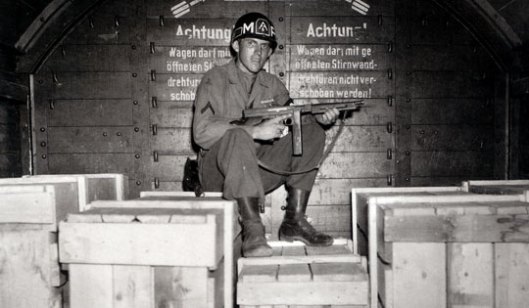
Mr S and I went to the movies on Saturday afternoon to see the long-awaited Monuments Men movie. It had been the hotly anticipated film in my set– guns, art, George Clooney: what’s not to like? We knew the history would be bad, we expected inaccurate museum practices, but still. The ingredients were sound, how bad could it be?
Well…not so bad that I’m sorry I went to see it, but sadly lacking in oomph. When a movie has a website that includes lesson plans, maybe you should not be surprised by its leaden, film-strip qualities.
I’d read the Times review, I knew what I was getting into when we bought our tickets, and we bough them anyway. Art, guns, Clooney, remember?
Here’s what I thought, in somewhat random order:
That movie’s not done. The soundtrack is horrible and needs to go. Also, the voice-over. George Clooney can read me the dictionary at bedtime any time, but the kill the heroics. Please.
But that’s just a symptom of the film and director’s insecurity. This movie isn’t brave enough to be convinced of its own mission, not unlike museums today. It keeps trying so hard to sell me on the idea that art is humanity, our collective soul, that must be saved and is, in fact, worth a life. Dude, I bought that program before I was 12. To toss a cliche back, Just believe. Everything else will follow. If the film, the director, and the star keep trying to sell me on the principle idea, there’s something wrong.
A Rembrandt self-portrait recovered at a German salt mine that had been used as a storehouse, with Harry L. Ettlinger, right. Monuments Men Foundation
There’s no clear enemy, and that leads to the film’s core flabbiness: no tension. Clooney looks slender as I expect my 1940s-era heroes, but the center doesn’t hold. Narrative, dramatic films need tension. (You know, plot.) “Get the art before something bad happens” doesn’t quite do it. Before Hitler burns it? Before the Soviets scoop it up and haul it back to the USSR? Ultimately, Clooney doesn’t need Nazis or Soviets as enemies: his real enemy here is time.
Surely Mr. Clooney schooled himself in the one of the loopiest but most entertaining WWII caper films, Kelly’s Heroes. Acting out of pure self-interest, a group of American soldiers on 3 days R&R race 30 miles behind enemy lines to steal $16 million in gold. It’s not great art, but this is a good movie. Anachronistic? You bet. Oddball is an unlikely character, a Joseph Heller minor figure crossed with a healthy dose of filthy hippie. Crapgame’s a stereotype and so is Big Joe. But there’s tension in this movie, helped along by a pleasant lack of music, which allows us to experience the crunches, thrums, clicks and booms of war. A few scenes in The Monuments Men refer to Kelly’s Heroes (Goodman and Dujardin’s scene on a road is reminiscent of a road ambush in the Eastwood film), but the places where you might expect to find parallels, I found the Eastwood film better. (Yes, we went home and watched it.)
And then there’s Sam Epstein from Newark via Germany. This Monuments Men character left Germany in 1938, with his parents, but his grandfather stayed behind. By 1944/1945, his grandfather had not been heard from in 4 years, but the family knew he’d been sent to Dachau. Though the family lived in a town with a museum with a Rembrandt self-portrait, Sam has never seen it; they weren’t allowed into the museum, because, as the grandfather said, they were ‘too short.’ Why can’t the film confront the confiscation of Jewish property more directly? Why can’t it do a better job with the Holocaust than Clooney’s scene with the German officer? There’s brief scene with a barrel of gold that is absolutely chilling: and I think the film would have been better served with more upfront recognition of that barrel’s contents, what ‘too short’ really means, and the pervasive anti-Semitism of most of the world in the 1940s. (Gentleman’s Agreement, anyone?)
I don’t know enough about the actual history to quarrel over that, and while I will hunt up the books and read them, I was more taken with what seemed like obvious cinematic, movie-making failings– the “I’m heroic!” soundtrack, the lack of central tension, and the curious blindness to, or oddly tangential portrayal of Nazi racial hatred that fueled confiscation programs.
(For another movie about French resistance to Nazi art theft, there is always The Train: Burt Lancaster, art, and guns.)
I wish Clooney had been more willing to frighten us, to make a Saving Private Ryan about saving (or failing to save all of) the art. Feeling the losses and the failures more might have let us see the greatness, the monumentality, if you will, of what the team did accomplish.
Pluses: Good costuming with uniforms that age over time. Plenty of hardware.
Minuses: Soundtrack, unconvincing replicas of masterpieces. Also, nobody had 2014 Hollywood teeth in the 1940s.
Damn terrifying: The vision of Clooney to come in the final scene.
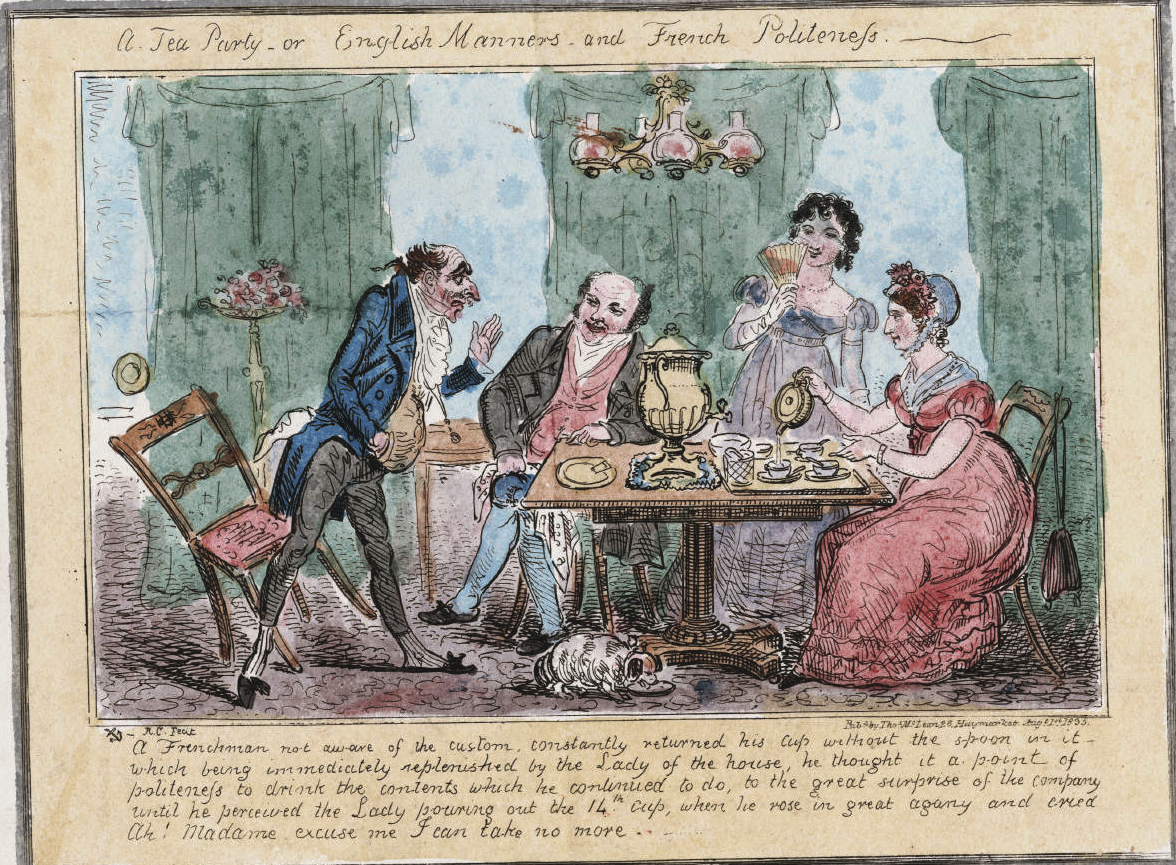
A tea party, or English manners and French politeness. Hand-colored etching on laid paper by Robert Cruikshank, 1835. Lewis Walpole Digital Library, 835.08.01.19
The story of the Frenchman who did not know the customs for refusing more tea may well be apocryphal. I cannot find the citation for the “French officer” whose cup was continually refilled by an 18th-century Providence hostess, but did find this cartoon from 1835 illustrating the same trope. Cliches and stereotypes, always with us. If there’s a lesson in here, it may well be, Don’t believe everything you remember.




 Kirsten Hammerstrom
You must be logged in to post a comment.