Robe à la Polonaise ca. 1775 British silk Length at CB: 56 in. (142.2 cm) Purchase, Judith and Gerson Leiber Fund, 1981 MMA 1981.314.1
Scrolling through Pinterest lately, I was struck by how different two presentations can make one gown look.
Above, a lovely Ikat-type silk gown with en fourreau back and trim, center front closing and probably a little closer to 1778 or 1780 than 1775.
It’s presented on a mannequin that supports the gown for photography and allows us to see it clearly, from the trim at the neck to the pleats down the back and the pleasant fullness of the skirt.
The gown is shown, we get the details.
And then, in another image, another view.
Robe à la Polonaise ca. 1775 British silk Length at CB: 56 in. Purchase, Judith and Gerson Leiber Fund, 1981 MMA 1981.314.1
In this image, the gown (and its companion) have been styled and accessorized, fichus, hats, ribbons, sashes. The skirt is more fully and completely supported, showing off the silk to even better effect. We lose the trim and pleating details, but the gown is much more attractive in this view.
This is not meant to criticize the images or the handling of the costumes, but to point out that you have to look past the plain record shots in museum databases, and see the gown as it would have been worn. Working with database images, and re-creating garments from those images, requires a leap of imagination.
The more you look (at database photos, exhibition photos, extant garments, fashion plates, other re-creations) the better you will be able to imagine the garment as it might have been, and to make it yourself.
To be fair, original garments cannot always be mounted in stylish and appropriate fashion, but they can still tell us something. The more you look, the more you’ll see.
Detail, James Malton, A Military Encampment in Hyde Park, 1785. YCBA Paul Mellon Collection. B2001.2.999
Who knows? She’s hard to find, though I am told and have real hope that the microfilm of the Abbott orderly books that chronicle her misdeeds in wending its way to me down the dirty, salt-and-sand covered highways of southeastern New England.
Where have I looked for her and Francis Connor, whom I presume is her husband?
Well, crap, right? This genealogy stuff in Massachusetts is hard work—there are so many more people and towns than we have here in Li’l Rhody—but diligence and method pay off, and when you figure you’ve about exhausted the primary sources you can access for now,[1] you turn to secondary sources.
Crippled soldier with family. Etching, London (?) ca. 1760. Lewis Walpole Library, 760.00.00.16
The common denominator: poverty, and the resulting lack of choices. This is useful for Bridget, because her story is probably one of necessity. Most women who followed the Continental Army, and worked for it, were from the lowest ranks. [2] These are women who would do what was necessary to survive, and as Mayer notes, “would rather steal than starve.” [3]
I’m not suggesting that Bridget, who would likely have received rations, needed to steal shirts to survive: I rather think she was attempting to leverage her position and profit by ill-gotten gains. But how did she end up in the Army to begin with? Massachusetts in 1782 is not New York in 1780, or Rhode Island in 1778. What drove her to (presumably) follow Francis Connor?
Late in the war, maintaining troop strength is more difficult. The fervor of patriotism has cooled, and recruiting sergeants find it harder to fill the ranks.[4] There are bounties to be had, and the economy has suffered. Could Francis have been a property-less laborer who enlisted for the bounty? Nothing talks like cash. And, if the couple were tenants somewhere, without Francis’ income, Bridget might not have been able to maintain a home. Laundry doesn’t pay that much.
Why didn’t she stay with family? Could they have been indentured servants? Could they have been immigrants? My guess is that Bridget had no family, and if Francis had family, Bridget got on with them as well as she did with the officers of the 10th. I think she had nowhere to go, no way to survive without Francis.
Did they love each other? Did they like each other? Were they grifting together? I don’t know—but Francis Connor deserts the same day Bridget Connor is expelled from camp, so they’re bound together in some way. No matter what, Bridget was assuredly dependent on Francis.
Knowing so little about them opens up a world of possibilities, and the “opportunity” to do a great deal more research on the context of 18th century Massachusetts populations and enlistments. My best guess is that they’re an unpropertied laboring class couple from Boston, source of many of the relatively unstable and non-homogenous companies that made up the 10th Massachusetts. I also think they don’t have family, and might be former indentured servants. I have guesses about their religion and country of origin, which could be why the records are so hard to find. [5]
Looking for Bridget, and not finding her, leaves me with more and more questions, and I’m happy about that.
[1] She’s in the Abbott Orderly books, at least. Other Orderly Books to follow, as time and funds permit.
[4] How do you think Deborah Samson got in, passing as a boy? That’s 1782 for you.
[5] The Catholic Diocese of Rhode Island maintains separate historical vital records, and when we cannot find someone in the usual town records, we ask the genealogist if their family is perhaps Catholic or Quaker. Lack of evidence can be a suggestion of faith in my home state. But could these two be Irish Catholic in Massachusetts in 1782? I have no idea, but it seems a great stretch and a great question all at once.
Photos by a real photographer won’t be available for another two weeks (patience, Iago, patience) but Mr S and I had a lovely time, high-heeled shoes excepted. The gowns were dramatic, the gentlemen dandy, and the dancing elegant, if bumpy at the start. There are some videos here, both of the assembled company dancing, and of the lovely minuet demonstration.
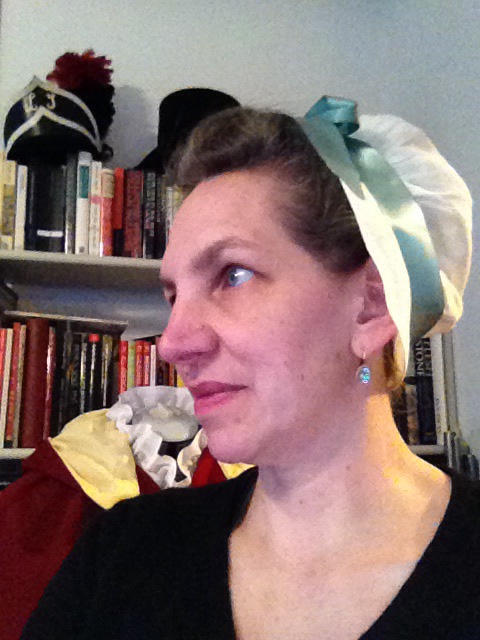
Selfie, and ready for bed!
I managed a phone photo just before I crashed into bed, and am generally satisfied with how the dressed-up laundress appeared. Clearly my laundry business is doing very, very well, or I have liberated some earrings from a client. One of the most challenging things about this event (aside from my over-thinking freak outs) was not having a persona to hold onto. We started reenacting as lower-class 18th century types, and spent some time as tenant farmers and maids. Mr S and I do not have clothes for the gentry, but can inch into the middling sorts when we want to.
That’s fine, and it’s comfortable– we’ve not yet really reached all the way down the lower sorts, either–but it does mean that when we’re presented with the opportunity to dress above our station, the need to really understand the new station kicks in, and delays the process.
I’ll finish that silk sacque someday, and sooner rather than later, but I’m glad I held off so I can really get the gown right, as well as the shoes, hair style, and other accessories.
An old gown, with new sleeve ruffles and petticoat.
We are going to a ball tonight, and while I am looking forward to seeing Sew 18th Century and the lovely Mr and Mrs B among other friends, this is a different kind of experience for Mr S and me. We are, after all, more accustomed to crashing parties than attending them. (There are photos of the Riot Act Night here.)
The biggest difference is in presentation. I ended up making a changeable blue silk petticoat to dress up a cotton print gown, to which I’ve added sleeve ruffles made by the incomparable Cassidy. While I once had plans–dreams–of finishing and wearing the silk sacque in time for this, I was overtaken by events and have settled for an ensemble more suited to my persona, and Mr S’s planned outfit, the Saratoga coat and breeches. I feel just OK with center front closing cotton print for late 1777, and have seen enough cotton print gown and silk petticoats at Williamsburg to brazen it out.
This is a marked upgrade from linen petticoats that smell like woodsmoke (sigh!) and print neckerchiefs that you shouldn’t smell.
I started this day with wet hair, curlers, setting lotion and bobby pins, swearing like a sailor and convinced/hoping the world might end right in our bathroom. Last night I watched Jenny La Fleur‘s 18th century pouf tutorial, and thought I had the basics down.
Wrong. Or half-wrong. I should have gone looking for a don’t-lose-your-mind video, plus one on how to make pin curls in exacting detail. True to my ability to over-think anything, I began to wonder which way I should spin the pin curls– clock wise? Counter-clock wise? Is it opposite if you’re in Australia and New Zealand? My brain is a cluttered place.
In under an hour I had achieved a lop-sided mound of curlers and curls, which I thoughtfully covered with a kerchief to spare my family from death by Medusa. They refused to take me to Walmart, though I finally had the hair for it. Eventually, I pulled out half the bobby pins in the known universe, and had a head full of snakes. Silver snakes. Apparently there’s more grey in my hair than I realized.
Another half-hour of pins and hairspray later, I had a slightly more upscale version of my usual hair style, accented with a shiny green ribbon. Underneath that demure cap, my hair is doing terrible, feral things. Of all the things I learned today, I know with certainty that despite my small head, the next time I’m gonna need bigger rollers, and when I get home from the ball, I must wash my hair.



 Kirsten Hammerstrom
You must be logged in to post a comment.