Light Housekeeping

Heavy Housekeeping: Piano Relocation

As new readers stumble along here, I thought it might be helpful to explain a few things, to explicate the process, if you will.

The Images

The images I post are, wherever possible, linked back to the holding institution or owner. When a full caption appears, chances are good there is a catalog record for the image. If the holding institution doesn’t have a database, or doesn’t have a good way to link to the image, there will be clues to the source in the text or caption. That way, if you want to share an image, you can click it and get the source to share elsewhere. Check Pinterest as well, usually there are even more images than I can fit here.

The Writing

While I conduct research for what I write and for the events I am part of, this is obviously not an academic blog. It’s a personal blog, and a conversation. I think by writing, so my posts tend to be process-oriented and more about questions than answers. The longer I live the less I know, and the more I am comfortable with uncertainty and the search for knowledge and understanding. You may not see the snow leopard. It’s OK. (I do recommend Matthiessen’s book if you haven’t read it.)

Jumping Snow Leopard by Emmanuel Keller

I try to give my sources (sometimes as footnotes, sometimes in the text; this is a blog, I don’t always follow the Chi Man of Style) so that you can verify what I find and reach your own conclusions. Most sources I use can be found on Google Books, or the Internet Archive so that everyone can enjoy the digital surrogates; I also try to link to holding library catalog records where digital sources do not exist. Please forgive me: I am not the greatest proofreader at 5:00 AM when many of these posts are written.

I pad stitch like crap, but it’s getting better.

The Sewing

Talk about your work in progress! I’m still figuring all of this out, and I expect I always will be. Grab your popcorn, I will be doing something stupid any minute now on a garment I need in very short order. Again, what I think is true is that 18th and early 19th century tailors and sempstresses had a vocabulary of stitches, materials, and techniques that they commonly used in a variety of ways. There will be typical constructions and idiosyncratic assemblages. Some garments will be a mix of both. Welcome to idiosyncratic central. This is about the process of figuring things out, gaining knowledge and increasing ability and understanding. I try to understand how I would have sewn in the 18th century, which  means not even as well as an 8-year-old would have constructed clothing in 1770.

The Topics

I have my obsessions, you have yours. Historic laundry processes, living history, poor women, cats, museums, art, books, construction, the spectacle of the art and antiques market…you’ll find I jump around. Think of it as a restaurant with a varied tasting menu built around a few key ingredients.

The Attitude

Snotty and snarky? Yes. But because I know some folks read this at work, you are spared my customary in-person profanity despite the mighty effort it takes some days to resist writing like Rebecca Schuman. Especially when I write about the art and antiques market.

The Philosophy or Mission

Be excellent to each other. Practice kindness. Share your knowledge.

Thank you for reading and commenting. I really do appreciate it. Now, where’s that snow leopard?

Finding Bridget Connor

Two washerwomen, one of the sketches made in Edinburgh and the neighbourhood after the rebellion of 1745 Pen and black ink and grey wash, over graphite. Paul Sandby, British Museum Nn,6.10.+

Regimental Orders, July 23rd 1782
At a Regimental Court Martial whereof Capt Francis is president, Briget Conner a Woman Belonging to the 10th Massachusetts Regiment was tried for purchesing a publick Shurt from a Soldier in Sd. Regiment found Guilty and Sentanced to Return the Shurt to the person from whom she purshest it and loos what She gav for the Shurt.
The Colo approves the opinion of the Court and orders it to take place Immediately

Regimental orders July 25th 1782
Bridget Conner a woman Belonging to the 10th Massachusetts Regiment is Directed to Leave Camp Between this and to Morrow Morning at Roal Call for her Insolence to the officers of sd Regiment on pane of Being Treated with Severity

The entries above are from the orderly book kept by Captain Stephen Abbot who served under Colonel Benjamin Tupper of the 10th Massachusetts Regiment. (This is a Continental Regiment, so the entry for the book in the holding library’s catalog is, um, confusing.)

The entries were sent to me by Mr Cooke as a place to start working on Bridget Connor (name confusion, it is Connor). I checked the Massachusetts Soldiers and Sailors of the Revolutionary War, and what did I find? Francis Connor.

Francis Connor. Where did he come from?
Francis Connor, in the middle. Where did he come from?

Francis Connor was in Benjamin Tupper’s (10th) Regiment. He enlisted on December 25, 1781, and was reported deserted on July 25, 1782, the same day Bridget is directed to leave camp. Do you think Bridget might be Francis’s wife? I think she might be, and I am inordinately pleased about it.

It is a sad but true thing that it is easier to find a man in the 18th century records than it is to find a woman. (See Jill Lepore’s new book about Jane Franklin Mecom.) But with a husband to look for, maybe I can find more about Bridget. And if I can find more about Bridget (and even if I don’t) I can start asking the questions that create a more engaging impression or interpretation.

  • Where did Bridget live before they joined the 10th?
  • Where was she born?
  • How old was she?
  • What did Francis (if he was her husband) do for a living?
  • Did Bridget work? (Probably- but at what?)
  • Why did she join Francis in the Army?
  • Did she have previous run-ins with authority?

I have guesses about Bridget and Francis, and even if I can find no more than what I’ve found, I can create plausible stories about their lives to make the past more real. For history, though, I prefer telling truths to making up stories.

Families and Hatters: more sale portraits

Lot 627, Sale N09106, "Esmerian."
Lot 627, Sale N09106, “Esmerian.”

Another lot from the Sotheby’s American Folk Art sale is this pair of paintings by Jacob Maentel. (There’s an entire series of paintings by Maentel, all worth checking out.)

Particularly fun in this family portrait? The two little girls wearing dresses made of the same fabric. One of my former colleagues and co-conspirators always wanted to dress interpreters in clothes made of the same fabric, dresses, waistcoats and other items, as if we’d bought a sole bolt of fabric one year. Well, there it is, above: one length, two little gowns.

Lot 576, Sale N09106, "Nesmerian"
Lot 576, Sale N09106, “Nesmerian”

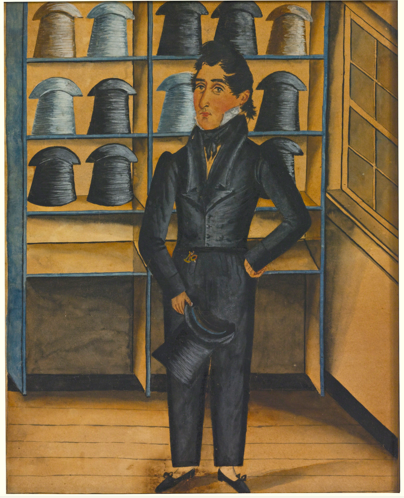
For my friend who makes hats, here is the portrait of Hatter John Mays of Schaeffertown, also painted by Jacob Maentel.

Top hats aplenty, bows on his shoes, and gold watch fobs. I’d say Mr Mays is doing quite well.

At the sales this month…

It’s auction season in antiques land, and the catalogs arrived at work smelling of money and expensive ink. Sotheby’s Folk Art and Americana sales offer some lovely pieces  at the end of this month.

From the Folk Art sale, Mr and Mrs (maybe) Fitzhugh Greene of (maybe) Newport, RI.

Lot 606 from Sotheby's sale N09106 "Esmerian"
Lot 606 from Sotheby’s sale N09106 “Esmerian”

Pretty sweet stuff, right? With an estimate of $400,000-600,000, chances are good that these aren’t headed for public display, so enjoy them now.

Mrs (maybe) Fitzhugh Greene

Mrs (maybe) Greene is a pretty fantastic painting, even if John Durand lacked the grace and skill of Copley or Feke. There is an airless quality to these paintings, though the details are fine and the contrast between the husband and wife in presentation is delightful. My favorite line of the catalogue entry is the final one: “When juxtaposed to the drab coloring of her husband’s portrait, Mrs. Greene can clearly be perceived as his adornment, a fertile beauty in the flush of womanhood.”

Egads, right? I suppose she could be, but I also suppose she could be a fine way to flaunt his wealth and success while he projects fiscal and mercantile stability and restraint. Without a solid link to actual people (and there isn’t) it could be that more is happening in these paintings than the woman serving as the man’s adornment. If you read the footnotes, you’ll see that the attribution to Newport is slim (it’s a story without a real source). If a Mr and Mrs Fitzhugh Greene lived in Newport in the 1760s and 1770s, they’re not buried in RI. They could be Loyalists who fled– auction catalogs are a fiction writers dream of inspiration– but so far, no solid evidence links these portraits to Rhode Island.

In terms of documenting a man and a woman of substance in 18th century America, or the material aspirations of those men and women, these portraits are interesting whether the clothes and jewelry Mrs (maybe) Greene is wearing are real or not. Because they could be fabrications.

Mr (maybe) Greene
Mr (maybe) Greene

Mr (maybe) Greene is firmly real. The frock coat, waistcoat and breeches are all presumably made of the same fine brown wool broadcloth, worn with a fine white linen shirt and stock adorned with lace. The buttons are interesting, and neither the zoom nor my nose pressed to the catalog page clearly reveal the pattern. They look like pretty standard issue death’s head buttons, except when one looks like it might be more like a dorset pattern, or the one that looks floral. These will be on display in New York if one has the chance, which I will not.

There are pendant portraits like these in museum collections that show a man and his sister. It is possible that what Sotheby’s is offering for sale is a pair like that: a man and his highly eligible sister, not a man and his wife.