Temporal Anxiety

First draft, heading towards a Pierrot jacket.

I like to have a selection of things to wake up and panic about at 4:00 AM, don’t you? If it isn’t sewing, it’s some weird noise I think the car is making, whether the post office has lost a package, or if that noise is not the cat but instead a pending disaster. My brain generously provides me with a Whitman’s Sampler of anxieties.

To start with, that ball. For one thing, Mr S will probably have to wear his Saratoga coat, which means anything nice that I have won’t match him, temporally. For another, anything nice I think I could make in time is French and not American. So I have temporal and geographic anxiety disorder about something that is supposed to be fun. But there is this jacket I think I could make (and want to make), so I started playing with the pattern in my “sketching in muslin” method.

I haven’t got a lot of the purple, but I might have enough.

I know this is not party wear. I know KCI says jackets like this were worn with white muslin petticoats. But I note that this woman in a Pierrot is not wearing a white muslin petticoat, and I carry on. My other option is my brown wool gown, and perhaps I will wear that.

Mr S still needs a frock coat, so that has to be patterned and fitted; his breeches are still being sewn. He’ll need a wool coat no matter what, but whether it will be done by February is up for grabs.

The last two parts of my current crazy are a program in Newport on early March, with an early date of 1813, and programs in late March in Providence, which I have yet to develop. At least in Newport I don’t have to create the program, just dress and deliver.
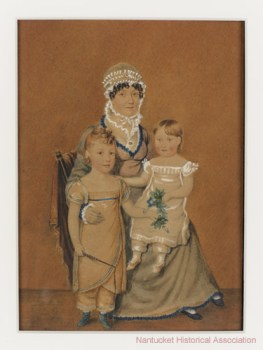
Portrait of Sarah Comstock Coffin and Children, ca. 1815. Nantucket Historical Association, 1917.0034.001

1813 is a fun place to start, and I have been looking at images for inspiration.

At right, Mrs Coffin  is a nice example of a New England woman in 1815, wearing the kind-of cross-over, v-neck, apron-front gown I’m thinking of making. I have some fabric reminiscent of a gown at the V&A, and I have some purple sheer cotton, as well as some green silk, so there’s a whole set of what-ifs? to enjoy.

Because that’s the rub: I enjoy all this planning and fretting and picking over details. I just wish it let me sleep a little longer some days.

Pinner Aprons

Mr & Mrs Thomas Sandby. Watercolor by Paul Sandby. RCIN 917875, Royal Collection Trust.

On Saturday, Sew 18th Century and I went out for lunch and fabric shopping. Along the way, I brought up pinner aprons, and that I’d seen them in British prints. She said, “You should blog about that!” and I went back to check my sources. Fail! There was an English print after a French original, and that doesn’t count!

So I shelved that idea, and went about looking for more Paul Sandby images of soldiers and maids and tents, and found instead Mr and Mrs Thomas Sandby. Ahem. Pinner apron alert.

Fluke, right? Well, no, not exactly.

Lady Chambers and child. Watercolor by Paul Sandby, RCIN 914409. Royal Collection Trust.

Because here is Lady Chambers and child, with Lady Chambers in a pinner apron.

The thing to note, though, is that “apron” here is a decorative, almost ceremonial garment made of black silk, while the maid engaged in Domestick Employment is wearing a working garment of [probably white] linen.

Domestick employment, washing. Mezzotint by Richard Houston after Phillipe Mercier, 1736-1775. British Museum 1876,0708.23

Well, can I wear a pinner apron as a Continental army laundress or not? Probably not, though I will be going back through all the images of laundering I can find. It would be so useful and protective a garment!

No, instead, it looks as if the black silk pinner apron was a fashion adopted by the British upper class probably in imitation of the aprons worn by young girls. These fleeting, black silk accessories were probably adapted to some other use when the fashion had fallen from favor. (You could make a lot of mitts out of one of those.) Sadly, I don’t care enough about the elite to go chasing inventories and more images, but someone else can. I think I have seen a few other examples of this style, but cannot immediately place them. My sense is that these are not common.

I’m much more interested in laundresses and maids. Doesn’t she look sassy? We could call her Bridget. 

A country girl, full-length, facing front, leaning against a fence & a tree. Watercolor by Paul Sandby. RCIN 914438. Royal Collection Trust

Camp Followers or Women of the Army?

Soldiers and Camp Followers Resting from a March. Jean-Baptiste Pater, 1730. private collection. used from Wikimedia Commons.

I prefer woman belonging to the army, or “regimental woman,” which sounds like Mick Jagger or Roy Orbison could sing it, but one could have a pretty lively discussion of which term to use. Camp followers has a connotation–prostitute–that doesn’t reflect the full reality of army life for women in either the British or the Continental armies.

Were there prostitutes who took advantage of the proximity of a large customer base? Yes, undoubtedly. In the John Robinson Waterman Papers there is an unusual letter from Col. William Battey dated October 28, 1812 with a sketch of the army camp near Albany and a description of camp life. This description includes the treatment of a woman accused of prostitution and summarily banished from camp. I think she was beaten and half-drowned, so the army took the no-prostitutes-whatsoever dictum very seriously.

As far as cooking goes, a commenter elsewhere explained that women would have been cooking, at least for themselves. Typically, they did not cook for the soldiers’ mess, unless they were being paid to. This must have been a difficult situation for the Continental Army: when women were present, it made excellent sense to assign them all possible non-combatant tasks to ensure the maximum fighting force. But could discipline be maintained? Not always, given Bridget’s temper.

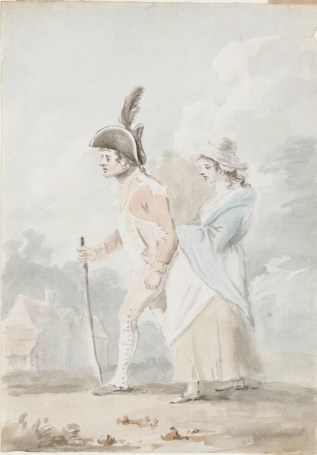
A soldier and his girl. Henry Bunbury, ca. 1794. Lewis Walpole Library, Drawings B87 no. 8

Rolling back a bit and trying to consider the army’s structure and camp layout, what are the mechanics of handling rations for women with the army? How are they fed? And did it vary, unit by unit? There is probably far more variation than we credit, that will only be illuminated by careful attention to the documentary record. That means finding as many victualing rolls and returns as possible, looking for women. It means reading all the orderly books that can be found, looking for women.

The best secondary source I know for the Continental Army’s women is with Holly Mayer’s book, Belonging to the Army. (And I’ll admit I haven’t read it in two years, so it’s time to re-read it.) If you’re British, I’m not in a position to help you as much, but there is Don Hagist’s work on Women of the British Army. For a more granular understanding of women in all armies, you have to turn to primary sources, and what’s available varies from unit to unit, state to state. There is a handy index of orderly books,  and while these vary in their utility, they are a good place to start. In fact, the whole RevWar 75 site is useful (though it is not loading at the time of this writing).

Soldiers’ diaries and accounts are also useful. Jeremiah Greenman of the 2nd Rhode Island Regiment recorded his experiences throughout the entire war, starting in 1775, when he joined Arnold’s expedition to Quebec. There were two women on that expedition, attached to two different companies. While there is not a plethora of detail about the women, it is clear that they were strong and able, and in one case, more able than her husband.

Camp Life

The Jolly Landlady in Hyde Park. Paul Sandby, 1780. British Museum 1904,0819.622
The Fair Stationer in Hyde Park, 1780. Outline engraving by Paul Sandby. British Museum 1880,1113.1915

Still wondering what to do in camp that’s not cooking or sewing? Technically, you shouldn’t be cooking if you’re a woman: that was a soldier’s job, though I recall seeing a reference to women cooking when all the men were pulled into the line during an engagement. A card file would help me, but for now, all I have is my scattered memory.

But if you’re tired of mending and making shirts (one of the most boring tasks, I find– all straight seams and very predictable), there’s more to do than laundry.

If the event represents a longer encampment, you could run a traveling coffee house or tavern. There’s the Widow Black in the Mid West, but I haven’t encountered this yet in New England. You could be a Jolly Landlady, or as the British Museum has it,  “a voluptuous lady stands in foreground to left, holding up a glass to a soldier on horseback.”

The Fair Stationer in Hyde Park 1780. Outline etching with watercolor, Paul Sandby. British Museum 1904,0819.576

The Fair Stationer shows us Lloyd’s Coffee House and what looks like a carriage body on blocks, converted to a news stand. You could sell newspapers and writing paper, pamphlets and poem and songs. It’s an impression that would take a lot of thinking and research for the American colonies, but could be very interesting. the transmission of news and information and the transport of mail and packages presented challenges. How were they overcome?

I’m also struck by the number of dogs in Sandby’s images. If it’s not the same dog, over and over, I would guess that in the 18th century as in the 20th, soldiers had pets that traveled with them, both common soldiers with common curs and officers with hunting dogs. The camps must have been disastrously messy, with fatigue details to clean them.  We can’t have dogs at reenactments, but we could have more outraged sergeants. It’s hard, though, because to do these things well, you have to know and trust the people you’re doing them with (and that includes yourself).