Consider the Collar

The Newport dresses seemed a little strange to me, in that the collar treatment was more like what I would expect to see on a pelisse than on a gown. But I am willing to be wrong, and delighted to be wrong if that’s how I will learn something.

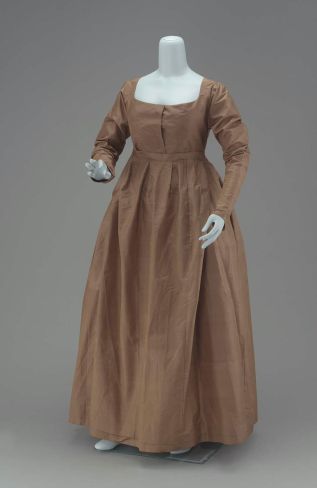
@silkdamask (that’s Kimberley Alexander’s twitter handle; she has a blog you might want to follow if you don’t already) posted a photo of the dress (above left) she imagined a young woman she’d been writing about might have worn. Housed at the Met, this embroidered American cotton and wool gown ca. 1806 has a cross-over bodice and collar.

Another day dress from the Met (above right) has a ca. 1820 date, but looks very much like the gown worn by Mrs Amelia Opie (she was a British Quaker) in this engraving after an 1803 portrait. (Other, similar gowns and portraits are pinned here.)

Amelia Opie (1769-1863). Engraving by Ridley after painting by [John] Opie, 1803. Massachusetts Historical Society, Photo. 81.490

Nantucket and New Bedford  both hard large Quaker populations (remember Moby Dick?), and the Williams family in Newport had connections to New Bedford, so I looked in collections in Nantucket and New Bedford as well.

The gown below, now in the collection of the New Bedford Whaling Museum, was worn by Susan Waln Morgan Rodman (Mrs Benjamin Rodman), while pregnant; using a genealogy, we can establish pretty solid date ranges for the dresses at New Bedford Whaling Museum. It looks 1820s in style, and her first two children are born in 1821 and 1822.

Maternity gown worn by Susan Waln Morgan Rodman (Mrs Benjamin Rodman). New Bedford Whaling Museum, 1991.45.5.

A date range of 1820 to 1822 seems plausible. Susan Waln Morgan Rodman would have been about 20 with her first pregnancies. (Genealogies are on Google books.)

She seems to have kept up with style and to have liked clothes; a search for her name in the NBWM catalog returned some interesting items, though the catalog does not allow for linking to item records or searches. Mrs Rodman’s appears to have kept pace with style changes; that is, her wardrobe did not ossify in 1820-something, but evolved as fashions changed, and was appropriate for different situations.

Does that mean that all Quaker women kept pace with style changes? It’s hard to say; each of us today updates our wardrobe according to our fancy, our purse, our inclinations and our age. Are those Newport gowns going to turn out to look more like the Met gowns than I imagine? I don’t know, but it seems possible.
Newport Friends

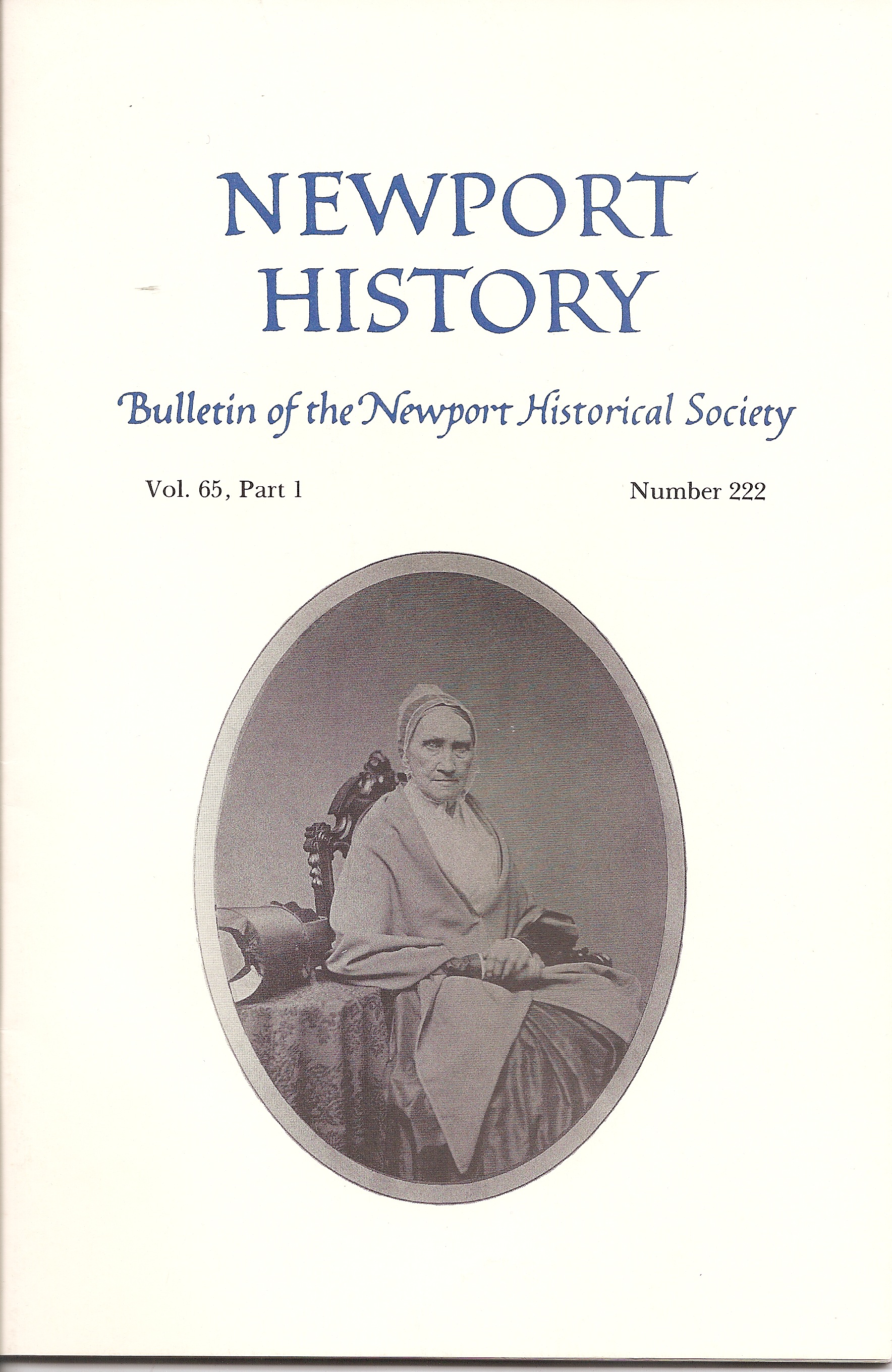
Newport History, V 65, Part 1. Number 222.

I had a bit of a surprise when details emerged about the program Sew 18th Century and I will be doing in early March at her workplace. I’ve known about this since late October, but only started focusing on this last weekend, when I realized just how close March really is, and how much time I’ll be spending on well-chlorinated pool decks in February. I’m so glad I asked, because it turns out that we’re reading letters from a family of Quakers. I was not expecting Quakers, and had what is probably a completely inappropriate fabric in mind! (Off-white meandering red floral vines, to mimic a V&A gown.)

Still, there is no surprise that cannot be managed by research. There is an article about the family in Newport History, and they were kind enough to send it to me, and it arrived yesterday. Yay, mail in a small state! The article is helpful in providing context and family history, and there is even a photo, probably from a daguerreotype, of one of the women in the family.

Ruth Williams silhouette, Newport Historical Society, 91.14.4

So, what did Quaker women in Newport wear between 1800 and 1820? Lappet caps, for one thing. Lappet caps appear to have been a common cap in late 18th and early 19th century Rhode Island, and Ruth’s silhouette seems to bear that out.

These caps are also seen in many images of Quaker women, and borne out by the images in the collection where I work (sadly not appearing the catalog record, but still stable in the blog post on caps).

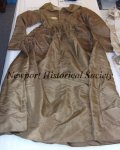
I can’t read letters in just a cap and a shift (it’s not that kind of event), so I need a dress. Newport Historical Society has two possibly Quaker gowns from the early 19th century, and they seem like plausible models.  But they raise questions quite aside from what you might find out by digging into provenance. What’s up with collars?

The form, a brown or drab front-closing, high-waisted (but not too high) gown, with long sleeves and a pieced, shaped back, is consistent with images of Quaker women from the first quarter of the 19th century. The color and material (brown silk) is consistent with those images, and with earlier im,ages of Philadelphia Quaker women, and that all matches up with a gown that was worn by Sarah Brown of Providence. But the collar is curious, and without putting the garment on a dress form, it’s hard to tell exactly where the collar would fall, and how it would lie.

A Quaker's dress of greenish-brown taffeta American, Early 19th century. MFA Boston. 52.1769
A Quaker’s dress of greenish-brown taffeta
American, Early 19th century. MFA Boston. 52.1769

This gown at the MFA seems iconic to me, and I can imagine it underneath the white linen, cotton or silk kerchiefs and shawls of the portraits.

To learn more about Quaker aesthetics, I’ll be taking a trip down the hill to the RISD Library sometime this week, to look at books and articles. of particular interest is Quaker Aesthetics: Reflections on a Quaker Ethic in American Design and Consumption, 1720-1920. I’m also interested in an article by Deborah Kraak, Variations on ‘Plainness’: Quaker Dress in 18th Century Philadelphia. It’s not Newport, but at least it’s this continent.

I have read The Quaker: A Study in Costume, by Amelia Mott Gummere, and found it to be a pretty challenging work. It is possible that paint fumes made the writing seem more disjointed than it is, but I thought Gummere’s time-skipping references made it hard to follow the changes in Quaker dress in America, beyond what I do expect from a book published in 1901.

Book Notice: Wearable Prints, 1760-1860

This just in, literally, from the mail carrier: Susan W. Greene’s long-awaited book, Wearable Prints, 1760-1860. It’s discounted (and out of stock) at Amazon, but should be shipping soon, since I have one right here on my desk.

It’s fair to call this book lavishly illustrated (1600 full-color images in almost 600 pages), and while I have access to a copy at work, I am seriously thinking of buying my own copy, based solely on about 10 minutes skimming the book. There are images not just of fabric samples but also of garments, paper dolls and illustrations that help put the fabrics into context. Images of garments from collections I can’t get into? Delicious! Information to help me understand how to use a printed cotton? Even better.

The book is organized in three main sections: Overview, Colors, and Mechanics. Appendices include timelines, prohibitions, price comparisons, print characteristics, and more, as well as a glossary and an extensive bibliography.

The photographs are amazing, and show a range of print designs of greater variety than we may have credited heretofore. Particularly useful is the section on evaluating and identifying printed dress fabrics, and the questions one should ask about fabrics. I think that the criteria could be used forensically on modern as well as historic textiles, and we could think more critically about the fabrics we use.

ETA: I wrote this while the downstairs room was being painted with oil paint, and it’s loopier than I expected. The book is still an excellent resource, and I highly recommend it. While it’s heavy for carrying to the fabric shops, it would be dead useful while shopping online. I have definitely seen bolts of fabrics very similar to those illustrated in Greene’s book. As Anna notes on her blog, Ms Greene’s collection is now at Genessee Country Village.  Wow. It’s amazing. If you can’t get there easily, well, the book will certainly help, and the images will you visual access to a plethora of collections. 

Ballet Arthritique

Three men wearing orthopedic apparatus. Etching and engraving by Paul Sandby, 1783. Wellcome Library image L0019751

How was arthritis pain treated in the 18th century? One option was the mustard plaster, which operates on the principle that heat generated by the plaster increases blood flow, which will reduce inflammation. Frankincense supposedly inhibits the production of molecules that cause inflammation and break down cartilage tissue, which leads to joint pain, at least in knees. This level of scientific knowledge wasn’t available to the 18th century physick, but frankincense is an edible aromatic resin with a long history of use in treating ailments including arthritis. At least you (or your breath) would smell good.

The primary ailment treated of was gout, and the remedies above are mostly directed at inflammatory arthritis, the kind where joints grow red and swollen. Think of wealthy, overweight men drinking port with swollen feet propped up on footstools: that’s gout.

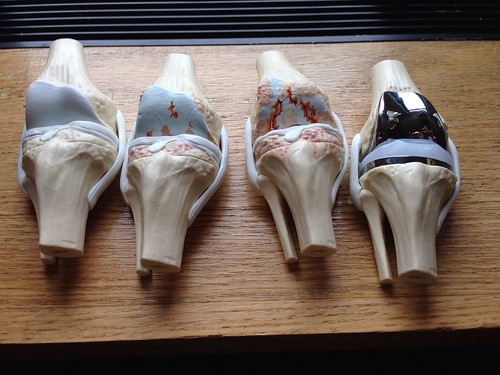
Models showing progressive arthritis in a knee, followed by joint replacement.

Then there’s osteoarthritis, or degenerative joint disease, once included in the catchall and obsolete term, rheumatism. This is a different matter, where changing your diet and icing the joint generally won’t bring much relief. When your cartilage is gone, your bones rub together. Osteophystes or bone spurs form is response to damage or inflammation, and cause both pain and noise.
In the pre-joint replacement era, treating this kind of arthritis was treating chronic pain. (In this era, that’s still the case: absent a TJR or resurfacing, all that’s treated is pain. Once the joint is replaced, there’s nothing left to hurt. It’s a neat little trick.)

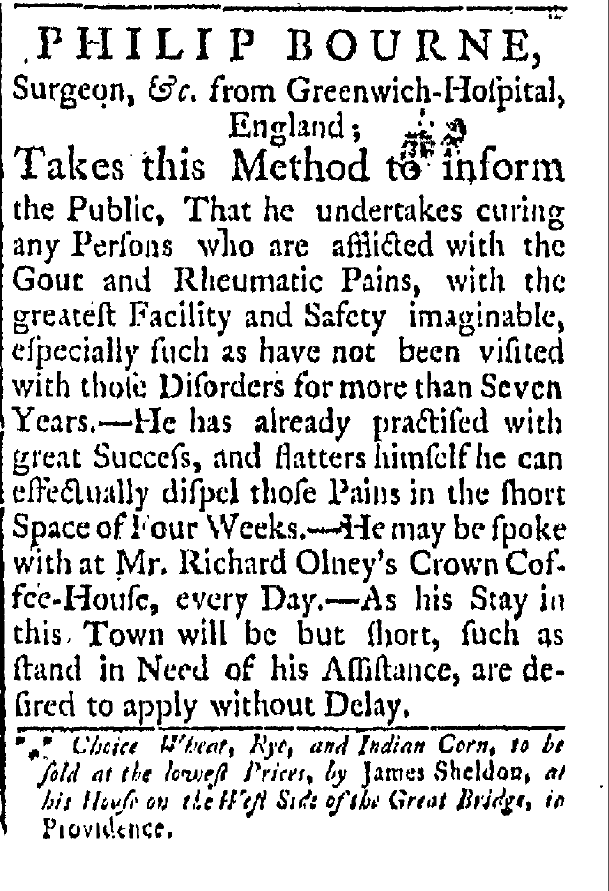
Providence Gazette and Country Journal, June 16, 1764. V II, Issue 87, page 3

In pre-Revolution Boston and Rhode Island, there were various cures advertised promising far more benefit than they were likely to deliver. Phillip Bourne, from Greenwich Hospital in England, promises to “undertake curing any Persons who are afflicted with the Gout and Rheumatic Pains, with the greatest Facility and Safety imaginable.” The caveat about “especially such as have not been visited with those Disorders for more than Seven Years” is particularly nice, since the longer pain persists, the harder it is to treat. He knew his limits, I suppose, if only of his patience, or the amount of time he could safely ‘practice’ in any location.

Boston Gazette, February 14, 1774.

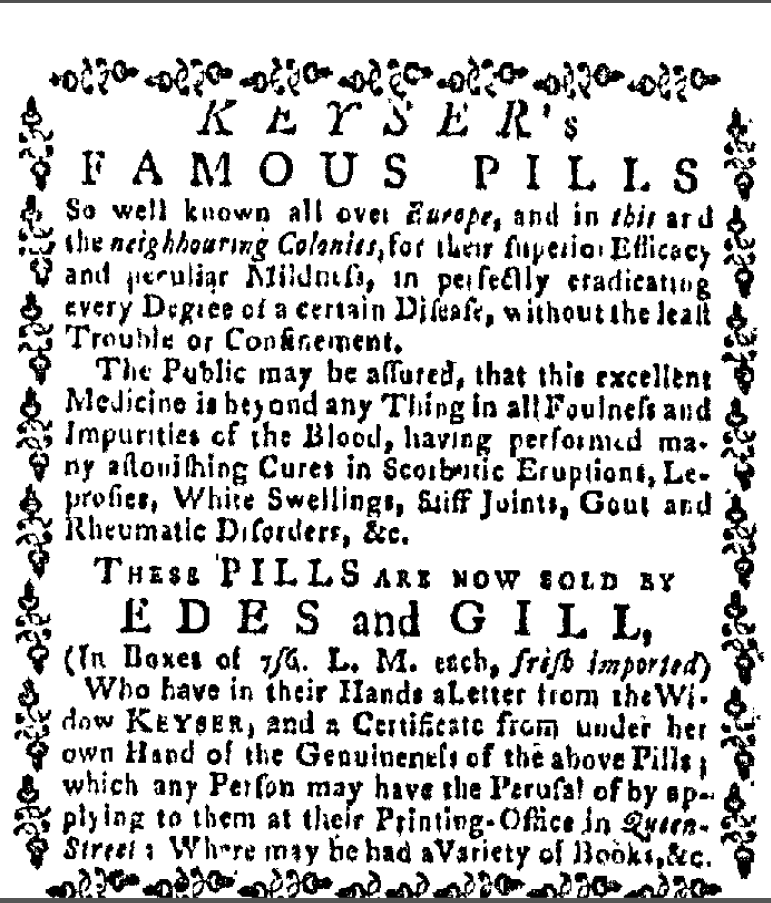
Edes and Gill sold Keyser’s Famous Pills, “So well known all over Europe,” and promising much, like Cures for Scorbutic Eruptions, Leprosies, White Swellings, Stiff Joints, Gout and Rheumatic Disorders, etc.” I don’t know about you, but I think I’d prefer to have my scurvy treatments separate from my arthritis treatments.

Ultimately, the best option was probably a crutch or cane, though braces were devised and are still used, along with crutches and canes. All that prevents their use or efficacy is the vanity of the user.