I’m close to being finished– all that remains are closures, but the sewing is done. It fits, though I haven’t yet tried it on over stays. It looks less wretched in the mirror than it does on a hanger, I will give it that.
The wool is a yard and a quarter worsted remnant, and while it has a nice hand, it was sometimes annoying to press. It may have been the fault of the silk, though; I used a very light weight silk–even lighter than Booth’s “persians”– and that was probably a mistake.
Last-minute peplum and button additions.
The Swedish Spencer closes with clasps, and while hooks and eyes are pretty common for center-closing garments (men’s and women’s) “clasps” was new to me. The double-breasted riding habit coat in Janet Arnold (from the Salisbury Museum, no photos online) closes with covered buttons. That seems reasonable for this worsted trial garment. I’m beginning to wonder if the Swedish Spencer is really finished, or if the clasps might be a later addition. Time to write a letter, I think…
James Malton, 1761-1803, A Military Encampment in Hyde Park, 1785, Watercolor with pen in black ink, with traces of graphite on moderately thick, moderately textured, beige, laid paper, Yale Center for British Art, Paul Mellon Collection
I’ve been thinking about laundry, and not just because I did wash yesterday, but also because I’m committed now to learning more about the women of the 10th Massachusetts (dude, it’s on paper). Since I won’t be able to get up to the Mass Archives or MHS until the holiday break, one place I can start is with the material culture of army women’s lives. This is also helpful as I am thinking about asking for a laundry tub for Christmas. (I had an aunt who got a toilet seat for Mother’s Day, and my husband once gave his siblings fire extinguishers for Christmas, so you cannot deny that we have a proud history of gift-giving.)
There’s a lot to love in the detail above, and while there are some things I don’t think you’d find in the 10th Mass camp — from red coats to chairs, even broken–we can still find useful information. After all, if your chair is broken, you have more of a leg to stand on for having a chair.
The buckets and washtubs have wooden hoops: that’s a fine detail, and one I appreciate, with my very particular bucket. That means, though, that the washtubs I have in mind might not work, as they have metal bands. My bucket man took a long time to get my bucket right, and he doesn’t make washtubs…but maybe the local man would consider trying a smaller tub. Hard to know, but size will be an issue. It appears there may be two sizes of tub in the image above: a larger tub on the makeshift table at left, and a smaller one on the broken chair.
Detail, James Malton, 1761-1803, A Military Encampment in Hyde Park, 1785, Watercolor with pen in black ink, with traces of graphite on moderately thick, moderately textured, beige, laid paper, Yale Center for British Art, Paul Mellon Collection
The improvised clothesline is a reassuring detail, being pretty much what I have in mind for our camps, pending some riverbank logging. These taller sticks would then join our kettle or musket-rack sticks as part of the permanent equipage carried by the Subaru baggage train.
We’d been talking about doing a cold wash at work, where a friend was advocating NOT digging a pit and boiling laundry on the lawn, so these washing women intrigued me: none of them are boiling clothes. In fact, there’s no fire to be seen! But look again at where those kettles are. In the detail above and again at left, note a large kettle adjacent to every washtub. Could it be that water was boiled in a larger (enormous) kettle, and dipped into these smaller kettles? The other thing to note is that this seems to be family-based washing and not regimental-scale washing. Given that I’d probably only have two shifts and four shirts to wash on a good day (they’re wearing their shirts, you see), could this model work?
None of the reenactments we see achieve anything like the scale of the events or activities we’re trying to recreate. Very few of us can cook with five pounds of flour, and there are never enough guys to make up a full brigade in the field. Those truths don’t mean we should skimp or cut corners, but they do mean that we should cut our coat to our cloth. Smaller scale washing could still convey the hassle, necessity, and gender division of the work.
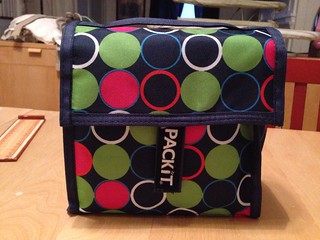
Mr S destroyed his lunch bag (zipper failure) and since I sew in a pre-zipper era, I declined to hunt up a new zipper and set it into the weird amalgamation that is the modern insulated lunch bag. I can’t even remember how old that lunch bag was, but it might have been six years old. So out we went for cat food (which happens a lot) and a lunch bag.
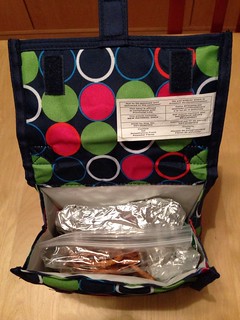
Just don’t get caught with tinfoil and plastic baggies if you’re eating in breeches.
This one seemed like it would be too small, but it does hold his entire lunch. And then I realized it would fit nicely into a haversack if one needed to pack a cold lunch on a hot day. You just have to be stealthy when opening the thing, at least until the velcro gets linty and quieter. This bag is lined with freezable something that serves as the ice pack, which does save space and should be more efficient and safer on a super-hot summer day (I’m looking at you, Cambridge in July.)
And, as ever, if you wrap your meal in tinfoil and baggies, hide it from the public. The best way to use it at an event would be to pull paper- or linen-wrapped period food from its hidden, chilled (shallow) depths. If you are not in the army, it goes in your market wallet, linen bag, or basket, not your haversack. Now, perhaps those cats can help me silence the velcro.
It all started out so well, in the muslin, but in the wool, not so much. I cut up a remnant, proving that a yard and a quarter of 60” fabric is enough for a Spencer, even for my arm length (but not less, thanks to that arm length and a respect for the grain).
The pattern I’m using has bust darts, which I haven’t sewn in years. They took some tweaking with the steam iron.
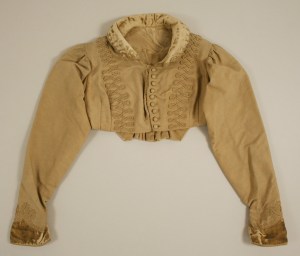
In 18th century clothing, one doesn’t see bust darts; there are some above the bust, shaping gowns at the robings, but for the most part they aren’t needed. Think cones, thanks to the stays. And later in the 18th century, a lot of work is done by gathers and drawstrings, as in the white and black ca. 1800 French spencer at the Met.
Spencer ca. 1818-1819. MMA 1982.132.3
But if you’ve got an endowment of the non-fiscal kind, and you want your military-inspired garment to fit smoothly over your endowment, what do you do?
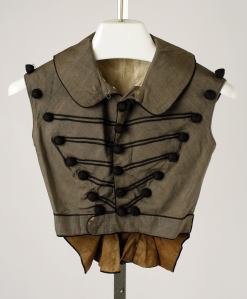
In this example, you hide the bust dart under braid and buttons. Check out that diagonal seam—and that the fabric appears to have been cut on the bias.
Brilliant, right? Gain ease by using the stretchy quality of the bias and hide the shaping under decorative elements.
It’s only cataloged as “wool,” with no weave given. There is a detail image of the darts and braid as well; I think that might be serge, and not superfine broadcloth. Still, three bust darts help achieve a smooth fit.
The Swedish Spencer at the museum in Lund has but one grainy photo: it’s hard to imagine that it doesn’t have bust darts, but the photo leaves much to the imagination.




 Kirsten Hammerstrom
You must be logged in to post a comment.