The View from Ft Lee

To the South.

Silver and shimmering, there’s Manhattan Island: you can hear the train whistles from the New Jersey shore, this century always intruding on the past. To be honest, this event makes me as nuts as it makes me happy (the 32 pound gun did, finally, go off after four tries). There’s something slap-dash about it, this last event of the season (or the first of next, as the BAR commander would have it). The range and quality of impressions is astonishing but it’s a small, manageable event that’s good for trying things out, and for first-time-users.

Which could bring me to the highlight of the day for someone close to me, but suffice it to say that what happens in the blockhouse stays in the blockhouse and I haven’t seen a particular teenage boy that excited, like, ever. He stayed excited, too, until he finally fell asleep somewhere on I-95 northbound.
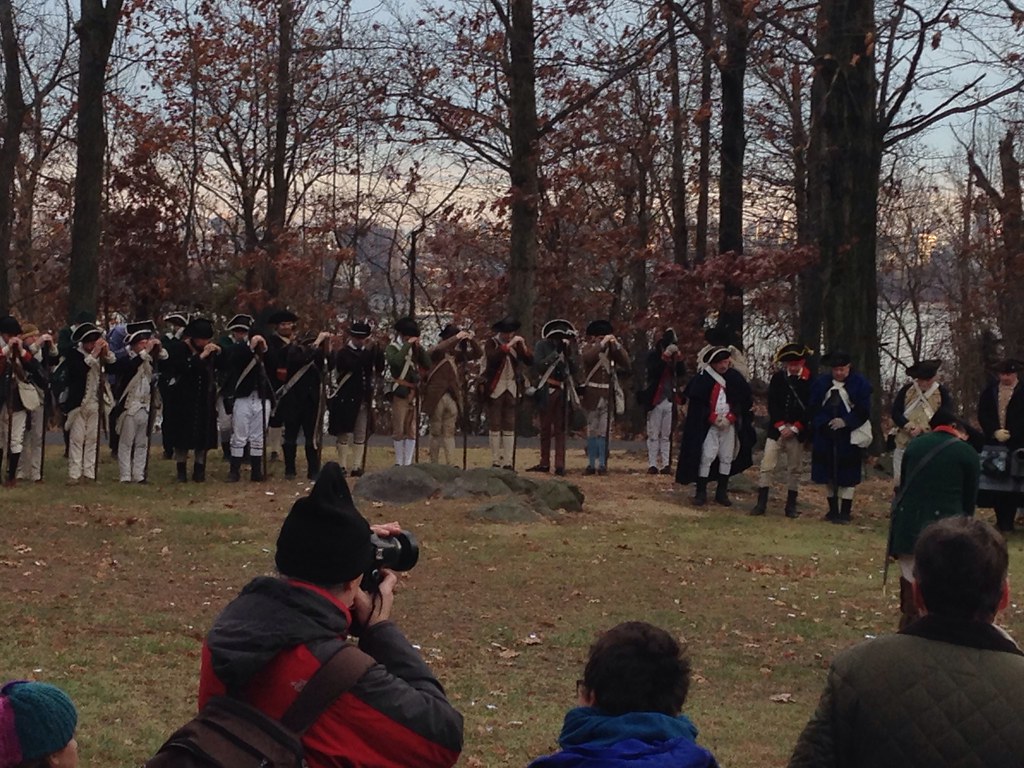
Mourn Arms at the end of the Day.

I like the predictable ritual of Fort Lee: it’s always cold, the sun fades around noon and the light is always pale by the afternoon, the guns are always fired, and the blockhouse is always lost. There’s a ceremony up in the town and the square always smells delicious, the kettles are always full of mysterious stew with some charcoal bits mixed in and the kid always has three bowls full.

There are always a lot of photographers stalking the ‘wily and elusive reenactor’ at this event; there’s a Fort Lee photo club and they come every year. Unlike Tower Park, there’s no touching, just long-lens stalking. It’s a little weird and I try not to laugh but the lengths they go to do are funny, somehow, though it’s just someone else’s hobby and obsession.

The comments in the public are always revealing. This year’s prize goes the gentleman who told his son muskets are slow to fire and hard to use because they’re breech loading. I think few people have much experience with the physical world, and we would be well-rewarded for spending some time thinking about larger themes in our interpretations, as I’m not convinced people come with much context for what they’re told or what they see.

The Four in Brown, portraying Colonel Moses Little’s 12th Continental Regiment.

Mr S could not remember the name of the regiment they were portraying when I asked him to remind me: the best he could do was “Colonel Sanders’ Regiment,” which was thankfully taken in good spirits when confessed, but you have to know that a man who has managed to get potato on his hat is, well, let’s call it befuddled with hunger. We were probably all a little punchy with cold when the conversation turned to the overheard remark that there would be parakeet [parapet] firing. I asked how many parakeets it took for a four pound gun: four. And then we were off on a flight of fancy noting that loading the guns with the birds would clean the barrels on the way down, and that a parrot, beak forward and in flight, had a fine and aerodynamic profile, but it is damned hard to load the birds tail-first. [Insert squawking noises and some broadcloth-sleeved arm flapping.] After this, we had a demonstration of a simple rapid-fire musket exchange principle which I believe may have been employed to some good effect in the blockhouse.

On the way down, we had spotted a woman driving with a small parrot on her shoulder, loose in her small car, with a cage in the back, so the day really began on a parrot and parakeet theme, though the Free Men of the Sea were parading in Plymouth. All in all, a very typical, slightly surreal Fort Lee.

‘A perfidious wretch’: A Sermon on Benedict Arnold

Reverend Enos Hitchcock, pastel on paper. RIHS 1970.23.1

By now you probably know how much I like the Reverend Enos Hitchcock in all his forms and centuries. I am lucky enough to have near-constant access to a collection of his papers, and in going through them folder by folder looking for clues to the Reverend’s waistcoat habits, I came upon a seemingly innocuous folder: Notes, untitled and undated sermons, commonplace book. You won’t find receipts for pink satin in there, but every folder is worth a look.

This folder was worth every minute I have spent on it, and every other folder in that box.

I found an undated sermon, but was able to date it by the content: October 1, 1780.

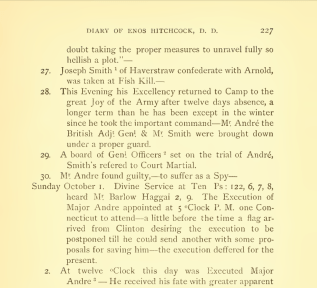
In his diary, Hitchcock notes the days of divine service, and the verses he used.

Diary of Enos Hitchcock, published by the RIHS, 1899.

PS 122, 6,7,8 refers to the text he used, Psalms 122, A Prayer for the Peace of Jerusalem. He quotes it at the very end of the sermon.

As I read this manuscript, I was struck by the anger in it, and wondered if the “perfidious wretch” could really be who I thought it was, and yes, it was true: I had found Hitchcock’s sermon on Arnold’s treason.

...faithfull to the trust reposed in us...
…faithfull to the trust reposed in us…

Here is the full transcript of the text:

MSS 78 Enos Hitchcock Papers
Box 1 Folder 57 Sermons: Notes, not titled and undated sermons

While some are called to the Council board to direct the affairs of State other[s] are called to the more arduous & dangerous task of defending it by arms- as their genius or opportunity directs them- and in whatever way we undertake to serve our Country, therein might we be faithfull to the trust reposed in us by the public.

The Legislator should study the things of the peoples [sic] peace that they may lead quiet lives in all Godliness & honesty The Magistrate under the equal administration of Government. The Magistrate distribute [sic] Justice with an equal hand, that he may be a terror to Evil doers & security to them that do well.

Those who take on them the Military Character & are set for the defence of their Country, are under every possible obligation to be faithful to their trust—for the immediate safety of their country depends on it. They have committed to you their liberties & their all & they look up to their Army for protection & security- and your own is connected with theirs in common—that in betraying your trust, you might would involve your country in all the miseries consequent upon the invasion of an unbridled Enemy- reduce Millions to absolute subjection to British Tyranny- ages & generations yet unborn to all the wretchedness of Slavery. What then can tempt the Soldier to desert his colours & treaterously [sic] betray the trust reposed in him – besides being guilty of perfidy, he must share in the consequences with them, must be afraid of the face of his Countrymen- or if he take refuge with the Enemy, must live an Exile in a State of Banishment & despised by every noble Spirited Friend to their interest. A Deserter- A Runaway- a perfidious wretch who has once betrayed his trust & therefore no confidence can ever be placed in him again! detestible [sic] Character! May every American Soldier have a Spirit above it.

If this be the danger & disgrace of Soldiers [sic] deserting his Country’s Cause & perfidiously betraying his trust- What Language will convey a Just Idea of the magnitude & blackness of that horrid plot, laid, by the Commander of a Department, for the tame Surrendery of the most important fortress in America? here language fails us! A design, black as Hell! a plot laid at the root of American Liberty! Millions of Subjects bartered away for a little shining dust!

“What chosen curse, what hidden vengeance in the Store of heaven Thunderbolt red with uncommon wrath, shall blast the man who owes his greatness to his greatness [sic] to his Country’s ruin?”

O Lucifer how art those fallen! Arnold, lately proclaimed, by our Orators, the thunderbolt of war, now a vile perfidious refugee with the Enemy, must live despised & die accurst by every generous Lover of his Country! May that day ever be remembered by America in which the discovery was made of the plot which must have nearly determined its fate!

While we regret the Treason, let us with gratitude acknowledge the goodness of providence in effecting the discovery. The train of minute circumstances which led to it, at once shews a superintending providence guideing [sic] the affairs of mankind, and that the justice of our cause challenges the divine patronage.

The Annals of history don’t afford a more striking instance of baseness & ingratitude, nor a more special interposition of divine providence. Tis the language even of the infidel, that the hand of providence is visible in this event, and indeed how can he do otherwise when he considers all the steps that lead to the discovery. A combination of circumstances, small in themselves, wholly independent of each other and yet necessarily connected in producing this Event & could all these take place in their proper order by merely chance or accident? Most certainly they shew an observant Eye penetrating thro’ all the secret machinations of vile, designing men- & a wise hand skillfully conduct the little adventitious events which opened the way to this important discovery.

Let us, my candid and generous fellow Soldiers, acknowledge with gratitude & the goodness of divine providence in this event- and express the sense we have of it by resigning ourself [sic] & all our concerns to the service of that God who governs all things in wisdom. & by a steady & uniform adherence to the cause & interests of our Country-

It often happens that the worst & most wicked designs of men are overruled in such a manner as to be productive of the greatest good. What advantages we shall derive from this cruel & vilainous [sic] act may be more clearly seen a twelvemonth than at present.

We have so often experienced the secret but powerful operations of divine providence concerning itself for our good, producing event very different from the designs of our enemys, leaving us no room to dispond but to hope its continuance to work out out [sic] real good & happiness & doubtless it will if we are not wanting in duty to God, our Country, & ourselves.

Pray, then with humble confidence in divine providence, for the peace of America: they shall prosper that love thee.

Peace be within thy walls and prosperity within thy palaces.

For my Brethren & Companion’s sake, I will now say peace be within thee.

Because of the house of the Lord, I will seek thy good.

Amen

Headed for the Hudson

Fort Lee: It’s a mixed bag.

Fort Lee is a mixed bag: the site is very urban, authenticity levels vary, the activities sometimes get off schedule, and I don’t think anyone knows for certain what goes into the stew pot. Still, it’s an easy there-and-back dash, and all of us are going now that Sunday’s swim meet is cancelled.

After all, the Young Mr has an agenda. After being told at the Fort that “they didn’t have grapeshot then,” we found a reference in the Jeremiah Greenman diary to grapeshot being fired on the Continental troops at Fort Mifflin in 1777. He’s fastened on this and looks forward to moving that conversation forward…

And I’m just happy to have a day outside to look forward to. It’s a little dull without a fire and tent, but the event has its quirky charms, and I can always bring a book or work on shirts.

To (Ft) Lee or Not to (Ft) Lee?

A Market Girl with a Mallard Duck, pastel by John Russell, 1787. (Sold by Christie's)
A Market Girl with a Mallard Duck, pastel by John Russell, 1787. (Sold by Christie’s)

I like Fort Lee: after all, I like big guns, and Fort Lee has a 32 pound gun.

It’s always cold, though, and I could use a day sewing various projects or vacuuming. But it’s also the last event of the season. Of course, in the slack time, I always stand on the NJ shore wondering how feasible it would be to run over to Manhattan for trim, fabric, or a trip to a museum. In kit. Because…. why not?

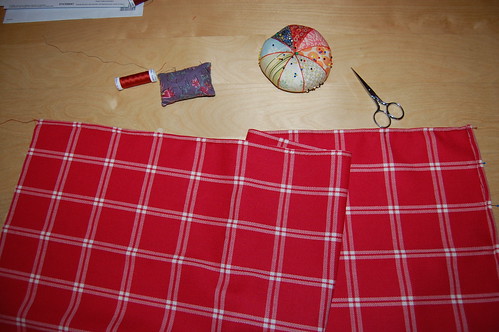
But Mr S wants me to come, so I’ve stirred myself to cutting and pressing and starting to hem a wool kerchief. This is made from some crossed-barred wool found in Somerville on the shopping expedition with Sew 18th Century.

She kindly sent me the image above, which is a good thing because I get distracted and think, “you know, that image with the duck and the girl and the bonnet,” which will give you 71,000,000 results in Google, but fortunately includes this one.

Three hems: I should be done by now.

It’s an easy project, but sometimes those are the hardest because you’re not learning anything. That, of course, is what Netflix is for: ghastly murders or sophisticated dramas keep you going on repetitive hems.  (I do my best backstitching to BBC crime dramas– go figure.)

So, a November Saturday up on the Palisades means wool, in fact, requires wool, and for the first time I think I have enough wool to stay reasonably comfortable. That’s a cloak, kerchief, gown and two wool petticoats, plus wool stockings and, if they fit, sheepskin insoles for my shoes. We have a wool shift at work, but at about 50 years later than the Fall of Fort Lee, it provides no justification for a wool flannel shift. Still, a wool shift is a tempting thought, and suddenly that kerchief hem gets more interesting, as I start to think about where to look for documentation of wool or flannel shifts.