
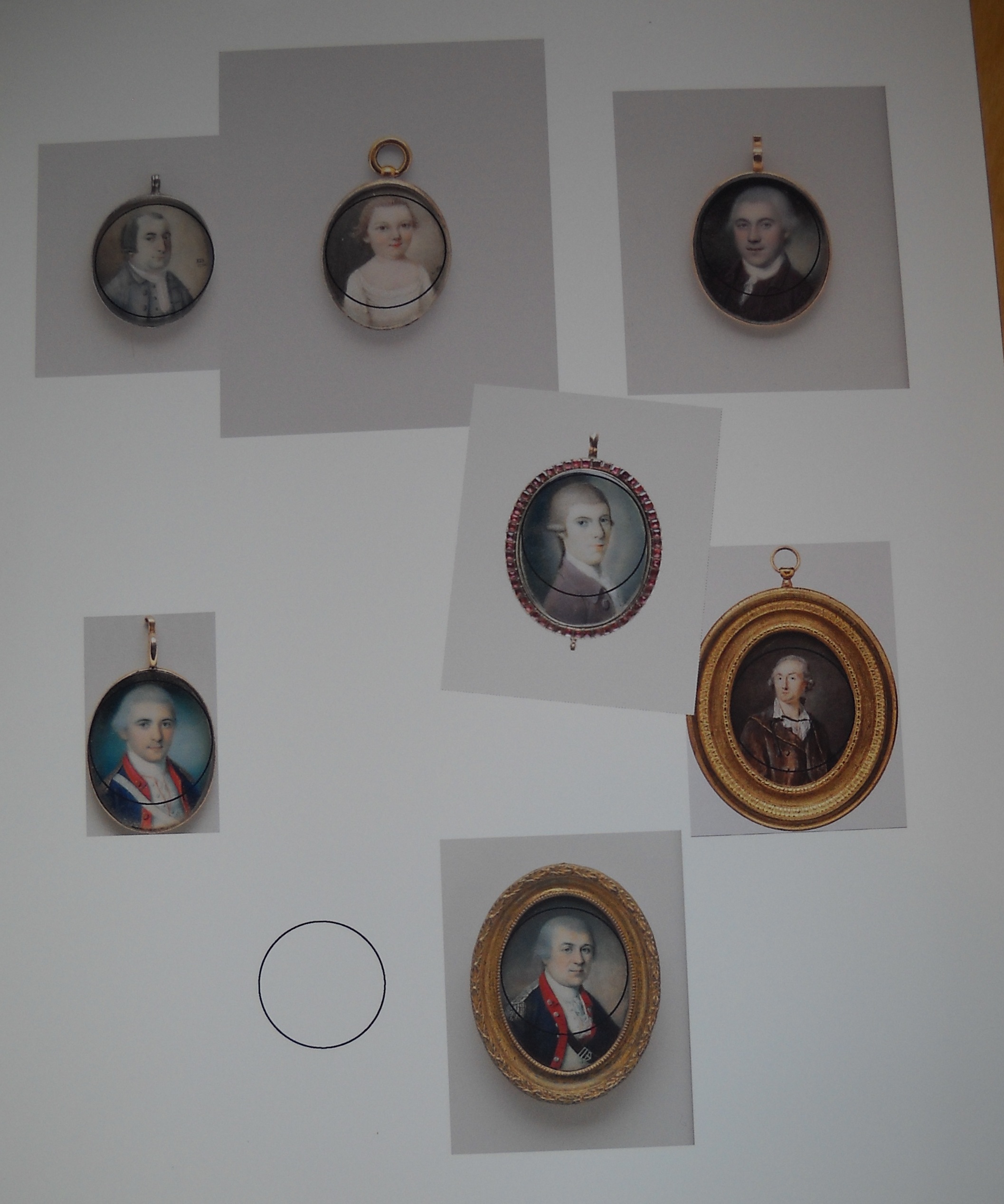
Miniature Miniatures

Images arranged in Illustrator

I admired the Pragmatic Costumer’s post on painting miniatures, but recognized that my desire for immediate gratification was going to run headlong into the small workspace formerly known as our dining room, where it would crash into my lack of practice at painting and result in unhappiness for all.

In recognition of my family’s right to peace in our time,  I made like an ’80s artist and appropriated images.

Separated and ready for trimming

After selecting gentlemen and an infant from 1761-1776, I downloaded the files and placed them in Illustrator where I could size them to one inch diameter circles. Why so small? Because to test this plan, I used rawther cheap little cabochon kits from Michael’s, and they were only to be found in the one inch size.

After cutting the images out generally, I trimmed them to the black line I created in Illustrator. (I don’t yet have a non-Illustrator answer to this process; I am lucky enough to have an ancient copy of CS Dawn-of-Time; let me think about a workaround.)

Henry Knox, the first trial

Here’s Henry Knox, my first trial. I was willing to ‘sacrifice’ him because although I admire his fortitude in dragging artillery across Massachusetts, he was a beast to Joseph Plumb Martin about post-war bounty land in Maine. I’m Knox-conflicted.

Some squishing and fiddling with the self-adhesive fronts later, here are three of the four miniature miniatures.

Three sandwiched images
Finished tiny miniatures

Yes, this is so ridiculously easy as to be evil.

What would I do differently next time?

I’d order proper cabochons and fronts in a larger size (I may convert these to bracelets).

I’d give painting a try, perhaps over the winter break at work. I’ll need time to get that right.

I’d string them on actual silk, and not polyester, ribbon. (It was handy, and the proper size).

But for a cheater’s way to miniature jewelry in under an hour, I suppose they could be worse.

Whatever you do, if you follow this example and “appropriate” images, don’t sell them. The Met may have millions in revenue, but it’s still wrong.
Pouting over Putnam

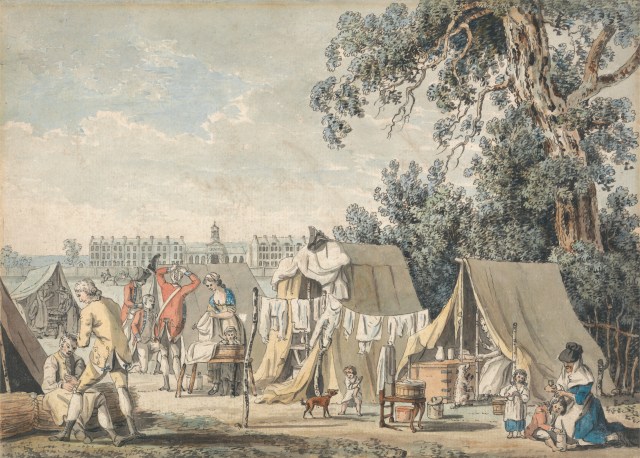
James Malton, 1761-1803, A Military Encampment in Hyde Park, 1785, Watercolor with pen in black ink, with traces of graphite on moderately thick, moderately textured, beige, laid paper, Yale Center for British Art, Paul Mellon Collection

This Saturday is the BAR event at Putnam Park in Redding, CT. This is an event with an early set-up time, one of those “early enough to be worth packing the car Friday night” events, as Mr S will need to depart at the time he usually gets up. I’m pouting not because of the early departure time, but because I won’t be going.

The Young Mr has his first swim meet Sunday, so Saturday he’ll have to get his homework done. That means someone has to stay home, or he’ll sleep till noon and spend the rest of the day eating meat and playing video games, all normal for a 15-year-old, but not helpful when most of Sunday will be spent marinating in chlorine.

I did a strange and awful thing to my back in an altercation with the face plate of an UPS unit for a server, and find that two weeks on, I still have a mis-aligned rib and occasional searing pain when reaching for Amelia Simmons’ cookbook to find something for Mr S to take with him to Putnam Park. At first, it seemed that it would be like Fort Lee, where one does not cook.

However, it seems that a camp kitchen is planned and there could be cooking, if only someone could tend the fire during the tactical, but no. I will not be there to stir meat of any kind, in any way, and the gentlemen, if one can call them that, will have to scrounge in the corners of their haversacks, take pot luck from the Boy Scouts, or find other means of nourishing themselves. I’ve also been told that it might be as well for me not to lace up my stays and push my ribs around, though on the whole, I think I might be better off wearing them more often. No matter what, home I shall I be, and the gentlemen will have to shift for themselves. Having seen them in action, I have no doubt that they will do well for themselves, and I might still bake them a pie.

Still More Sacques

I’m particularly interested in remodeled gowns, not that I have the patience to make a ca. 1750 or 1760 gown and then re-make it, even though I suppose it would be the path to the greatest authenticity. In figuring out “what next” now that the pleats are stitched down and secured to the lining, and the front panels cut, and one even pinned, awaiting a seam, I looked at the sack/sacque in Costume Close Up. It’s both tiny and a polonaise, so it’s not the best example for me to follow, but when you’re trying to understand construction before you totally screw up  take the next steps, you look at whatever details you can.

That led me back to Colonial Williamsburg’s collections database, which I try to avoid because they don’t have stable permalinks to their records. However, they have good cataloging and an amazing collection, so it’s hard not to end up back there.

I feel a little more confident in thinking of a ca. 1770- 1775 gown with a compère front. A compère front is a false stomacher, where there are two halves sewn to either side of the opening in the bodice. The sides then button closed. Button, and not pin, people: sweet. I will gladly trade you a week of sewing buttonholes for a wardrobe failure today (Of course, I’m not sure whether a compère front is accurate for a ball gown, but I very much want to avoid a pin explosion at a public gathering.)

Trim is another tricky area: in my regular, 21st century life, I am not someone who wears ruffles and lace or even many colors other than black, brown, grey and red. When I chose the cross-barred fabric, it was a choice really grounded in who I am, and in my love of things architectural, bold, and elegant. (Thanks to my Dad and my education, I now wonder, can one make a Miesian sacque? Let’s find out.)

Serpentine trim, no matter how appropriate and accurate, is not for me. I like the simple trim on the purple gown (padded furbelows), and will probably replicate linear, and not serpentine, trim.

Sacque Rationalizations

Before I get any farther along in the process of making a sacque (and I have not made much progress) I thought I should start to really look at gowns, and try to understand them.

Not only do I need to understand how they’re made, I want to understand how they change over time, and what’s appropriate for different time periods and situations. This will, or could, have some bearing on what I make for the gentleman accompanying me to the celebrations for which this gown is being made. If I start from Mr S, whose best coat right now is the 1777 Saratoga private’s coat, then I ought to have nothing better than a second-hand sacque several years out of date, and that is reaching indeed.

SacqueBySacque_back
What good fortune it is that the LACMA dress seems to be a gown in flux! This is the brown silk cross-barred gown with an assigned date of ca. 1760, which seems to have been abandoned in mid-alterations. Trim down the rights and left fronts ends abruptly at the waist, and two halves of what might have been a compère front lack any trim but boast plenty of holes. The front skirts come close together, but it’s hard to tell if they are meant to nearly close, or if the gown is fitted to a mannequin that’s too small and not adequately padded out.

Replicating a gown in mid-alterations would be interesting, but not what you’d wear to a ball, so I kept looking. In Hamburg there is another cross-barred sacque-back gown from about this era. There are similarities and differences, and never as much information as you’d like to have. Who owned and wore these? Who made them? When and where were they worn? We’ll never know, but at least with two similar gowns one can fill in some details for another, or help us understand them both.

The serpentine trim on the pink gown in Hamburg makes clear how unfinished or mid-alteration the brown gown in LA really is despite the visual interest created by the fabric itself.

Sacque_by_SacqueFront

So, what to do for my gown? And when will it be from? LACMA is hedging their bets with ca. 1760. I think Hamburg is pushing it a bit late with ca. 1775, but a ca. 1770 date for a gown based on the two seems reasonable. That would mean that the coat Mr S wears should also be ca. 1770, or newer than his green linen coat and older than his Saratoga coat. And luckily, I already have a plan, some fabric, and a pattern as a place to start.

While the ball itself has no date per se, it is in celebration of Washington’s Birthday, which puts it after 1775 at the earliest (think transfer of command of the Continental Army in Cambridge). Does that make a ca. 1770 gown too early? It would depend, I think on how one imagined the ball and oneself. If you’re a frugal woman who has lost much in the war, you’ll remake your gown; should the flounces become the shirred cuffs of later gowns? Could the kind-of compère front of the LACMA gown be a stomacher cut in half and stitched to the sides, with the pin hole indicating where trim had been removed from a once-was stomacher? Is it reasonable to make a compère front for a ca. 1770 gown? I want one mostly to avoid the stomacher angst I always seem to have, and in a way it marks a place between stomacher-front and front-closing gowns.

These unprovenanced gowns stand without the particular context and personality of their owners; the fun and the challenge for us, as costumers and reenactors, is in trying to bring our personalities to the fact-based garments we create.