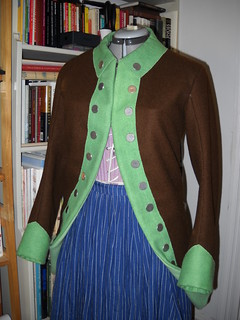
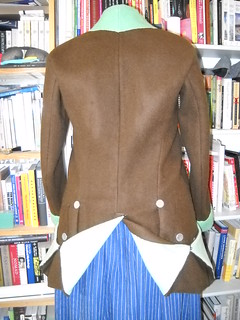
Front view on Cassandra.Back view, over petticoats
That’s right, it’s done, in all its brown and green glory, with not one buttonhole in sight.
I imagine Henry Cooke will tug on it, the same way my grandmother used to tug on my clothes, and find the things I need to fix that I can’t even see until he points them out. But that’s OK– what better way to learn?
You can see the progression on the project here, but there’s no tutorial or instruction manual, just visual notes as I went along. It’s Mr Cooke’s pattern and kit.
I think they’ll be glad of wool coats up at Saratoga, and if I didn’t have a new gown and petticoat, and possibly even stays, to make by October 5, I would think hard about making John Buss’s “red Queman’s pattern jacket” and “striped woolen trowsis” for the Young Mr to wear. With luck, he’ll have a borrowed coat to wear; I doubt a hunting frock will be as warm as he’d like by late September. No one, not even Mr Cooke (and I did ask), knows with certainty what a “Queman’s pattern jacket” is, but it might be a short coat or jacket. What I do know is that visions of a short red coat and grey striped trousers dance in my head, and the list of things I want to make just gets longer.
For now, though, this 1777 10th Massachusetts coatee is done, or nearly done, though on Mr S, I predict center back pleat tweaking.
In 1777, the uniforms of the Continental Army remained largely uncodified and, well, non-uniform. At Ticonderoga, German accounts from the spring of 1777 state that “Few of the officers in General Gates’ army wore uniforms, and those that were worn were evidently of home manufacture and of all colors. For example, brown coats with sea-green facings, white linings, and silver dragons(epaulettes or shoulder knots), and gray coats with yellow buttons and straw facings, where to be seen in plenty.”
Brown coats with sea green facings. There’s one in our regiment, and it is a lovely thing. The Adjutant thought it would be interesting for the troops to turn out in these coats at Saratoga, an event to which the coat can be documented (being soon after Fort Ticonderoga) and an event that will take place on the historic site. So we’re making them, in a project that started Saturday, and here we are: ready to have the lapel width adjusted, because my eye tells me it is too big, and yes, I’m told that it was cut a but wide. So this morning, a lapel trim is in order.
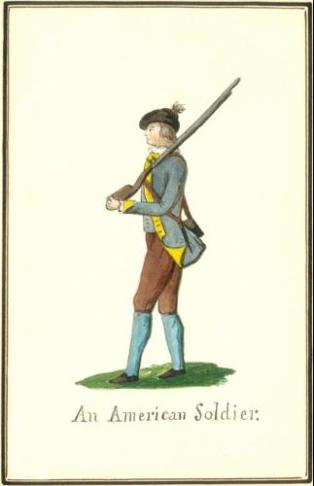
An American Soldier. ca.1852 copy of a ca.1777 watercolor by Hessen-Hanau Captain Friedrich von Germann. Niedersächsisches Staatsarchiv, Wolfenbüttel, Braunschweig
But really, these coats.
Here you can see the style that we’re making, with applied lapels and shanked buttons, simple turn backs on the front skirts, and flat collars. The cuffs are also applied, non-functioning cuffs that come to a point in front. (Also, documented blue stockings!)
These coats will be worn with overalls, waistcoats and shoes, because we know from John Buss’s letters that the regiment was issued overalls and shoes in the summer of 1777. No visible stockings, sadly.
This is the kind of project I can get pretty stoked about, with its combination of aesthetics and documentation. A coat described in a German diary, made in pettable wool broadcloth that will be unlike anything else on the field? Of course I want to help make that vision real.
Imagine a moment on the field, with these documented coats, so unusual (the sea green may have been a faded blue, but sea green is what was seen), worn in a place where they were worn. I don’t need to remind you about the authenticity/commemoration thing, do I? Because it’s pretty clear that’s what’ll happen three weeks from now in New York.
Part two of a series Mrs Garnett, Housekeeper, oil on canvas by Thomas Barber. NTPL Ref. No. 42286
I’m minding my own business checking out my friends’ business on Facebook, when Mrs Garnett appears on Joanna Waugh’s blog. Mrs Garnett had been rattling around in my head as “Wait, there’s that housekeeper painting, and she’s got, like, this great bonnet…” which is the art historical equivalent to an ear worm.
Yes, the Kedleston Hall housekeeper. A bit grand for Mr and Mrs Brown, if you compare a fine mansion in Providence to a English County House with a Collection and its Own Catalog, but not too grand if you compare John Brown’s House to Jeremiah Dexter’s, or Stephen Hopkins’.
We are talking about a man who asked his son-in-law to fetch back marble busts from Versailles, during the time of the French Revolution when the scent of blood was, literally, in the air. Mr Brown had pretensions.
This is tough to hang on to because I see that house every week and it is now so familiar that I don’t see it: it’s background. This is both good and dangerous: I need to hold on to the magic and mystery of the overwhelming high style decorative arts of the house, while also feeling ownership and pride in that house. The catch is that the meaning is so different to me now than it would have been to me then. Though to be honest, being a curator is not so different from being a housekeeper. Curator has its roots in the Latin “cura,” to care, and in that root lies the similarity of roles.
So I will care for the house, and care how I represent it: those are keys, I think, that, as Sharon Burnston says, point to a solid, sober-colored worsted. She referred me to the Francis Wheatley “Cries of London” series, which you may recall from earlier posts.
Again, it is hard to shake the familiarity with the street vendor/woman of the army/runaway apprentice chaser I am accustomed to being. But I think the solution to my desire for playfulness lies in thinking closer to 1800 in style, and in a contrasting petticoat. Also, a bonnet. You can never have too many bonnets.
But this is academic, in a way, until I get my fabric samples. I shall will myself to patience, and instead keep sewing the Wasmus Coat for Saratoga. Yes, I realize my idea of a brown gown and pale blue petticoat will replicate the contrast of the coat body and facings. But I do really love those coats!
Kyoto Costume Institute. Right: Robe a l’anglaise, 1790-95, England. AC5065 85-3-1
(Part one of a series)
Or do you wear what you are?
Both statements seem true, but what I know is this: dressing for the October 5 event has me stymied.
I am stuck on fabric. Sharon Burnston’s advice last Saturday was very helpful: Think Ralph Earl. She’s right: Earl’s iconic images give you the shape and accessories of southeastern New England dress in the last decades of the 18th century.
The tricky part for me is that Earl’s portraits don’t show you the maid or the housekeeper.
The character I’m playing is interesting to me: she’s invisible but powerful, respectable but not refined, loyal but detached. We don’t need to get into my familiarity with any of these paradoxes, but this might be a comfortable discomfort. What could this have to do with fabric? A great deal, as it happens.
The first thing I thought I should do was to figure out the “when and why” of my character’s style choices. After talking with Sharon, I thought I understood our characters’ relationship better, and at the very least, what her character would expect of mine. And let me tell you, it is much harder to imagine being a naughty maid when you like and respect your mistress!
But I like my work to be playful: authenticity does not preclude wit, and in the late 18th century, I would argue that authenticity, at some levels, requires wit. So, how does one visually signal respect for one’s employer and playfulness?
Good lord, when is she going to talk about fabric? Right now, that’s when!
With fabric, and with style and fit, that’s how you can signal the respectful/playful combination.
And fabric is where I’ve been stuck. The gown in the photo (aside from some interesting odors and a few unidentifiable splotches) is made of a sober and suitable wool fabric. The sleeves are partially lined with an Indian block print fabric to provide a non-itchy surface and a little contrast. But I think the gown’s style is a little forward for my character as I understand her in relationship to Sharon’s character. It was also made short for working at the farm, and needs a pressing.
Still, an earlier style in a solid light-weight wool feels a little too sober to me. It feels more like the Fortnightly Dances, and less like me or my character. A possible compromise? Style like Ralph Earl, fabric like the KCI gown.
Thanks to the Strategic Fabric Reserve, I have some black cotton block print yardage and in looking for that, I rediscovered the yellow linen.
BLOCK-PRINTED COTTON British, ca. 1780–90. Cora Ginsburg.
Why this particular fabric? Aside from my whimsy and the KCI inspiration, dark grounds come into fashion in the late 1780s, and as a servant, I will lag a bit, style-wise. Could I have a cheaper version of the fabric at left (a child’s dress, 1780-1790, at Cora Ginsburg)? Barbara Johnson’s book at the V&A contains samples of dark ground prints from 1787 on; they’re different the vine-like print at left, but floral prints on black or dark brown are popular in these last decades.
I’m not committed to the black ground gown for this event. I’ve ordered swatches of Burnley & Trowbridge’s new light-weight wools, and we’ll see. Color and hand could convince me, and I can always line the lower part of the sleeves with a cotton print.




 Kirsten Hammerstrom
You must be logged in to post a comment.